One record per aspect. The origin says what kind of thing each value is; the source says where it came from; the limit says what it cannot tell you.
Registered image field
J2000 image-field center RA 4.3 h, Dec -54.9°. Field 2.6 × 2.8 arcminutes; north 140.9° right of vertical.
EpochJ2000
LimitThe image field center is not necessarily a galaxy nucleus.
Adopted distance
Approximately 60,000,000 light-years.
LimitAn approximate reference distance; distances to individual points within the image are not supplied by the observation.
Observation-derived appearance
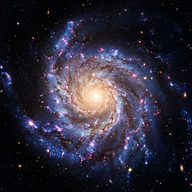
The Hubble field emphasizes the inner disk and spiral arms; portions of the outer galaxy extend beyond the observation. Ultraviolet and optical filters form the published palette. Projected structure follows the credited observation at its published angular scale and an approximate adopted distance. Shallow depth is illustrative, not measured tomography. The source palette is preserved; brightness is adjusted for the navigable view.
Live telescope view: Webb NIRCam + MIRI
Dark lanes in the Hubble view become bright dusty filaments; the spiral pattern stays at the same sky coordinates. Publisher release: 29 January 2024; this is not the observing epoch.
MethodPublisher AVM tangent-plane coordinates, resampled to the original destination field; approximate display registration.
LimitThis observation covers approximately 84% of the destination’s rectangular source field. Outside its footprint, the original observation remains visible. Field edges and detector gaps are not physical boundaries. Source palettes are display colors; shallow scene depth is illustrative, not measured tomography.
 Space Time