One record per aspect. The origin says what kind of thing each value is; the source says where it came from; the limit says what it cannot tell you.
Image-field position and adopted distance
Skull Nebula image-field center is placed at J2000 RA 0.8 h, Dec -11.9° in Cetus, at an adopted distance of 1,600 light-years.
EpochJ2000
LimitImage north is -180 degrees right of vertical. Line-of-sight thickness is illustrative.
Image field at the adopted distance
Skull Nebula (planetary nebula; central source Skull Nebula, illuminating stellar system): projected footprint at the adopted distance 3.3 × 3.3 light-years; outer radius used for arrival 1.6 light-years.
Methodmeasured sky-plane structure with constrained display depth
Sky-plane structure with a display depth
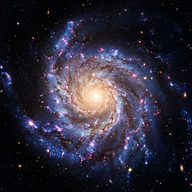
The optical composite maps selected emission bands. The central system has multiple stars, but not every component is visible in the source image. Projected structure follows the credited observation at its published angular scale and an approximate adopted distance. Shallow depth is illustrative, not measured tomography. The source palette is preserved; brightness is adjusted for the navigable view.
Methodmeasured sky-plane structure with constrained display depth
LimitEmission points and knots are deterministic presentation samples, not individually catalogued gas parcels.
 Space Time