Apophis flies past Earth on April 13, 2029
The 340-meter asteroid will pass about 31,600 km above Earth's surface, inside the altitude of geostationary satellites. It should be visible without a telescope from parts of Europe, Africa, and western Asia.
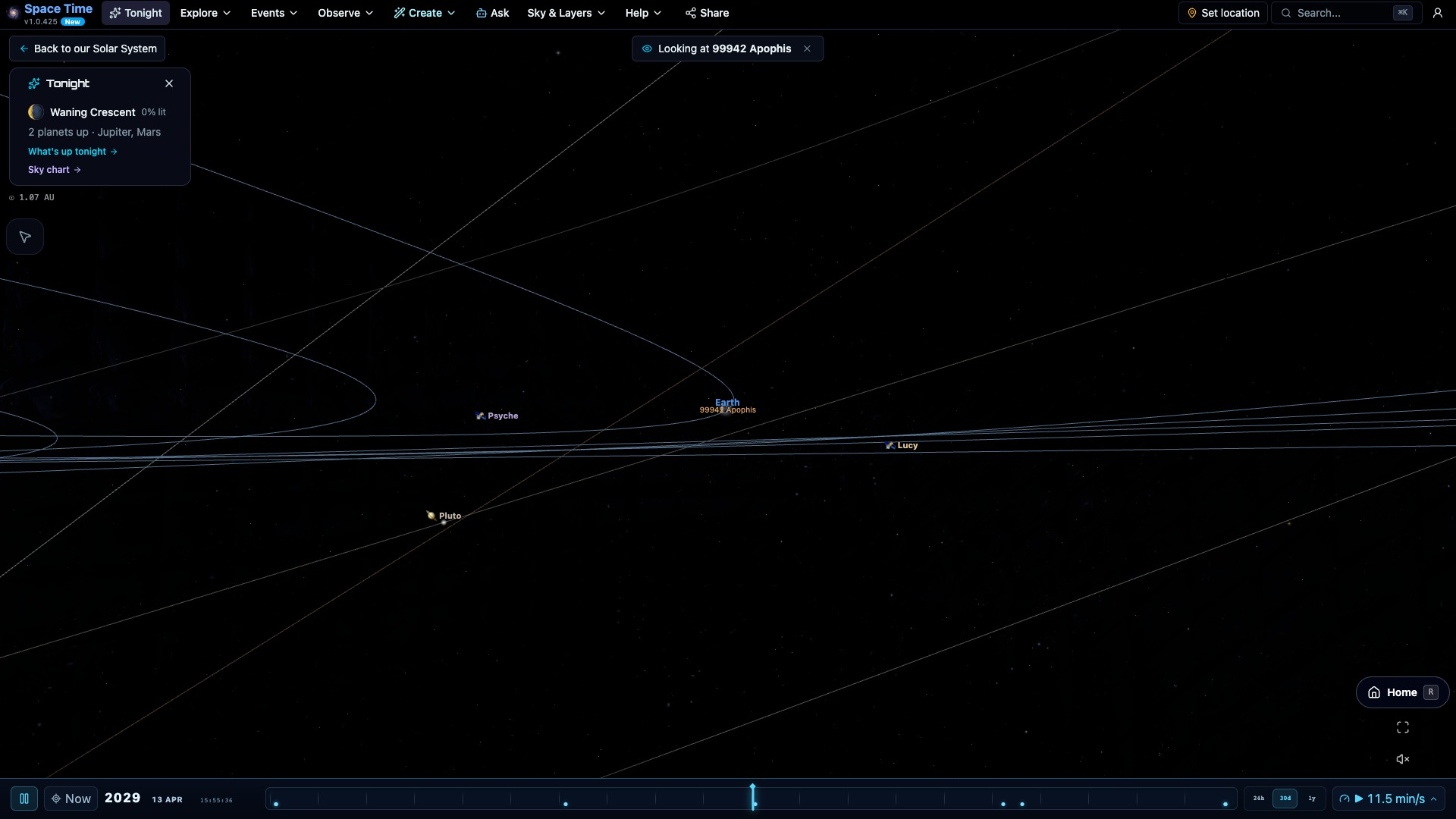
The encounter at a glance
| Closest approach (UTC) | April 13, 2029, 21:46 |
|---|---|
| Distance from Earth's surface | ~31,600 km (geostationary satellites orbit at ~35,800 km) |
| Size | ~340 m across (≈ the Empire State Building) |
| Speed relative to Earth | ~7.4 km/s at closest approach |
| Naked-eye visibility | Magnitude ~3 from Europe, Africa and western Asia |
| Impact risk | None. Ruled out for at least 100 years |
Frequently asked questions
Will Apophis hit Earth in 2029?
No. Its orbit is known precisely (radar + optical tracking since 2004), and an impact has been ruled out for at least the next 100 years. On April 13, 2029 it misses Earth by about 31,600 km.
How close will Apophis get?
About 31,600 km above Earth's surface, or ~38,000 km from Earth's center. That is closer than the geostationary satellites that carry TV and weather data, and roughly a tenth of the distance to the Moon.
Can I see Apophis with the naked eye?
Yes. It is expected to reach about magnitude 3, visible from Europe, Africa and western Asia as a faint star crossing the sky over a few hours. No asteroid flyby in recorded history has been visible to the naked eye before.
How big is Apophis?
About 340 meters across, roughly the height of the Empire State Building. Its size and unusually close approach make it an important target for observation.
Will the 2029 flyby change Apophis's orbit?
Yes. Earth's gravity will bend its path and may measurably stretch and shift the asteroid through tidal forces, which is one reason scientists care so much about this pass. NASA's OSIRIS-APEX mission will meet it shortly after the encounter.