Orion in 3D: The Distances Behind the Constellation
Orion’s familiar pattern is a view from our neighborhood of space. Its bright stars do not sit on a flat surface at one distance. Move around their catalog positions to see why a recognizable sky pattern changes when the viewpoint changes.
Reveal Orion’s depth →Free in your browser · No account required · 3D view uses WebGL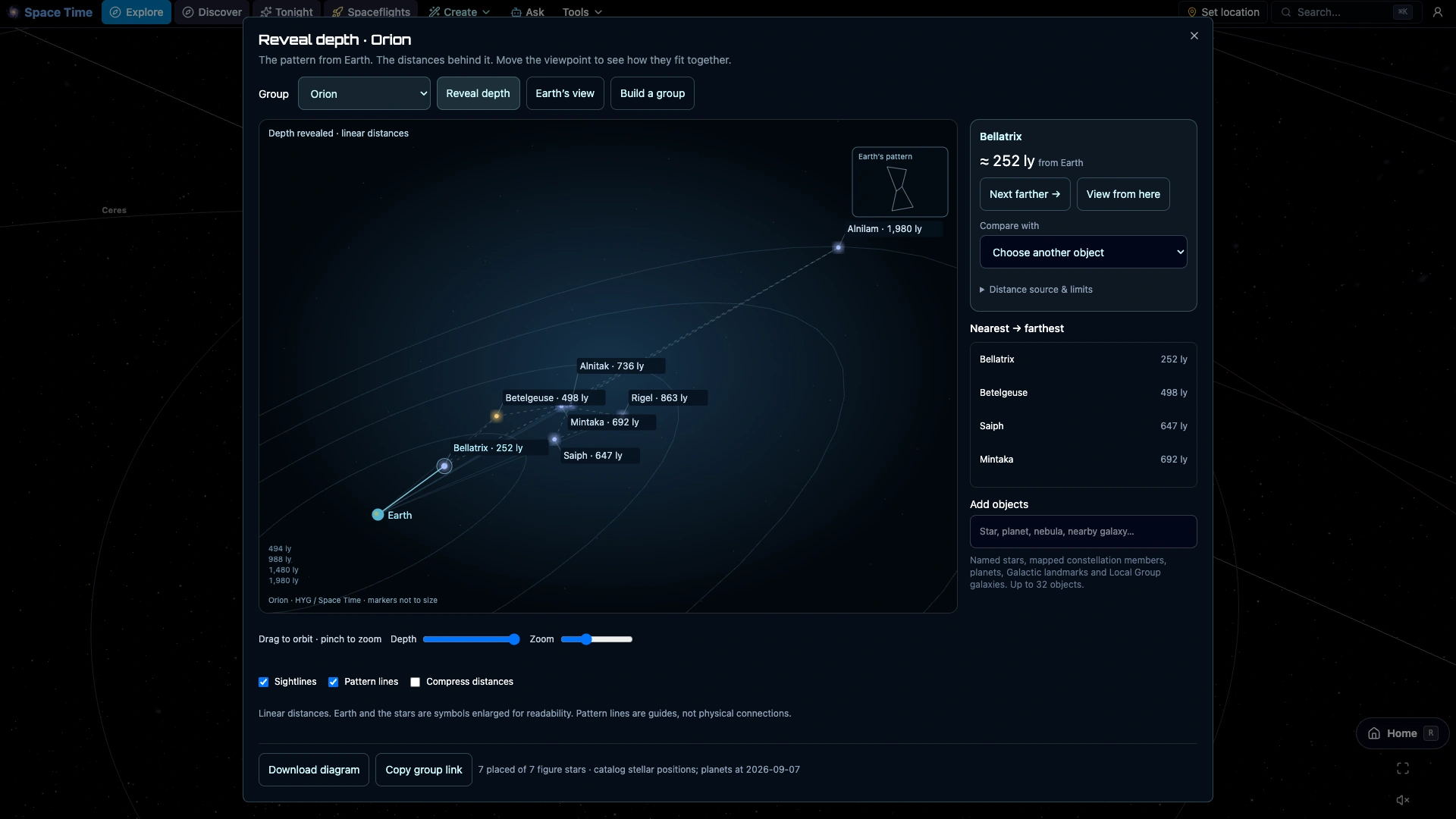
| Star | Adopted distance (light-years) | Uncertainty |
|---|---|---|
| Betelgeuse | 498 | Not supplied in this extract |
| Rigel | 863 | Not supplied in this extract |
| Bellatrix | 252 | Not supplied in this extract |
| Mintaka | 692 | Not supplied in this extract |
| Alnilam | 1,977 | Not supplied in this extract |
| Alnitak | 736 | Not supplied in this extract |
| Saiph | 647 | Not supplied in this extract |
HYG v4.2 / Hipparcos–Yale–Gliese. J2000 catalog positions; stellar motion not propagated. Adopted catalog distances, not exact measurements. Individual distance uncertainties are not included in this extract. The Sun and Earth coincide at stellar diagram scales. Rounded here to the nearest light-year for readability; these are adopted values, not an assertion of current best estimates.
Try it in the app
- Open Orion’s depth view and begin from the Earth-facing direction. Identify the three stars of the Belt.
- Move to a side view. Compare the catalog distances of the Belt stars instead of assuming that their apparent alignment means equal distance.
- Return to the original viewpoint, then record your explanation on the printable constellation-depth sheet. Note uncertainty as unavailable when the catalog extract supplies none.
On a phone, drag to change the view and pinch to zoom. If the 3D view cannot load on your device, the guide and its source links remain available here.
Why the Belt changes from the side
Stars can share a similar direction from Earth while lying at very different distances. A line connecting them in a constellation figure is a cultural and visual guide, not a physical structure. Moving the viewpoint separates objects along the line of sight and changes their projected pattern.
A catalog value is an estimate
The diagram uses adopted HYG distances. This extract does not include individual uncertainty estimates, so a precise-looking point is not proof of an exact position. Published distances can differ between catalogs and methods, particularly for difficult targets such as bright supergiants. Preserve the source when recording a value.
Try an evidence-based explanation
Pick two stars that appear close together in the Earth view. Compare their listed distances and describe what changes from the side. Keep three ideas separate: observed direction, estimated distance and a line someone drew to make a recognizable figure. The worksheet provides teacher notes for discussing that distinction.
Sources and evidence
Guide by Point Dynamics. Reviewed 2026-09-23. Saved scene images illustrate the experience; they are not current observations.