Explore the Andromeda Galaxy in 3D
Andromeda, also called M31, is a neighboring spiral galaxy whose tilted disc makes its dust lanes and bright center recognizable from Earth. Space Time places the galaxy in its wider setting and connects the navigable model to registered Hubble PHAT evidence.
Visit Andromeda in 3D →Free in your browser · No account required · 3D view uses WebGL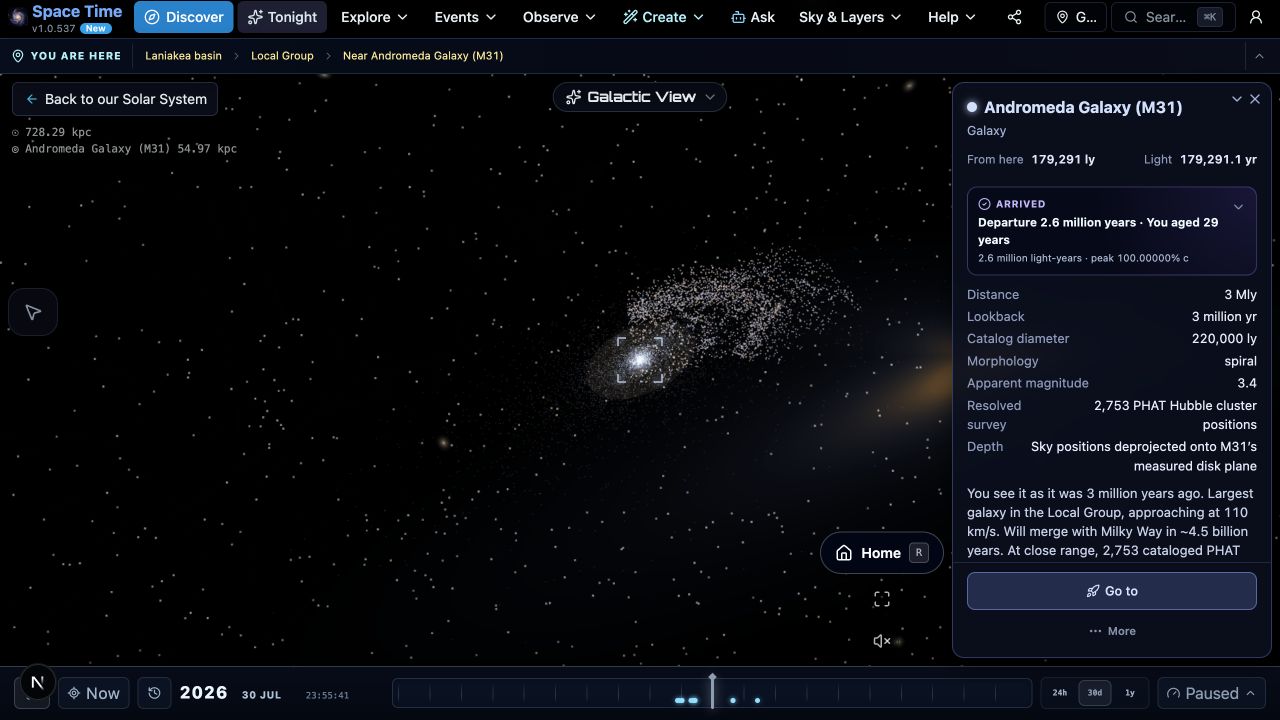
Try it in the app
- Visit Andromeda and begin with the Earth-facing orientation. Find the bright central region and tilted disc.
- Compare the registered observation with the modeled galaxy, keeping the source image’s footprint in mind.
- Move around the galaxy, then step back to the Local Group. Separate the model’s explanatory depth from catalog positions and observed image structure.
On a phone, drag to change the view and pinch to zoom. If the 3D view cannot load on your device, the guide and its source links remain available here.
Why Andromeda looks like an oval
We see its disc at an angle rather than face-on. The long apparent shape is a projection of a much wider structure. Rotating the model can help explain that projection, but a side view is a reconstruction: a telescope image from Earth does not directly measure the depth of every star or dust lane.
What PHAT contributes
The Panchromatic Hubble Andromeda Treasury surveyed part of Andromeda in several wavelength bands. In Space Time, registered evidence and cluster positions add specific observed structure to the destination. The survey footprint does not cover every part of the galaxy, and an observed cluster on the sky is not a complete three-dimensional stellar census.
Distance and apparent size answer different questions
A catalog distance sets the galaxy’s placement in the larger scene, while its angular size describes the span seen on the sky. The app combines those quantities to build a physical-scale context. Their uncertainties and the assumptions used to reconstruct depth remain relevant even when a rendered view looks precise.
From a galaxy to the cosmic web
After inspecting Andromeda, move outward to see how a nearby galaxy fits into a much larger map. The distant survey layers use their own selection rules and distance estimates. Gaps in a survey can reflect missing observations rather than empty space; read the layer explanation before interpreting the pattern.
Sources and evidence
Guide by Point Dynamics. Reviewed 2026-09-23. Saved scene images illustrate the experience; they are not current observations.