 Space Time
Fly through the real cosmic web
Explore 43,530 nearby 2MRS galaxies, then 630,968 sampled DESI DR1 galaxies and quasars. Measured directions and redshifts constrain a 3D map; cosmology supplies radial distances and lookback times. Survey gaps are part of the evidence.
🚀 Fly through the cosmic web Free · 2MRS + DESI DR1 · Runs in your browser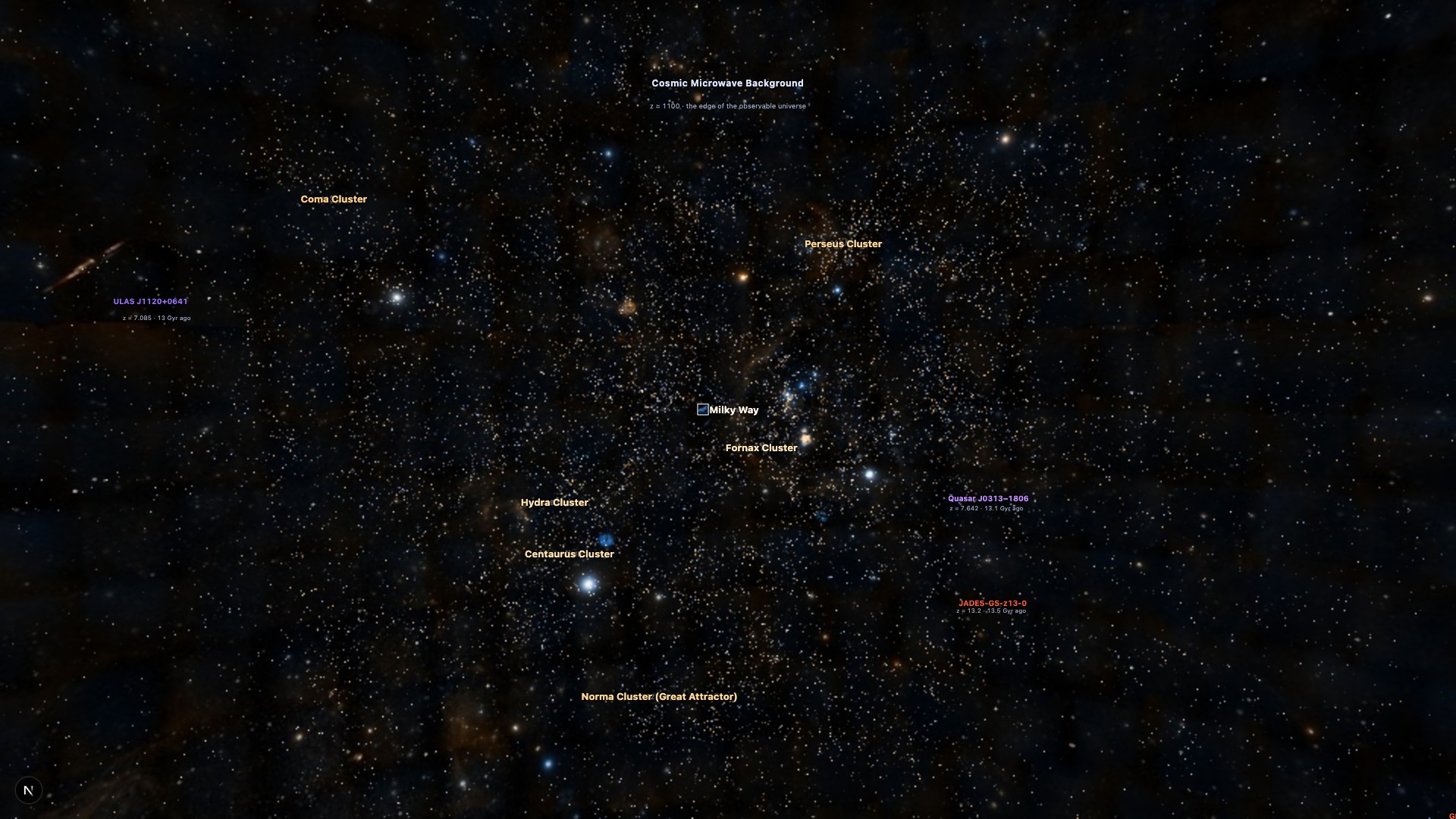
Follow a story. Keep a discovery.
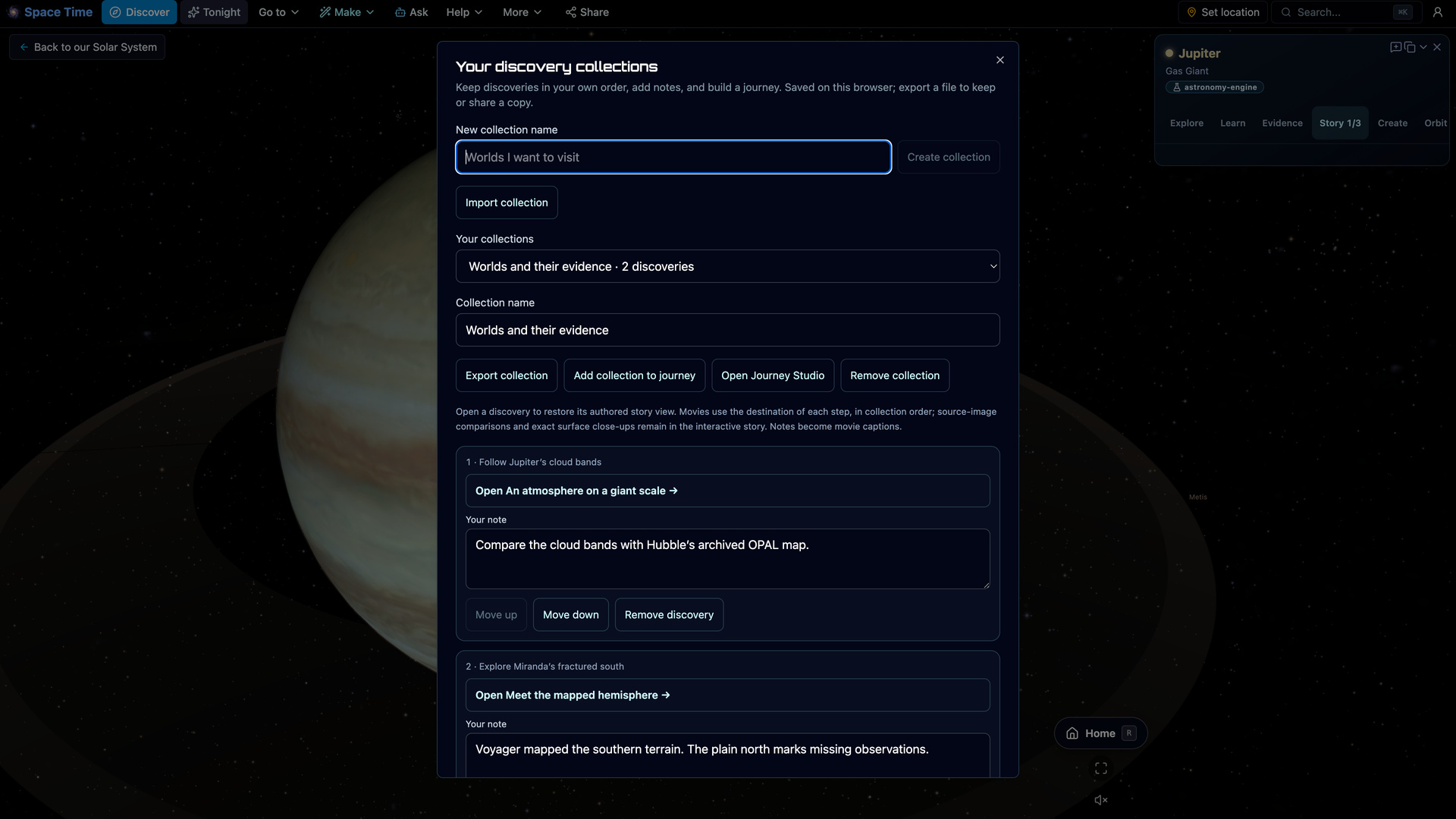
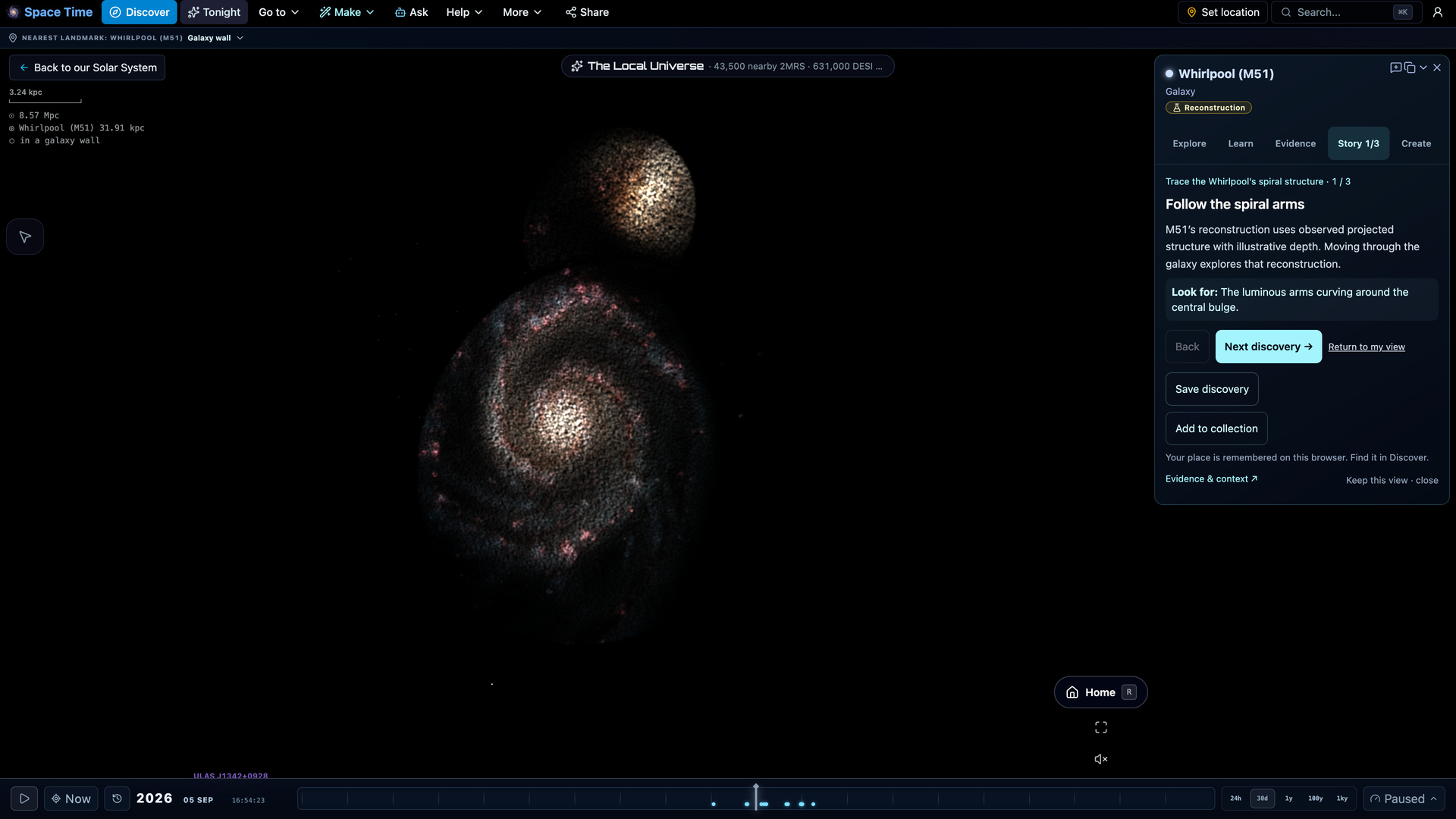
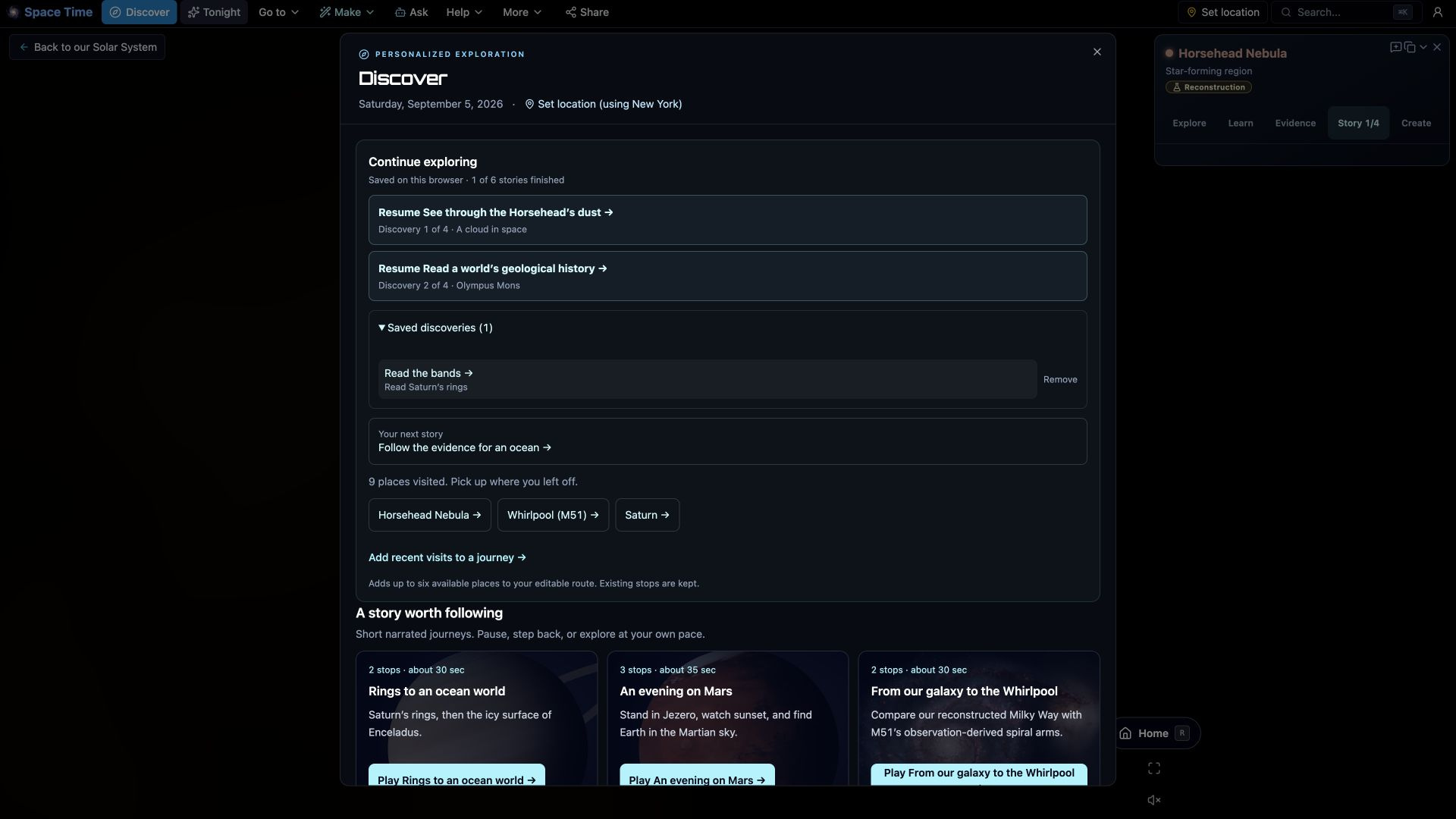
Explore new destination stories and build your own collection of views, evidence and notes.
More ways to explore and understand
New tools connect the view, its evidence and your next discovery.
Built from the 2MASS survey
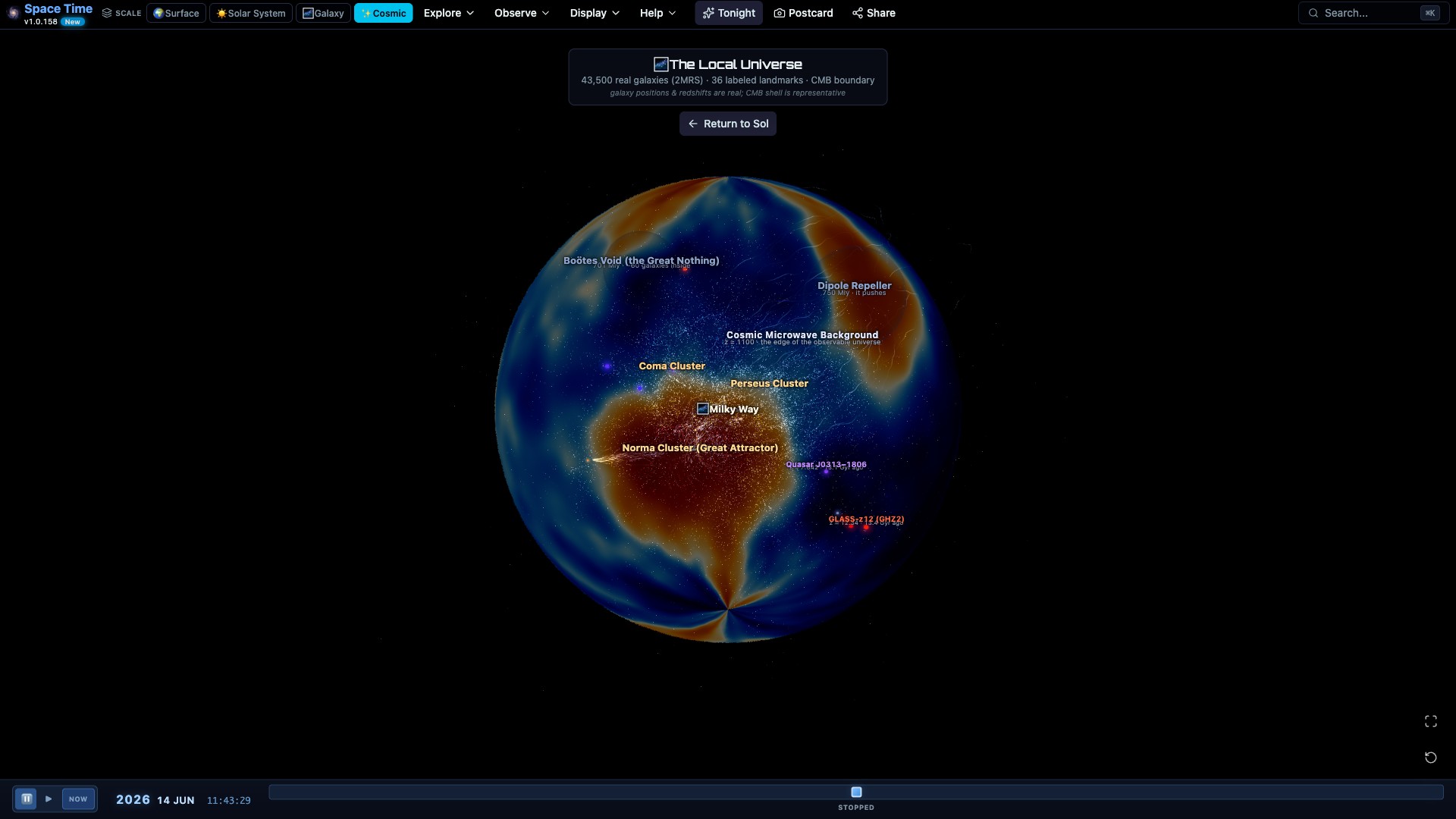
The map uses the 2MASS Redshift Survey published by Huchra and collaborators in 2012. Sky position and redshift are converted into 3D coordinates, and each point is weighted by infrared luminosity. The dark band is the Zone of Avoidance, where dust in the Milky Way hides distant galaxies from the survey.
Continue into DESI and the early universe
DESI DR1 adds a deterministic browser sample from its BGS, LRG, ELG and QSO catalogs. Select a point for TARGETID, tracer, redshift, footprint and cosmology-derived distance. DESI is not all-sky: missing angular coverage and selection effects do not establish empty space. Point colors and density glow are presentation aids. Beyond the sampled sources, the Planck 2018 sky is the observed temperature-anisotropy map of last scattering, not an outer wall.
Every dot answers when you click it
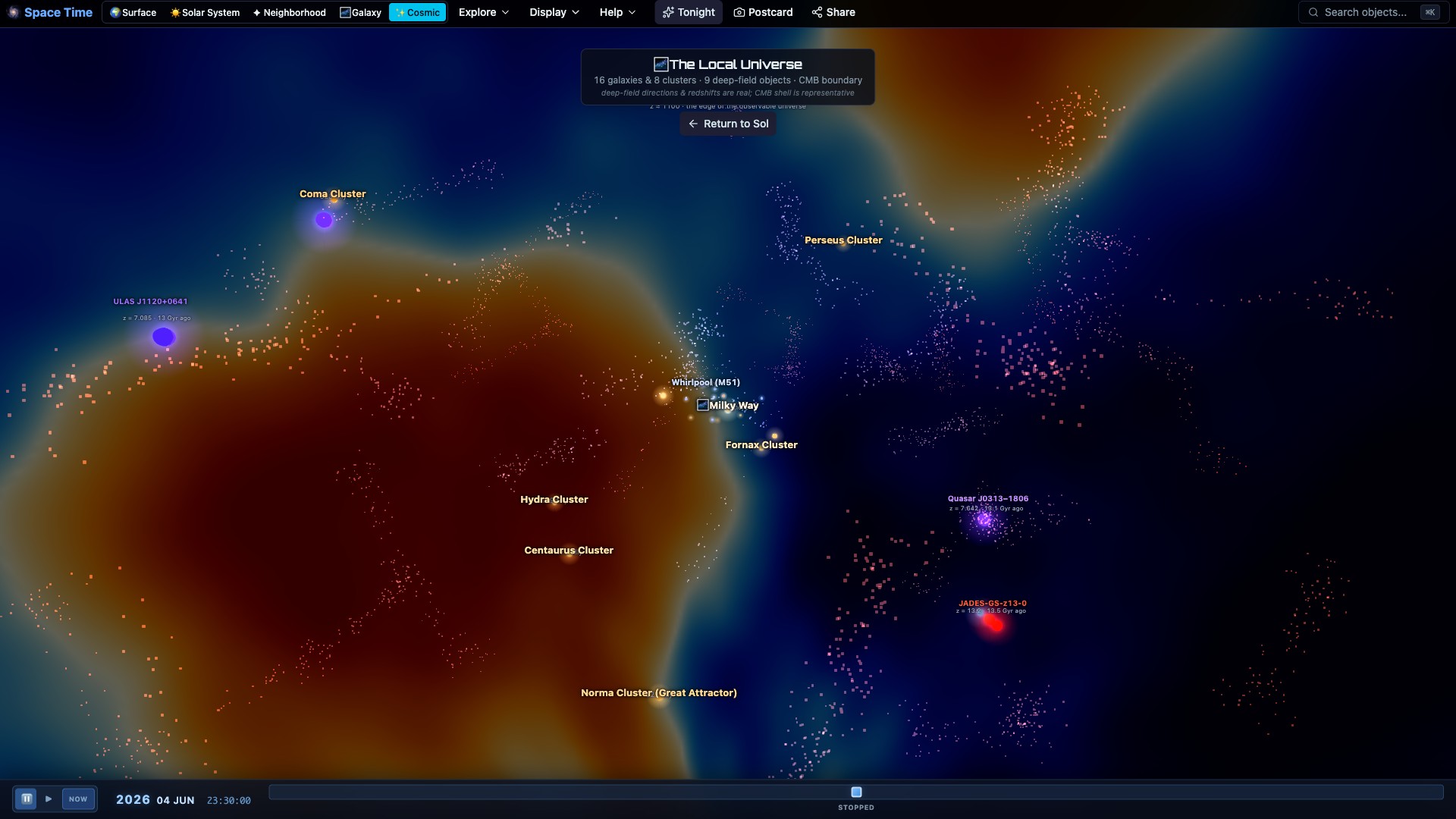
Any galaxy in the field is selectable. The card gives its distance and lookback time, and where the survey recorded a morphology it names the kind: elliptical, spiral or irregular. Color the field four ways from the Display menu: by distance for the redshift ramp, by galaxy type with old ellipticals warm and star-forming spirals blue, by local density, or plain. Brightness and dot-size dials are there too.
Choose a scientific or cinematic view
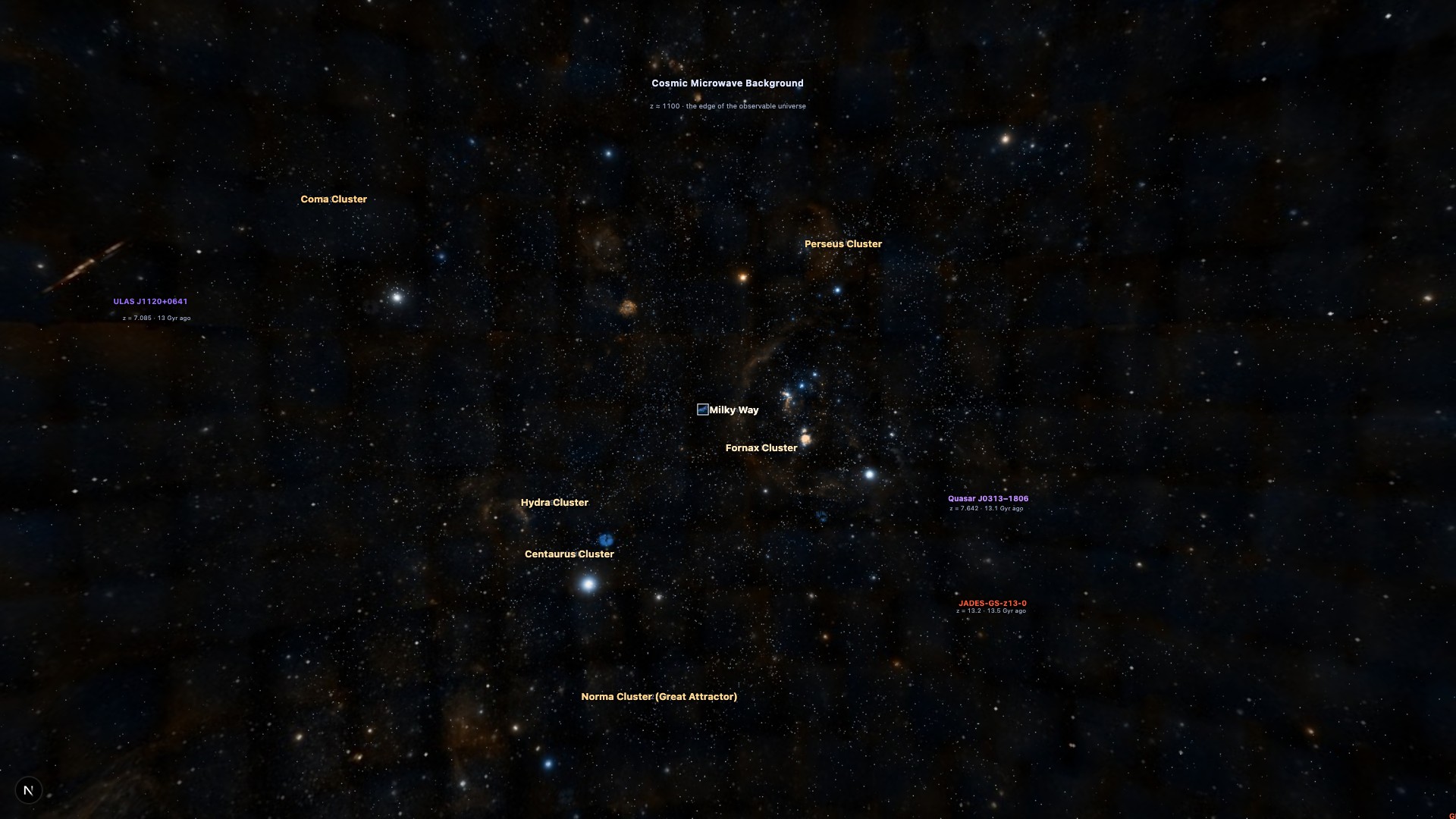
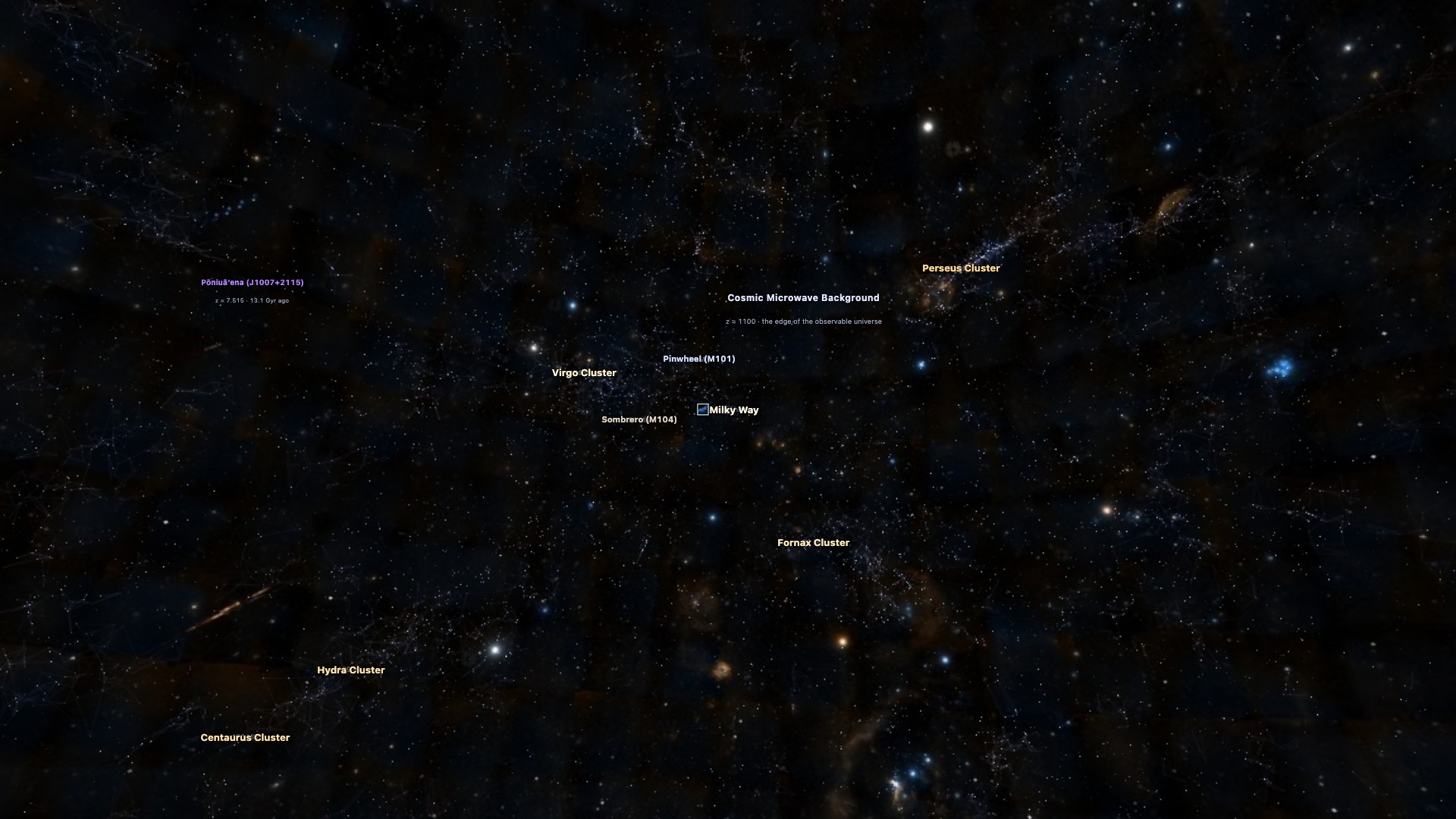
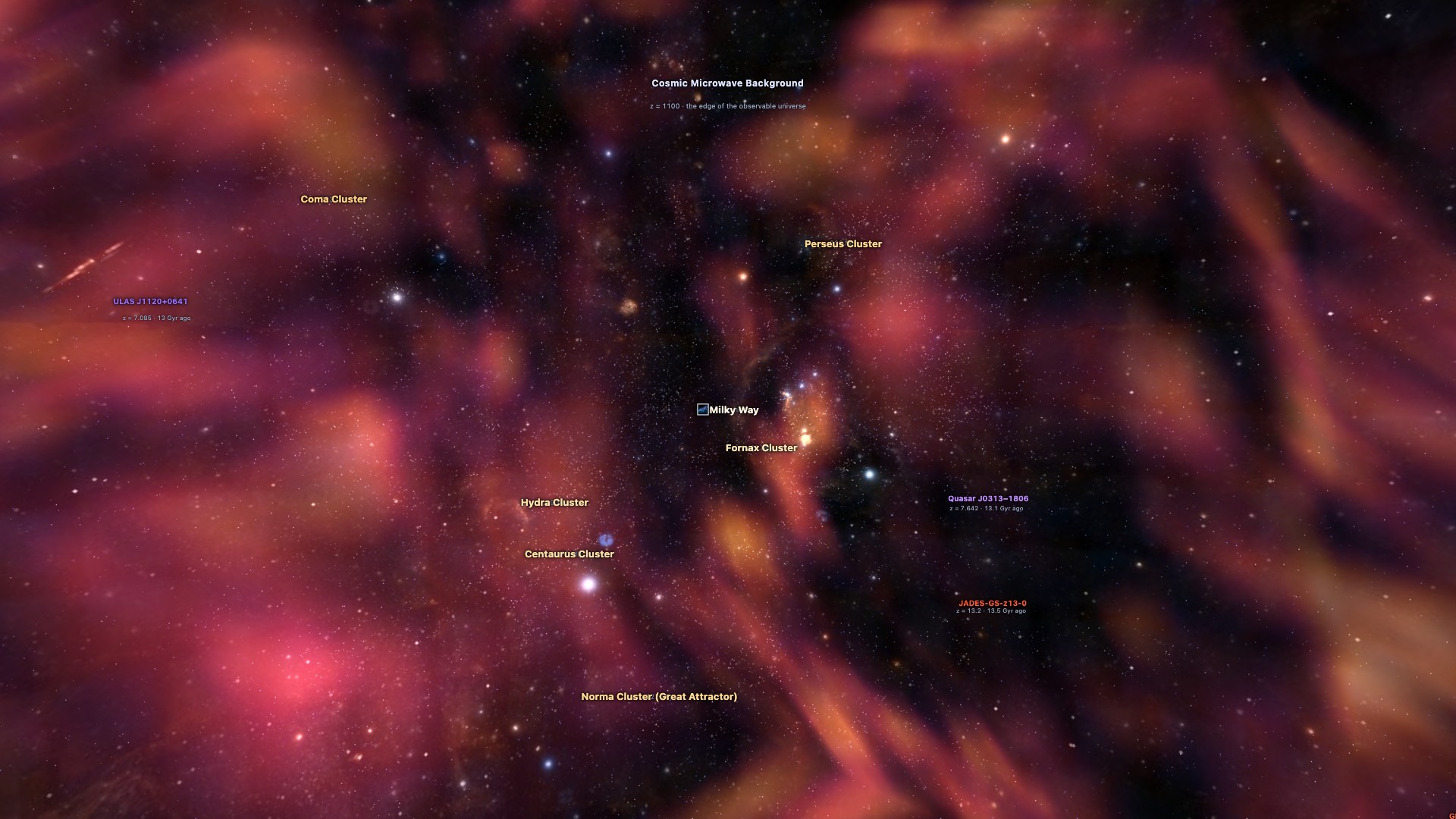
Scientific mode draws more than 20,000 links between dense regions of the survey. Cinematic mode adds glow and depth fog, with an optional volumetric density view on desktop. The controls let you switch each layer separately, and the distance readout identifies whether you are in a cluster, filament, wall, or void.
Connected to everything else
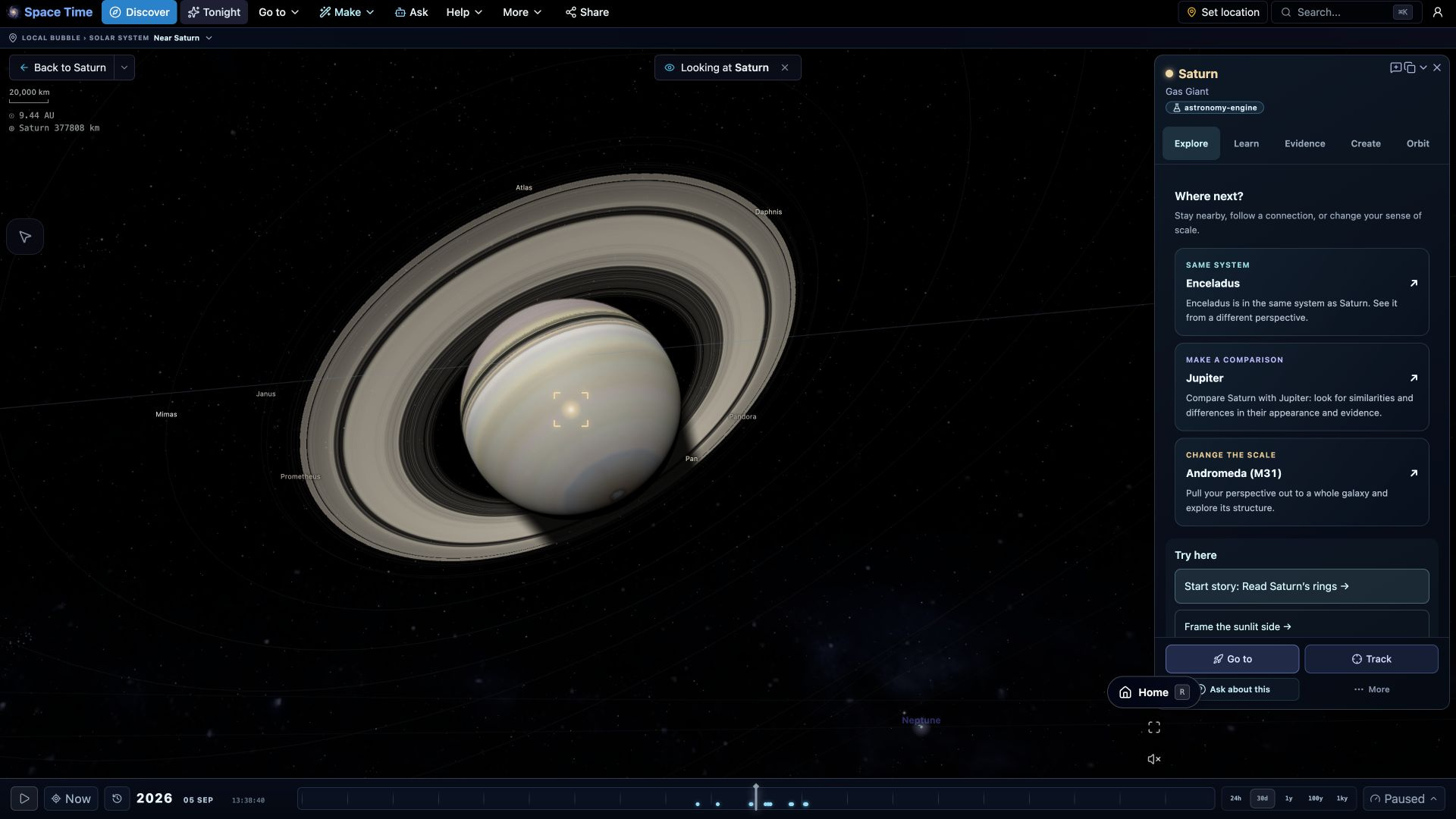
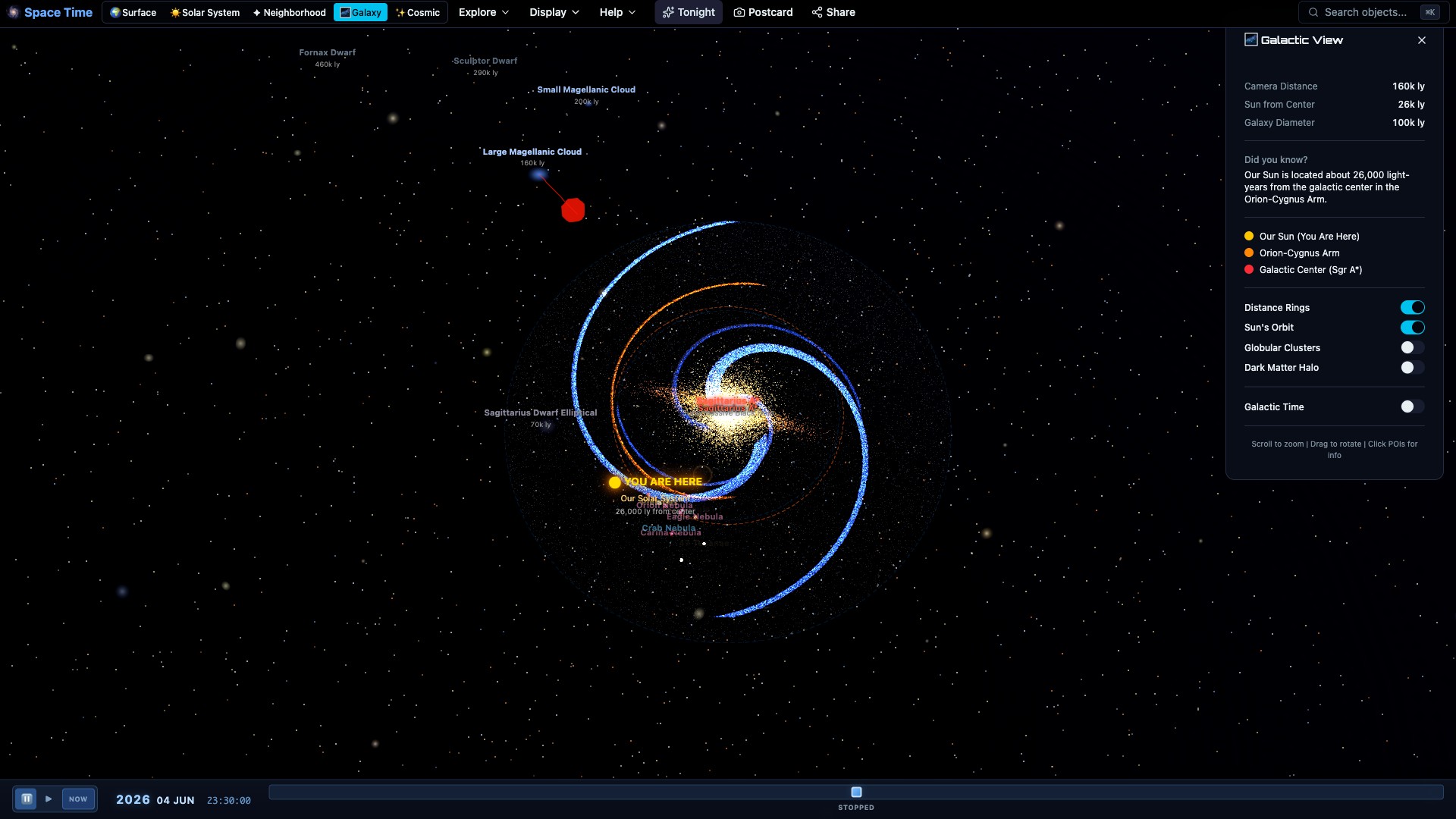
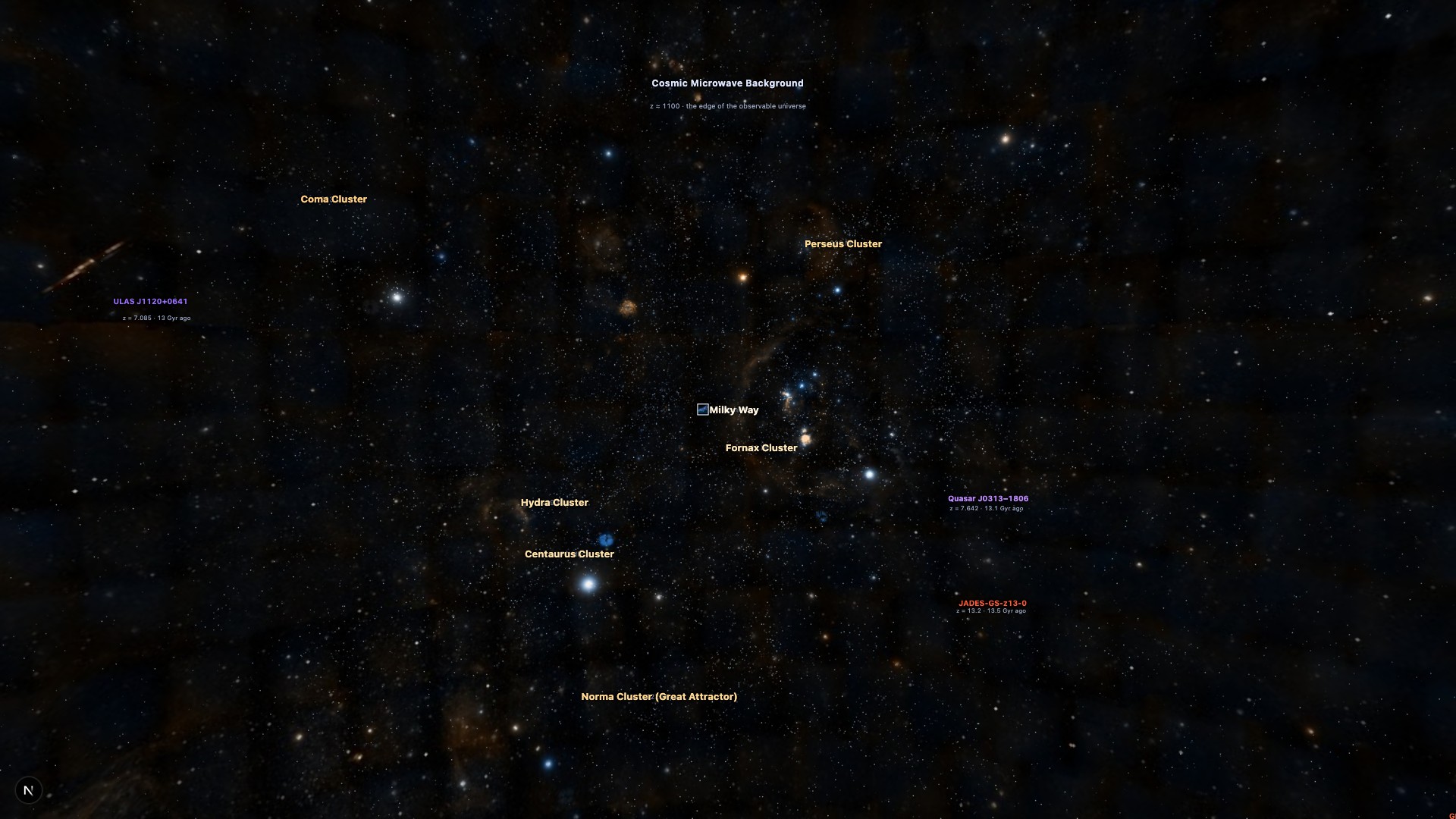
Zoom out from Earth through the Solar System, nearby stars and Milky Way into the same continuous universe. Use Home (R) to return to your saved place, Earth by default; G goes to the Galaxy and returns from that view.
Meet the galaxies inside the map
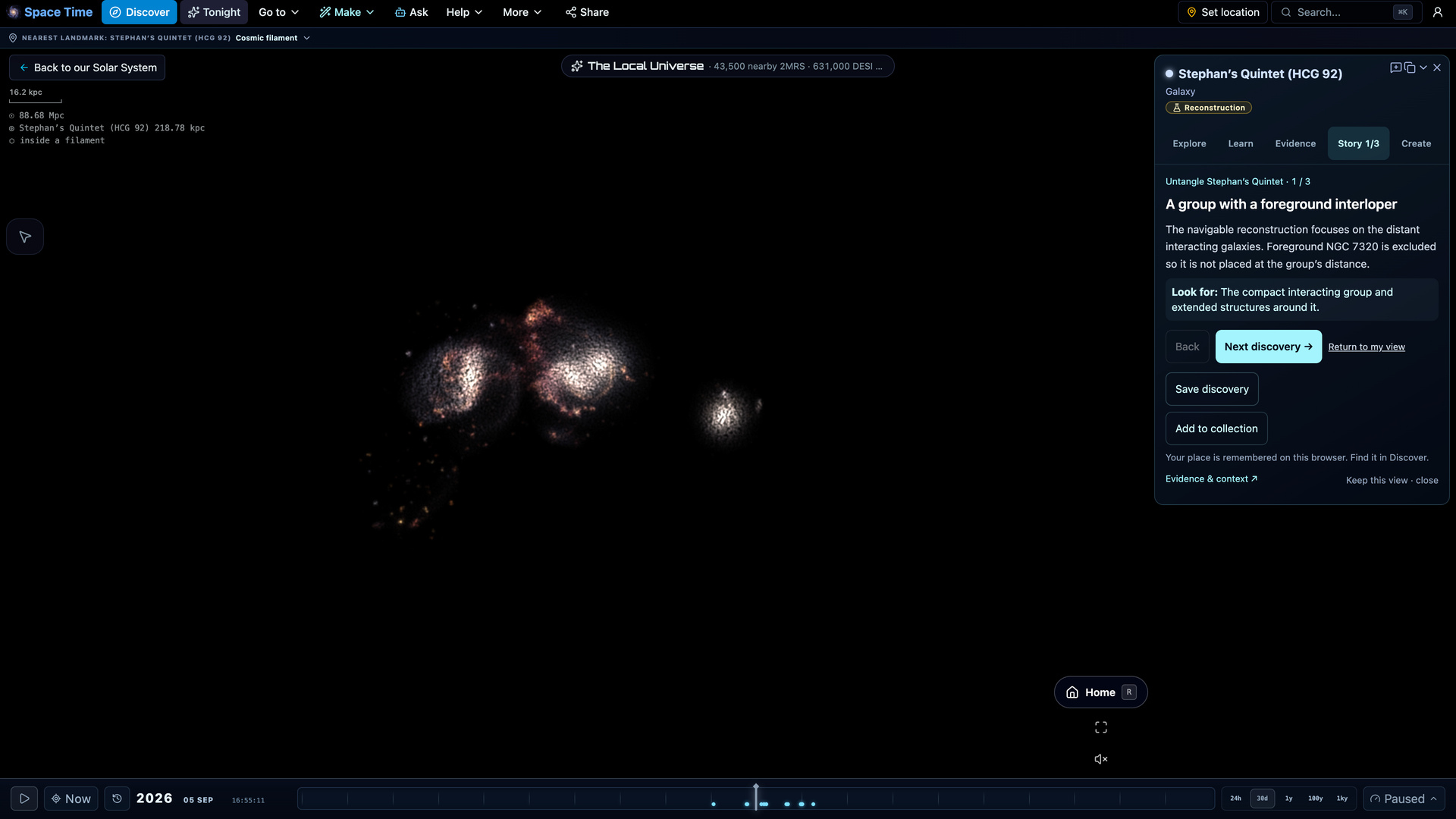
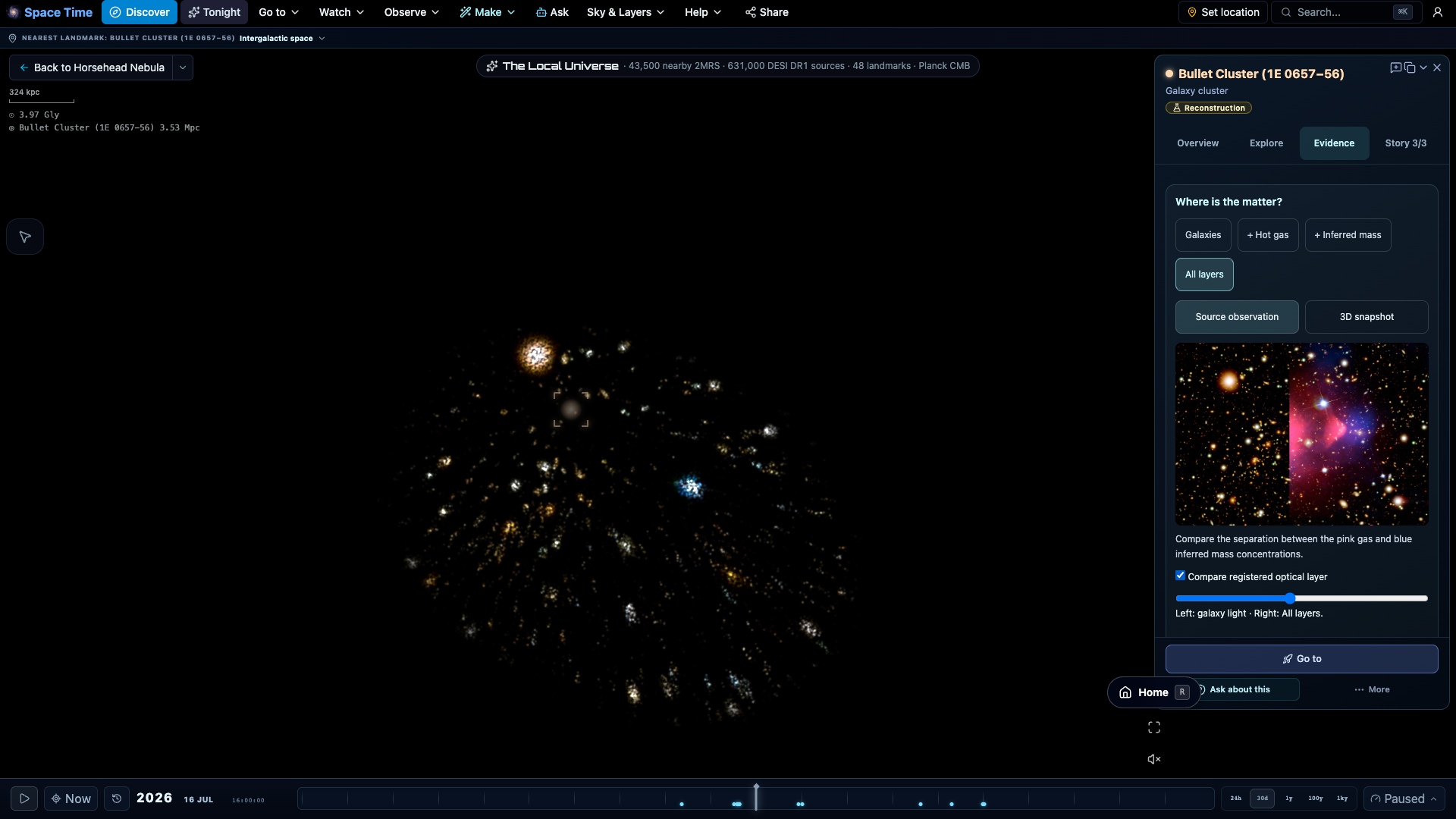
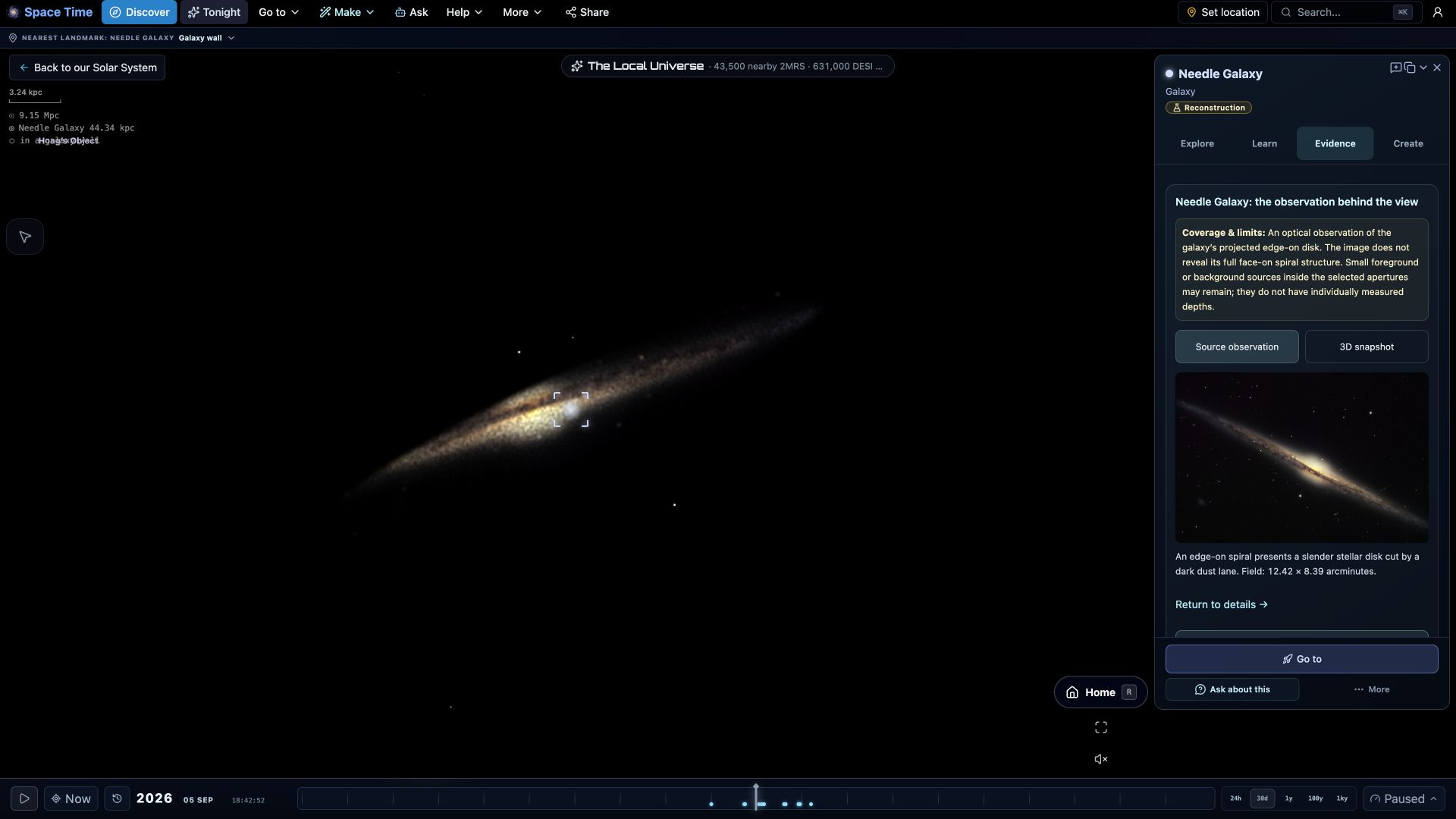
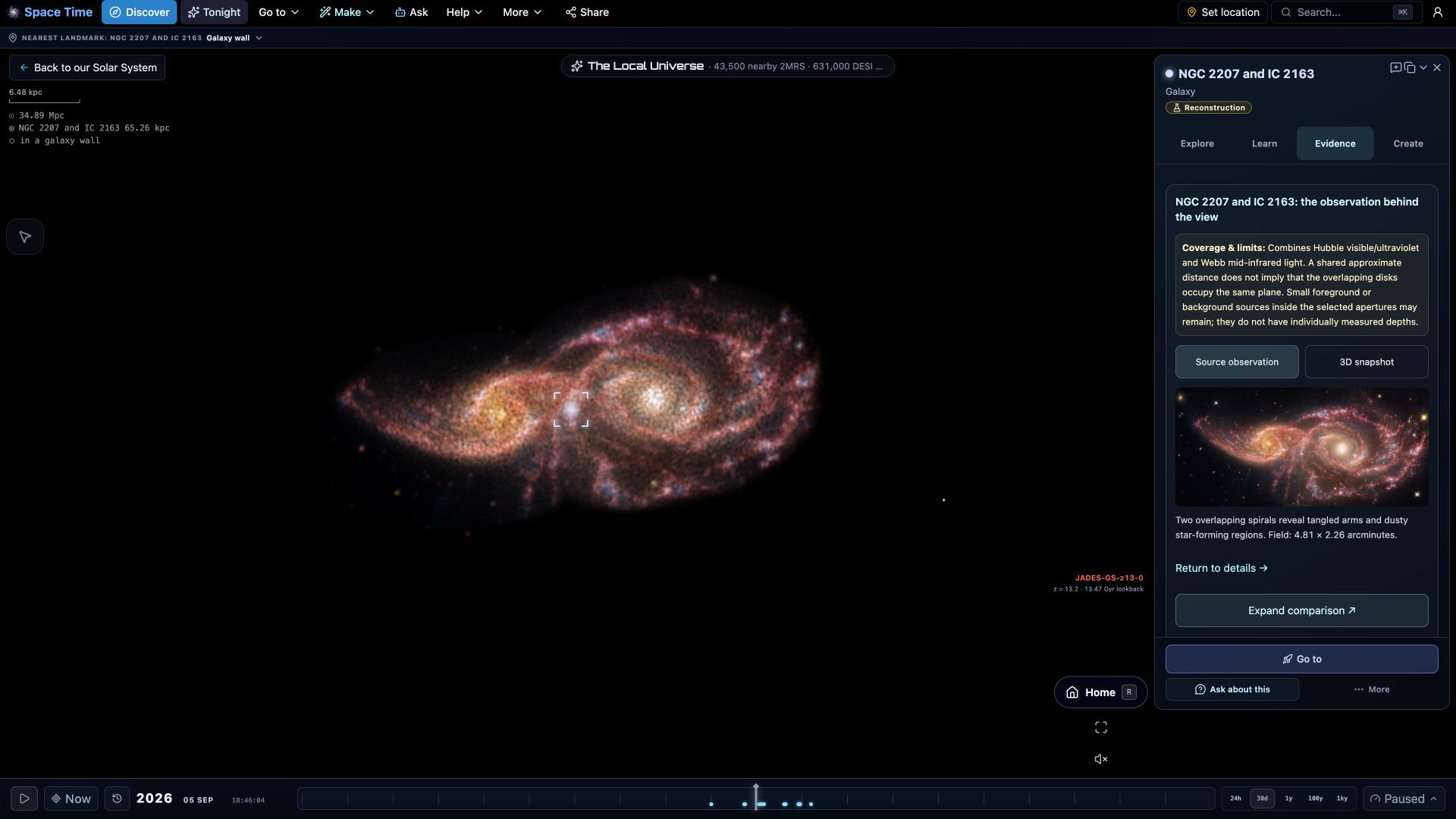
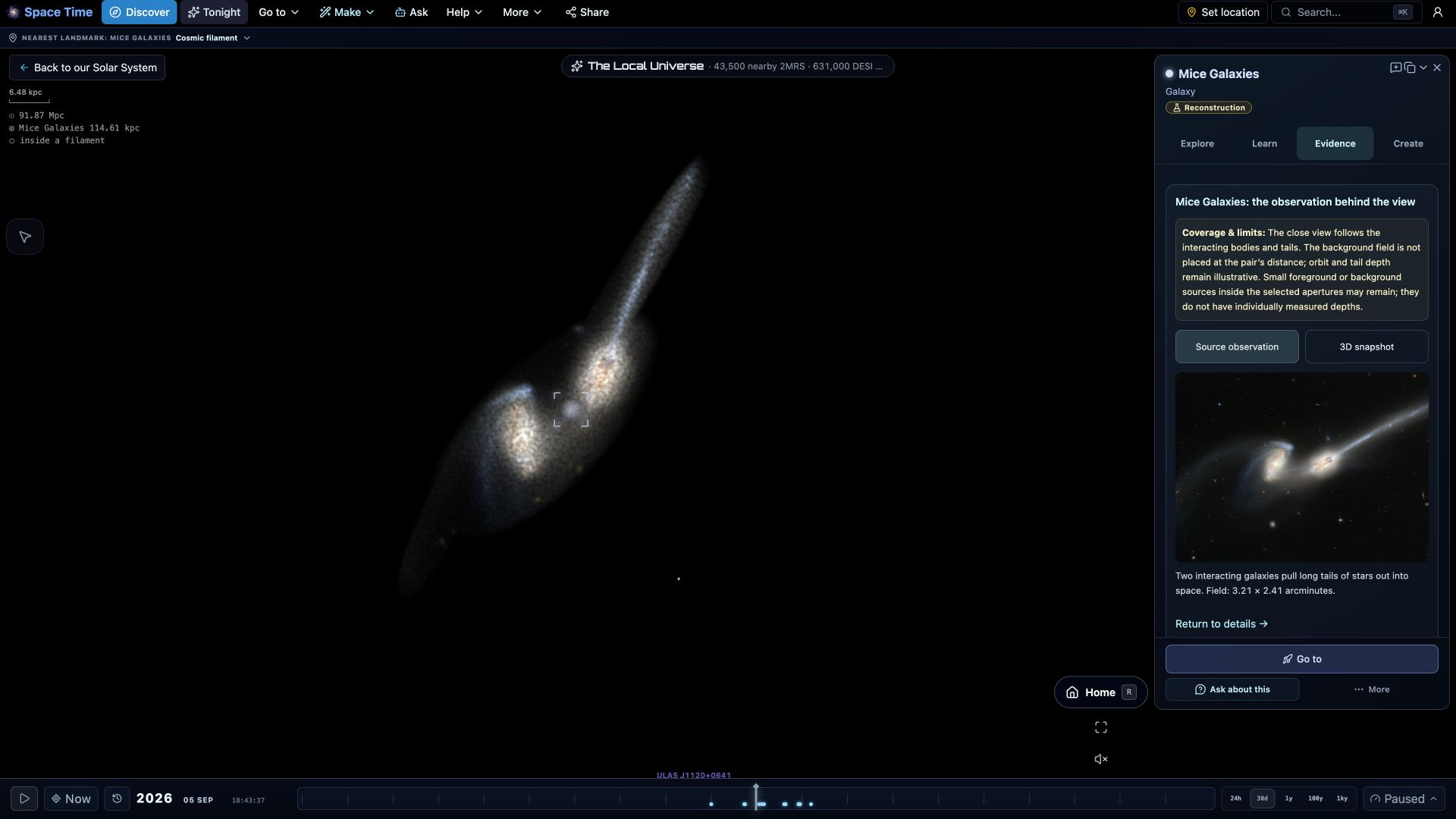
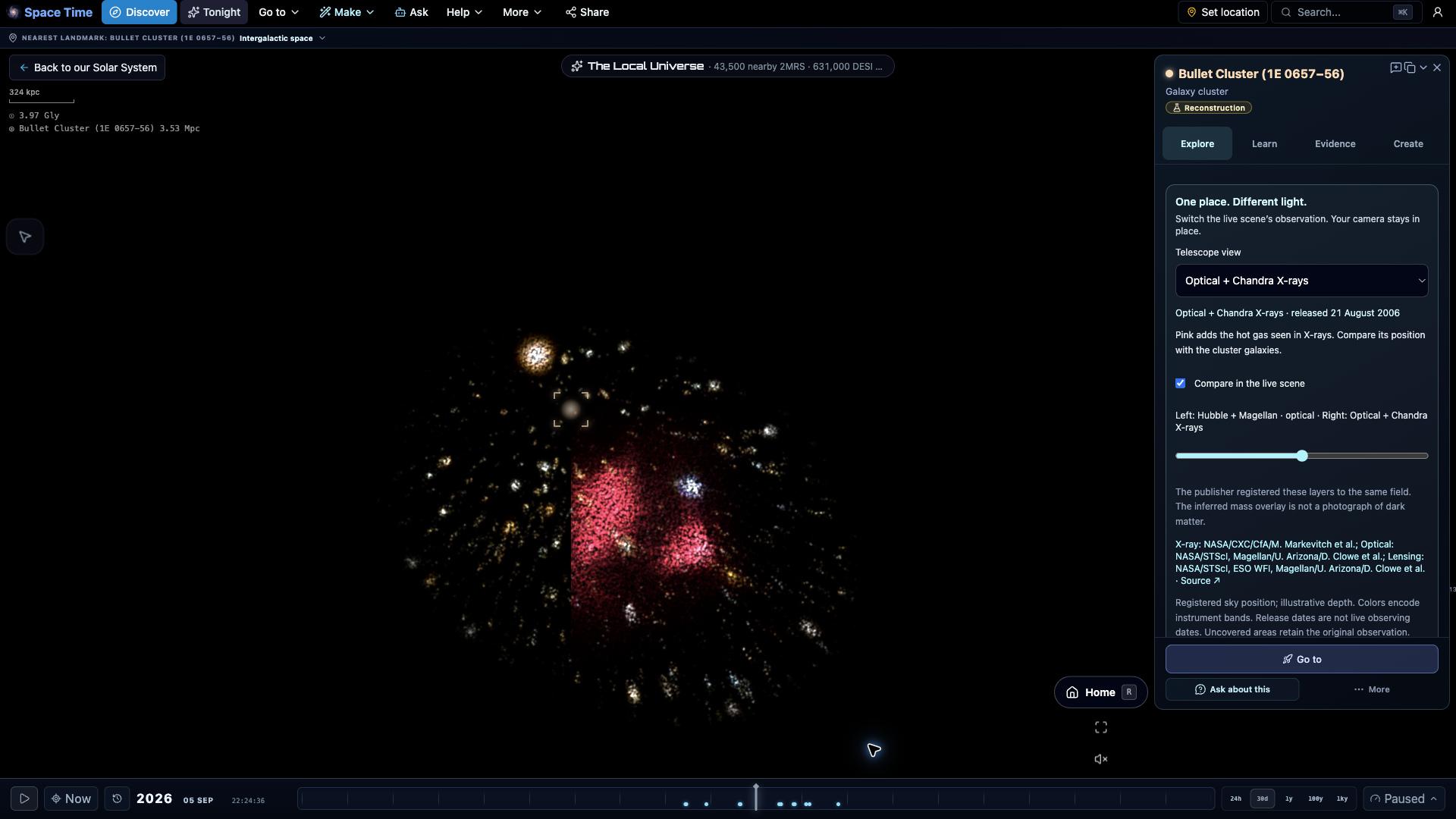
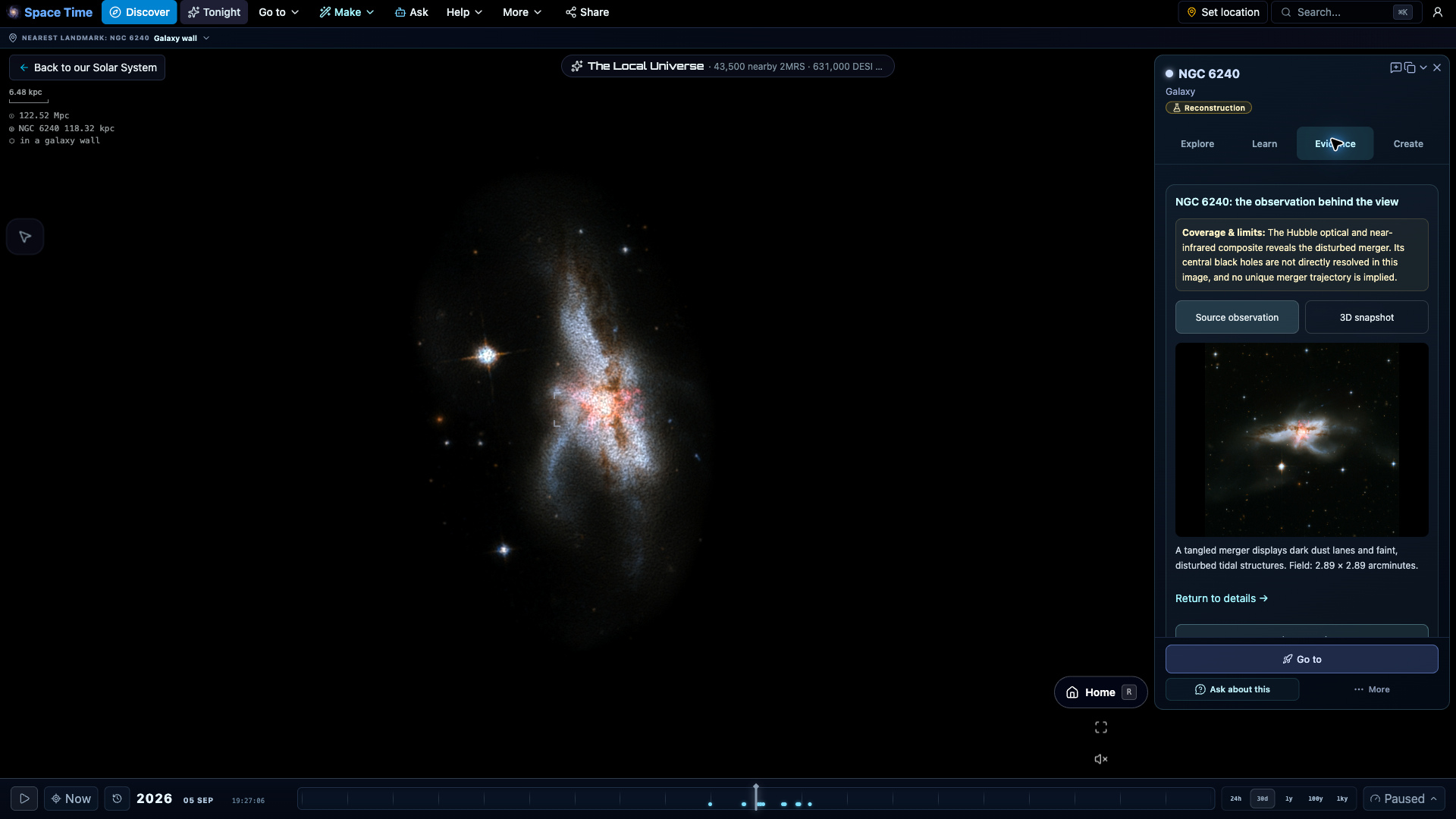
Enter the interacting galaxies of Stephan’s Quintet, the Antennae’s central collision and the Bullet Cluster. Compare the observed light with the reconstruction and read its limitations.
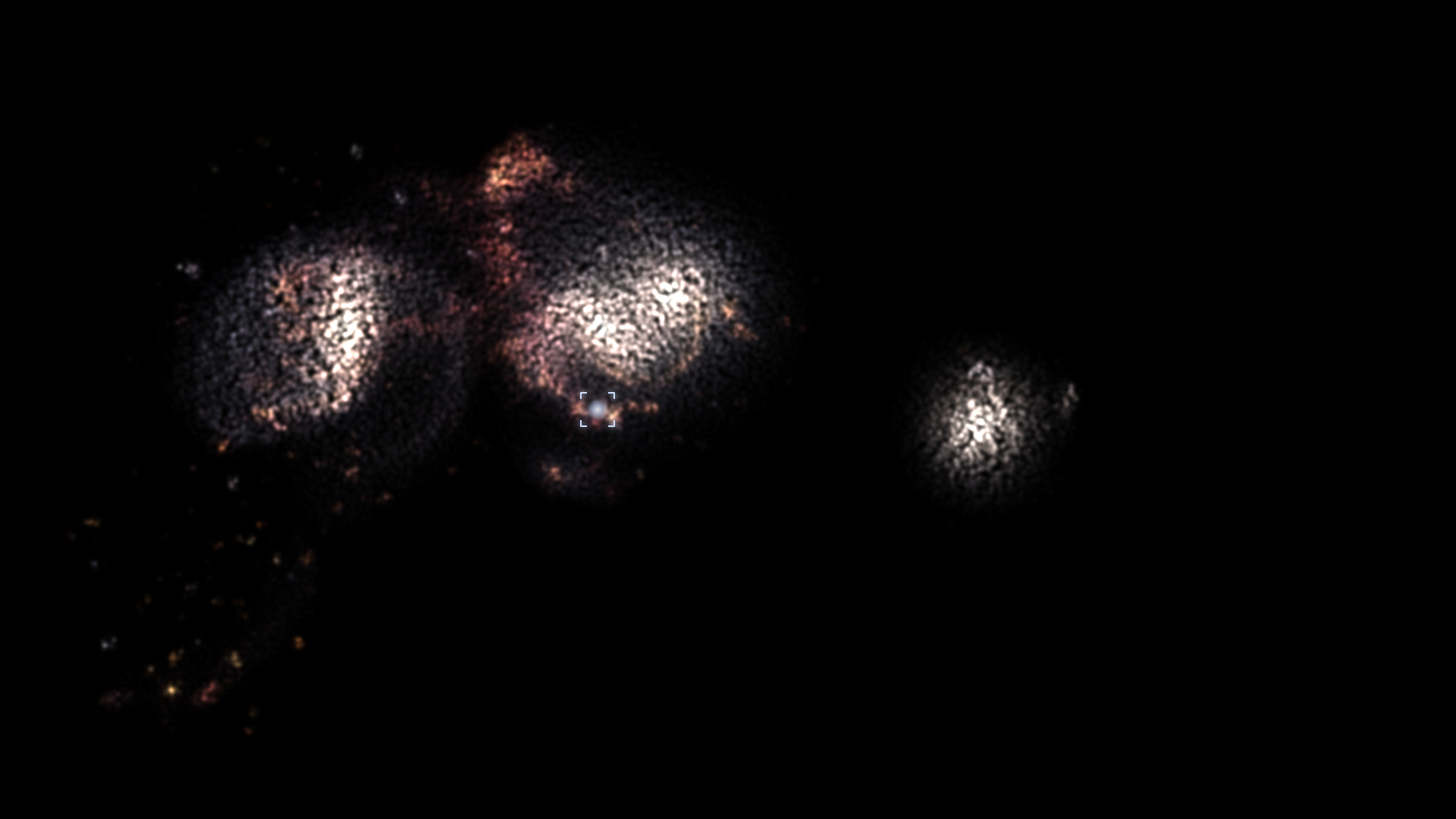
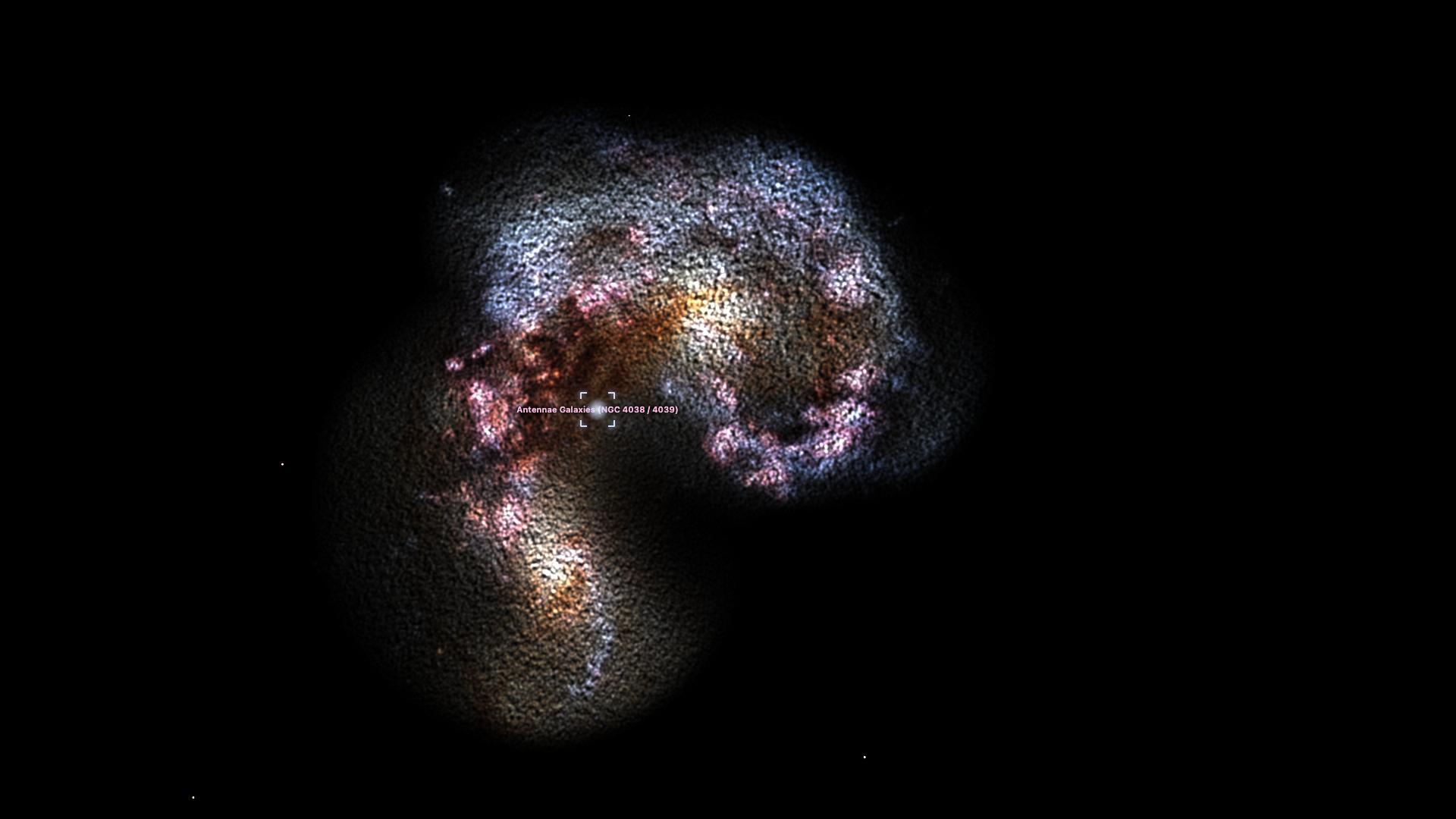
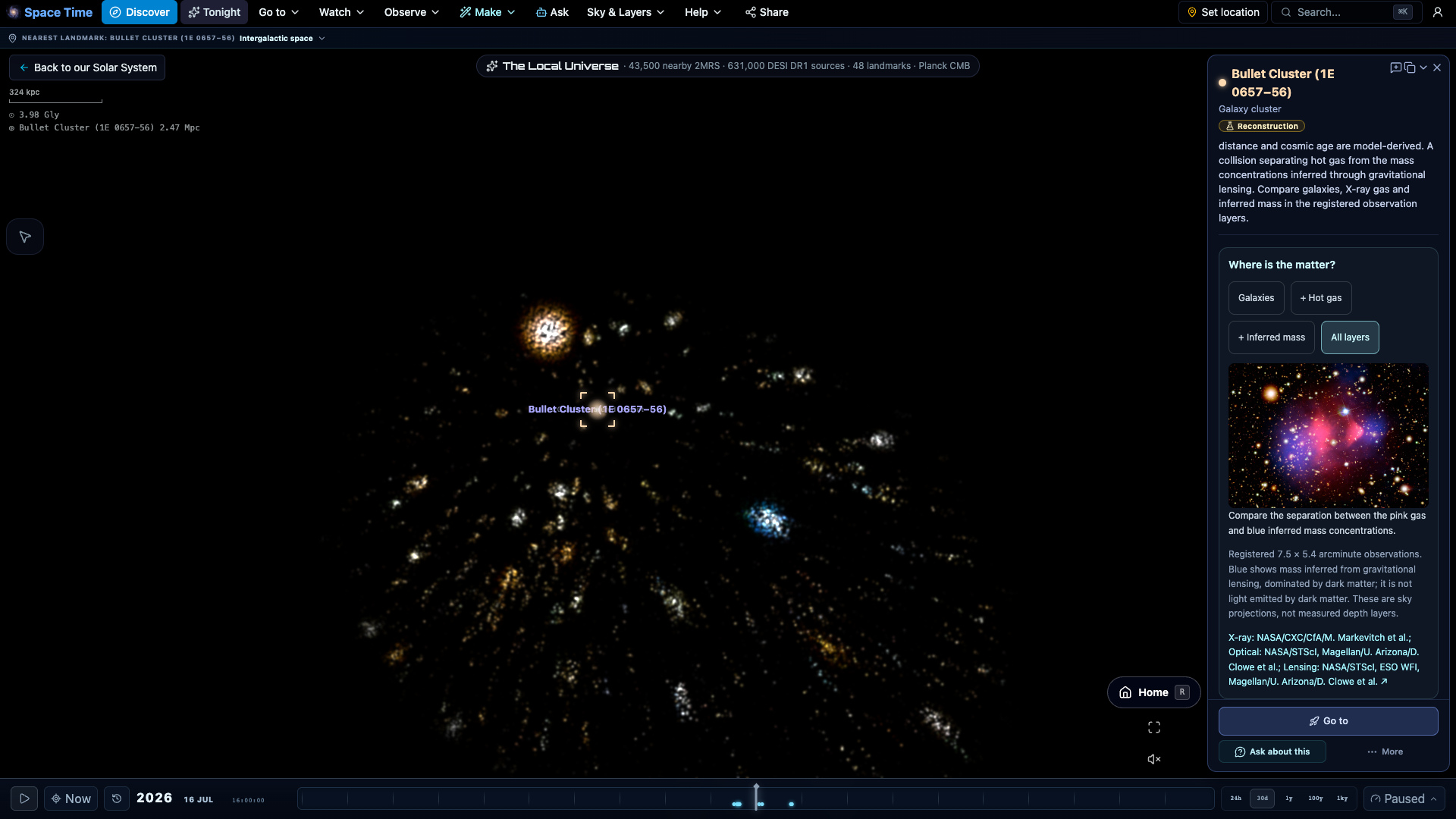
Destination atlas expansion
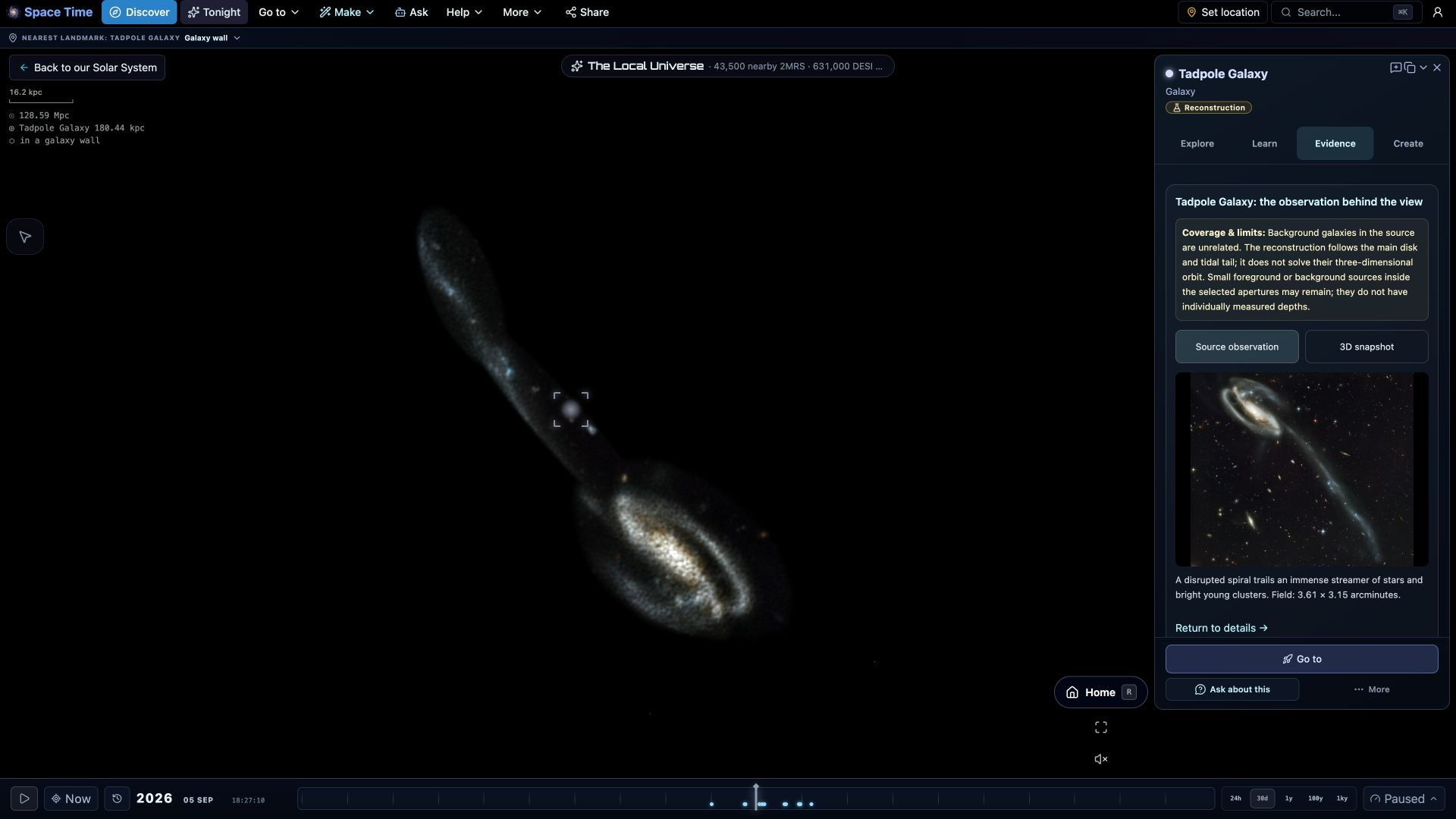
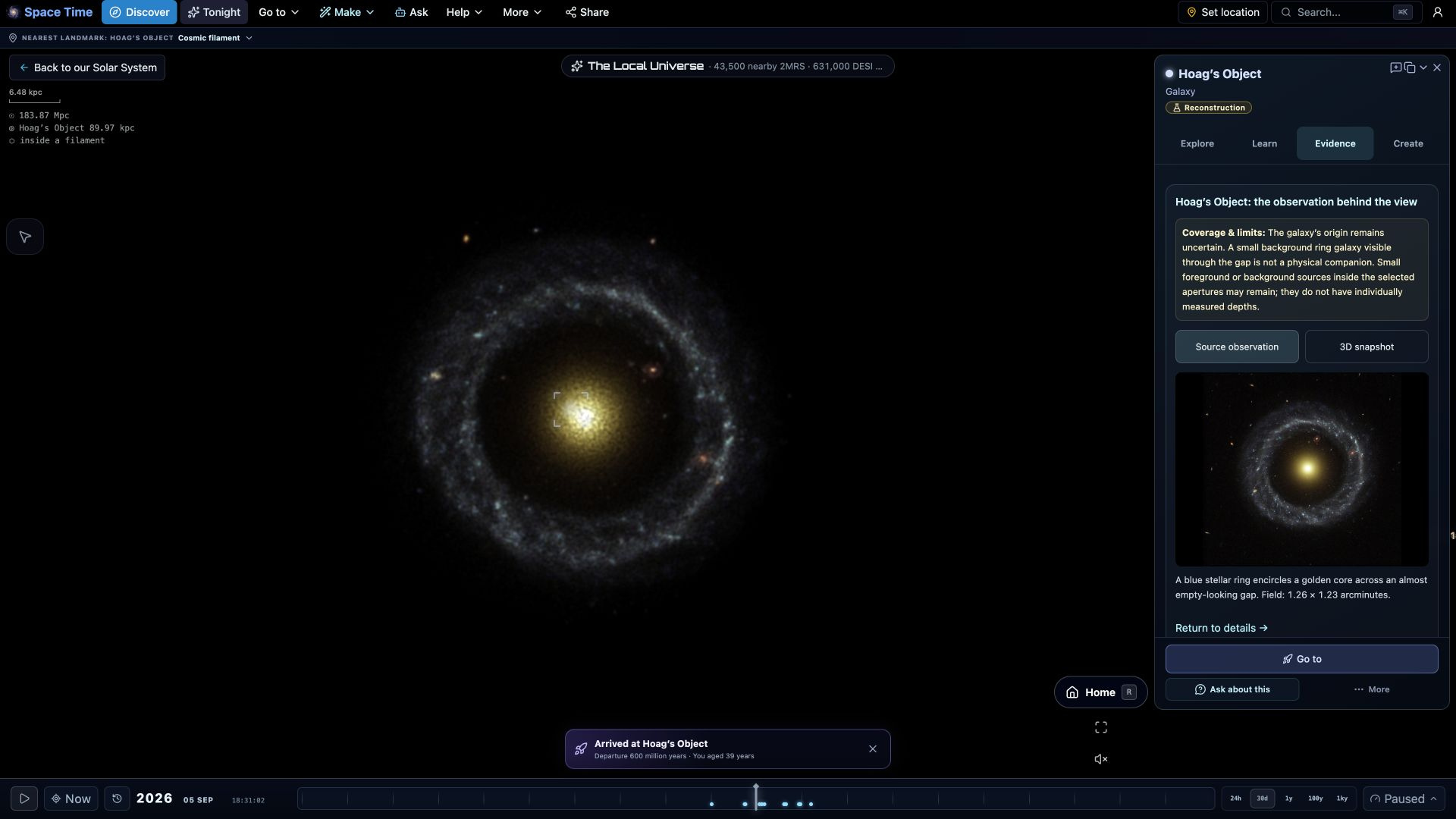
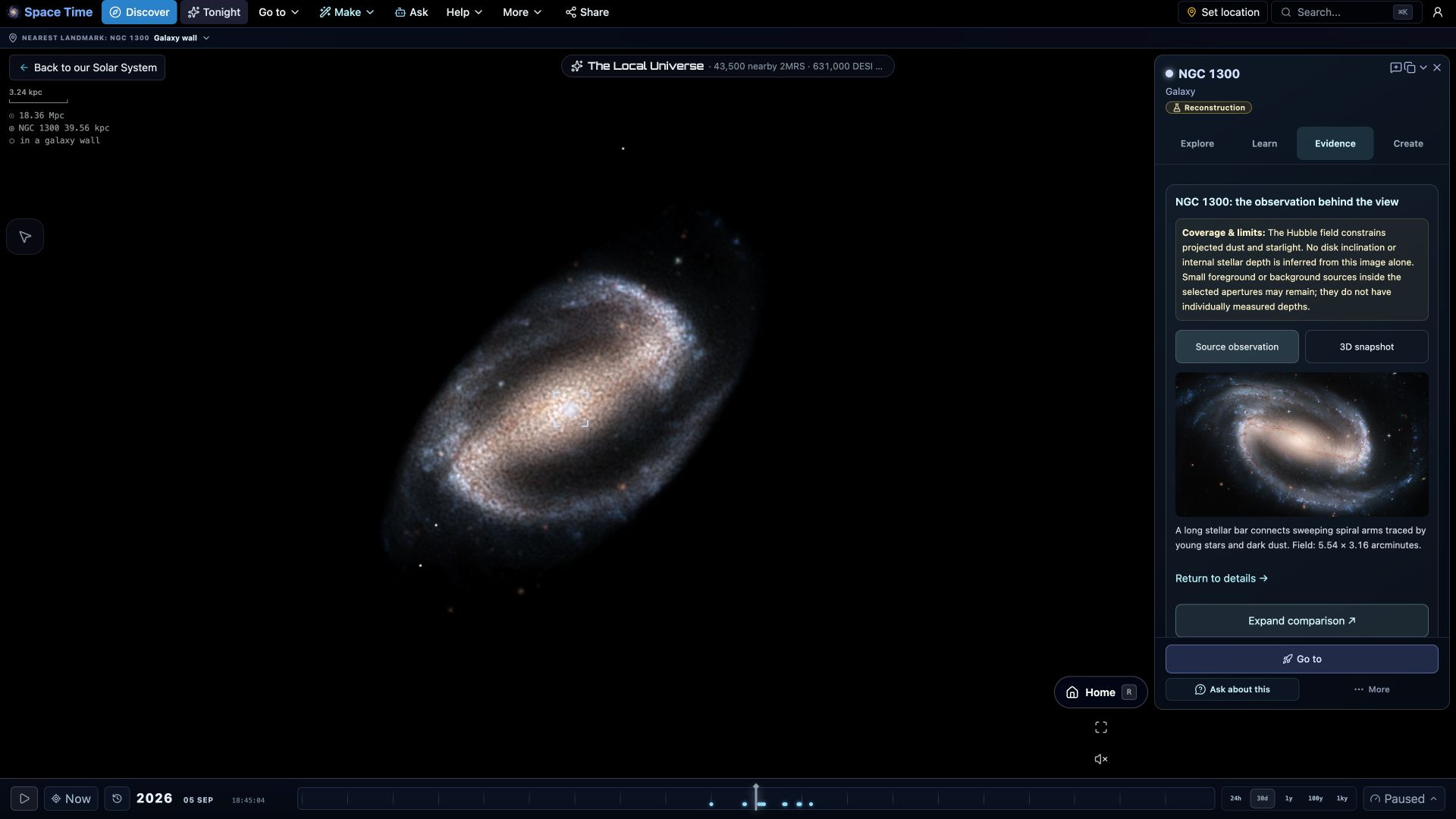
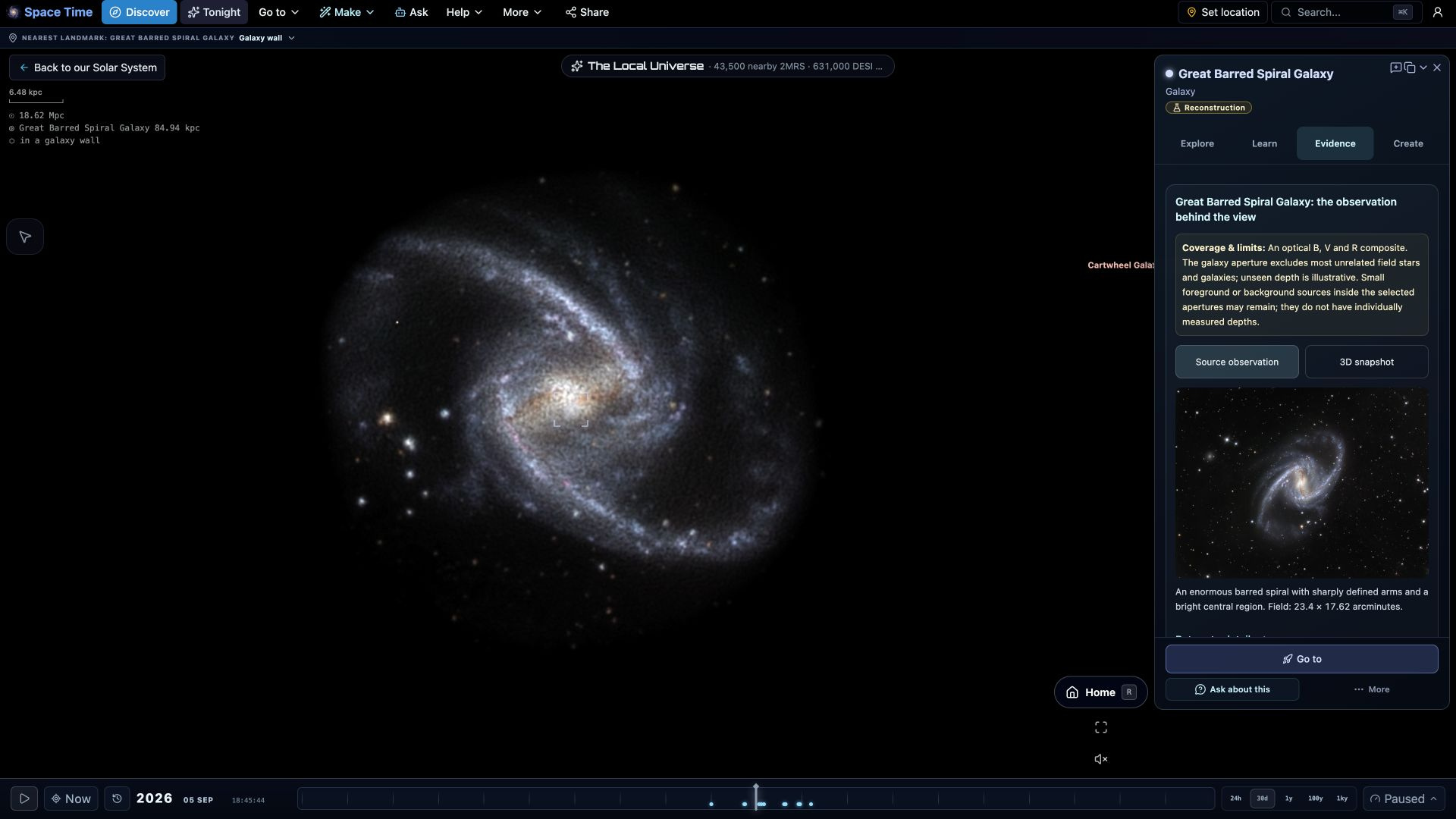
Eight more extraordinary galaxies
Follow tidal tails, explore barred spirals, and inspect unusual galactic rings. Each destination includes its credited telescope observation.
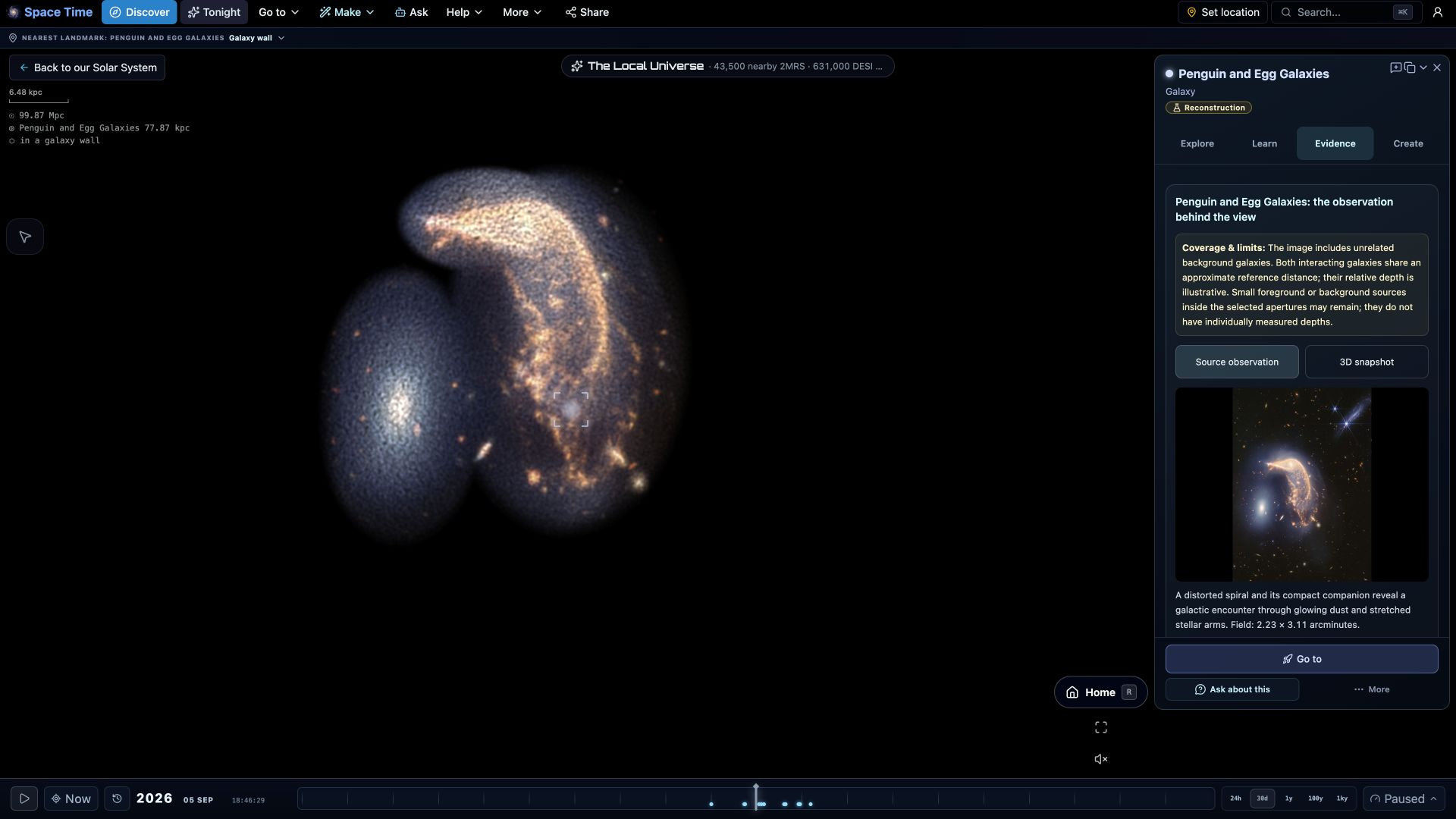
Explore all 8 destinations
Explore the Universe
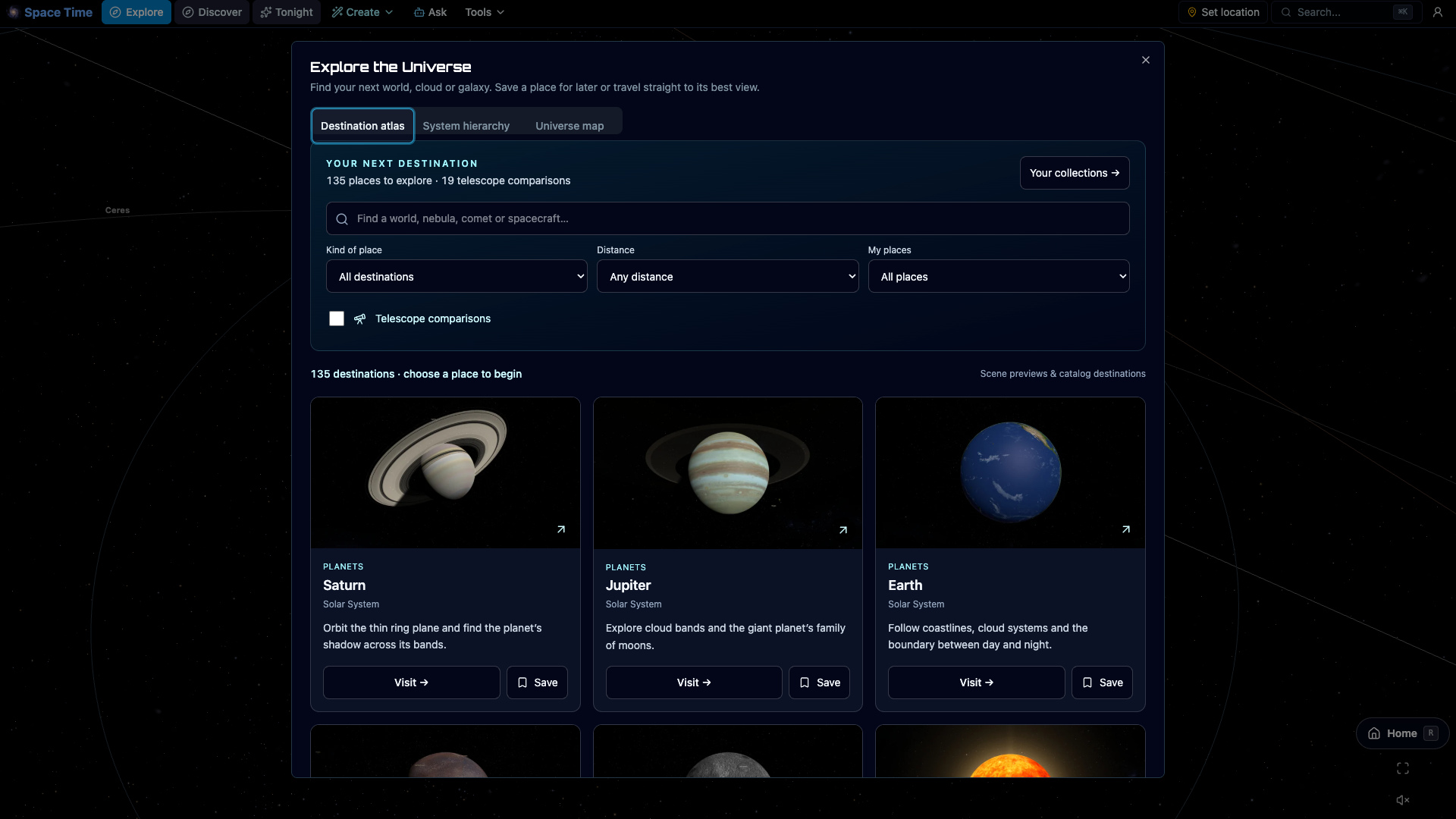
Find a place worth the journey.
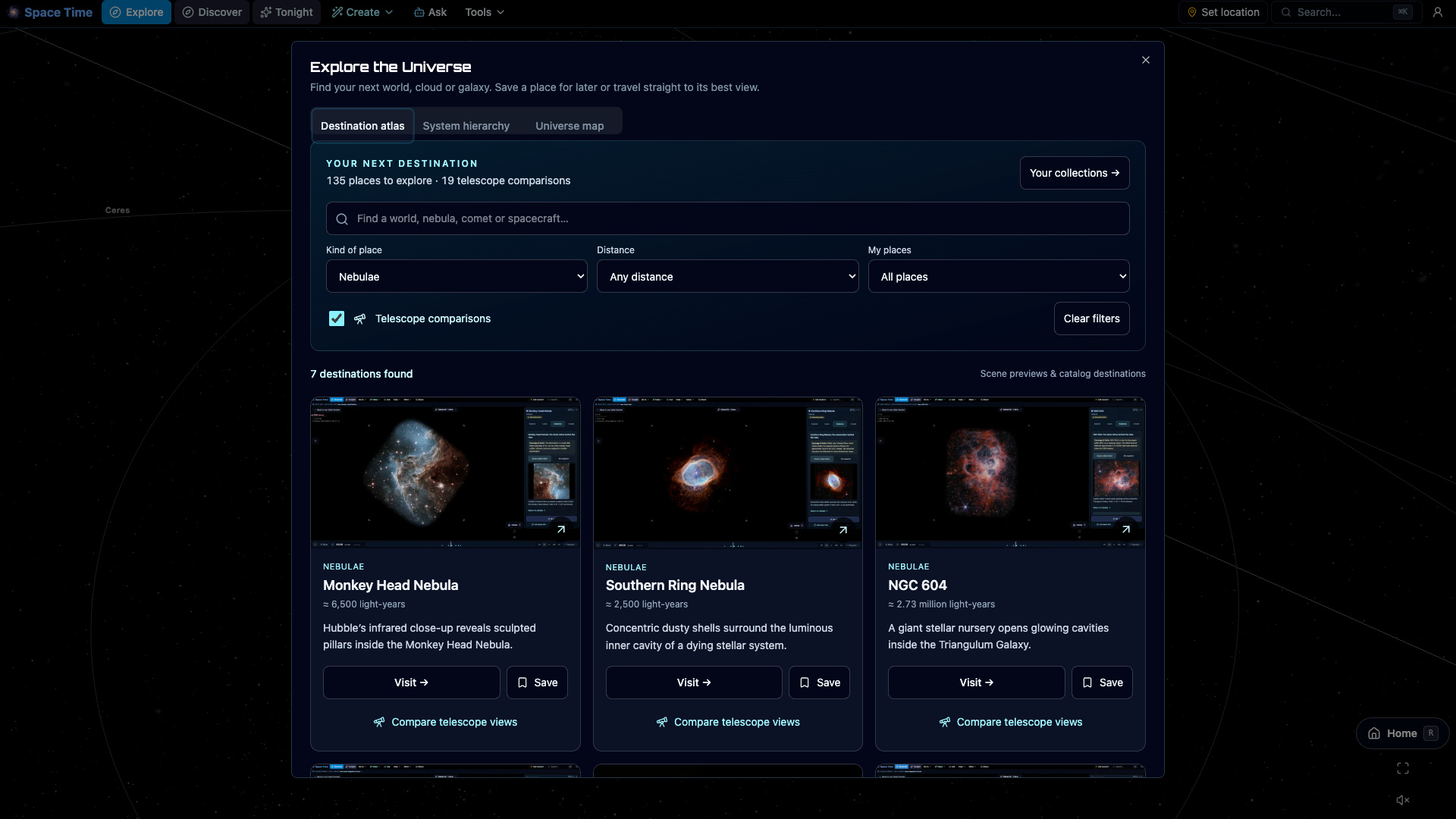
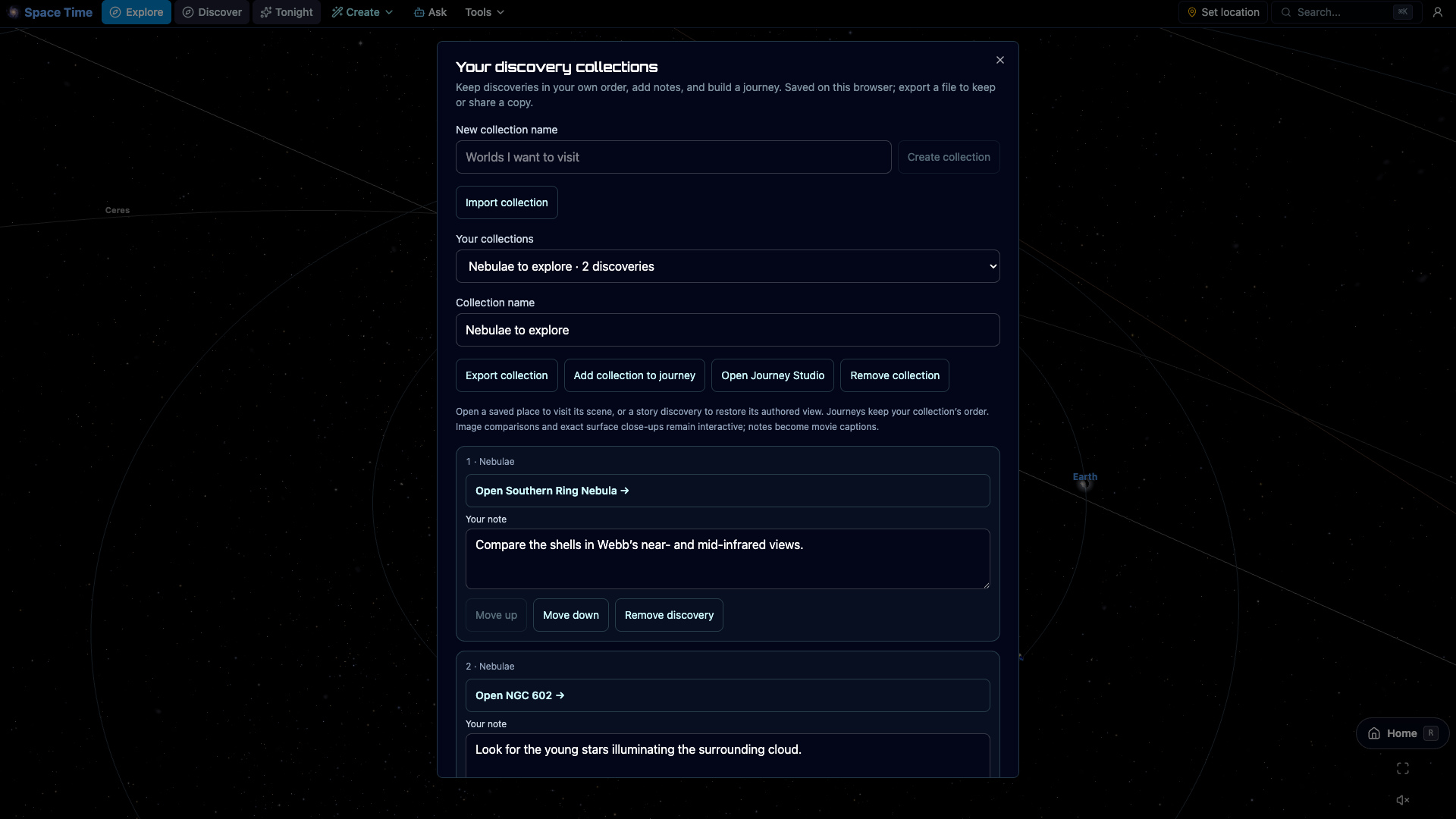
Browse worlds, galaxies, comets and spacecraft in one atlas, with 97 actual scene previews. Search by name, filter by kind and distance, find telescope comparisons, or choose somewhere you haven’t visited. Save places alongside your discoveries, add notes, and turn a collection into a journey.
Live telescope comparisons
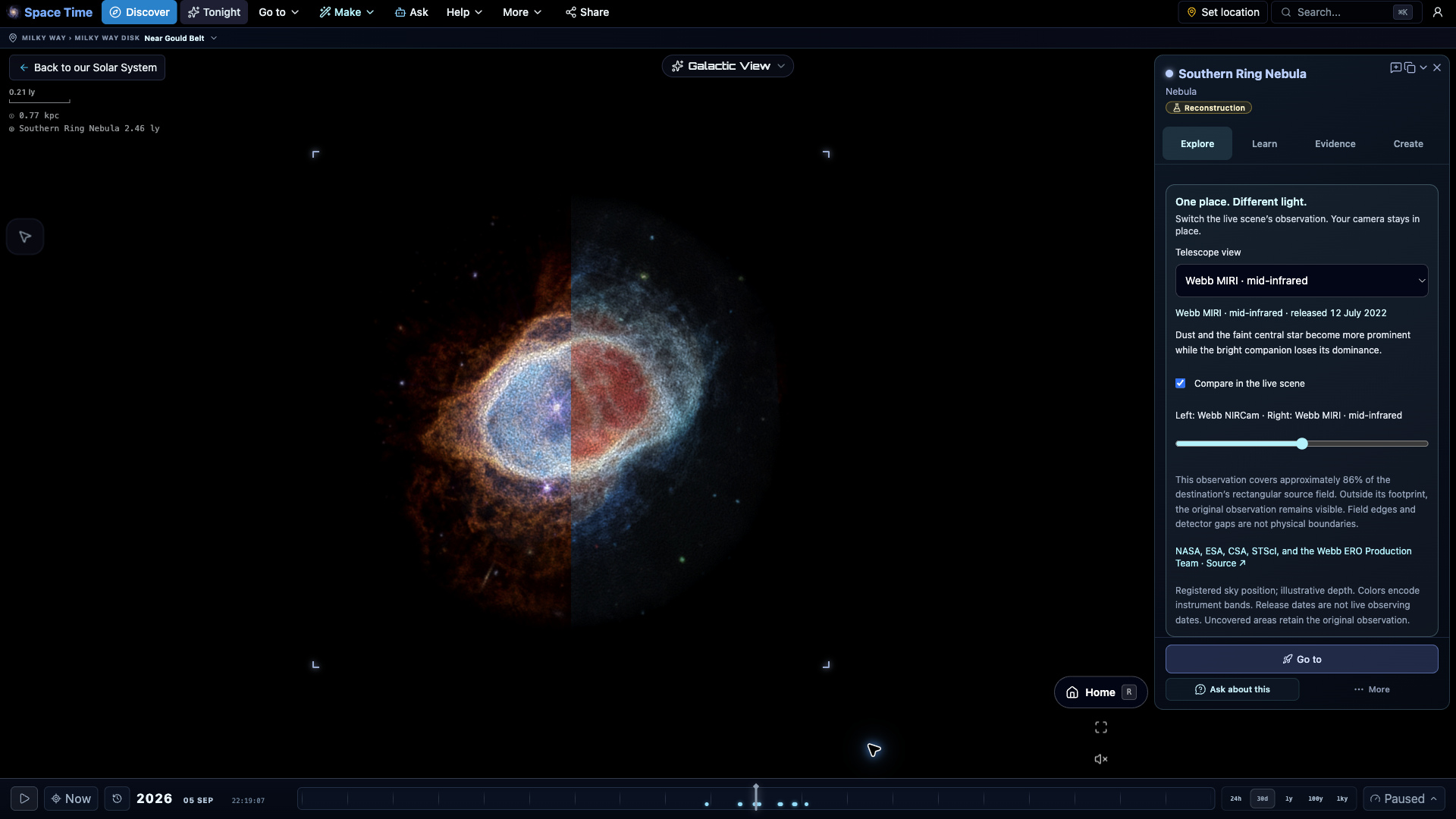
One place. Different light.
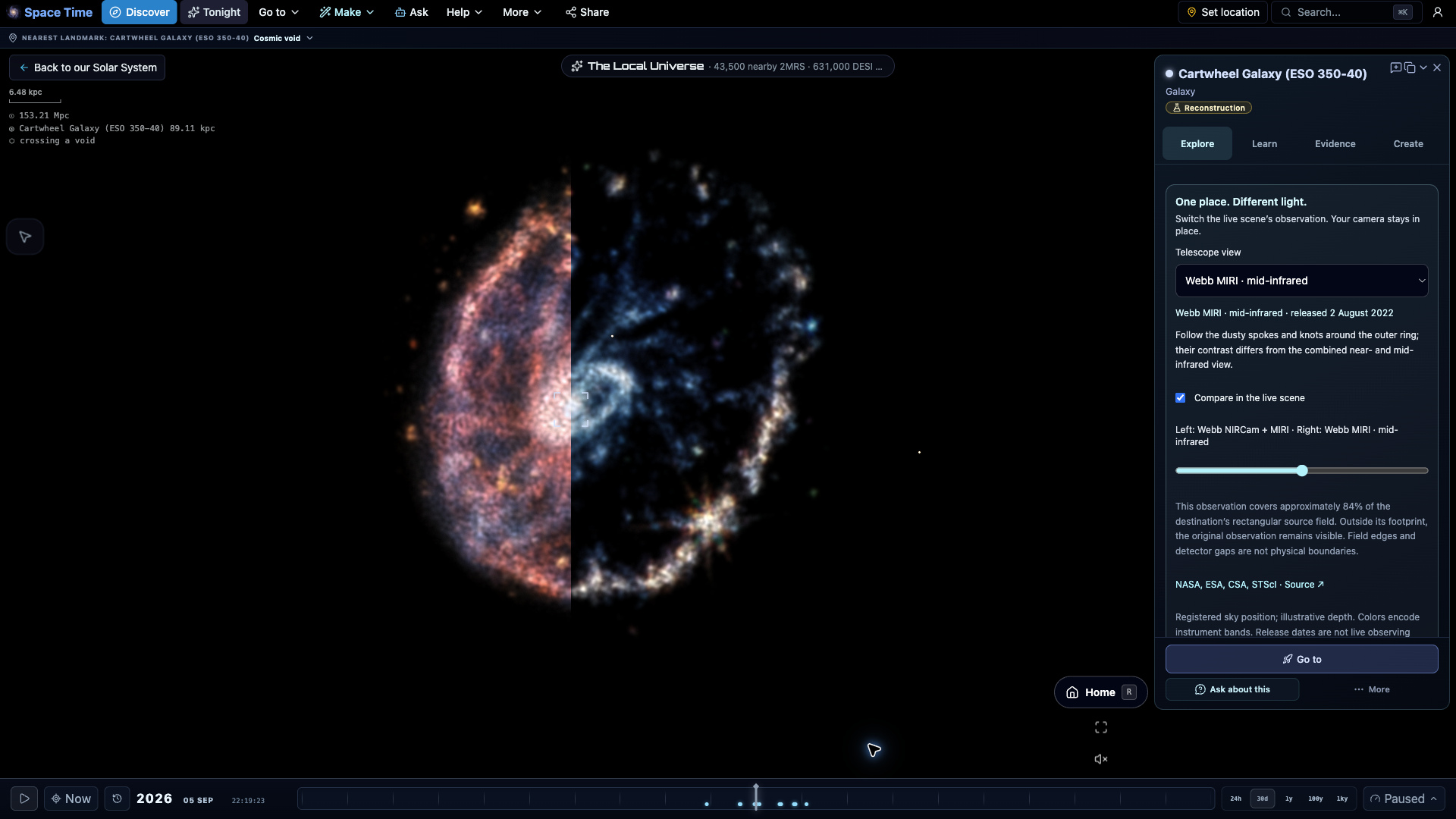
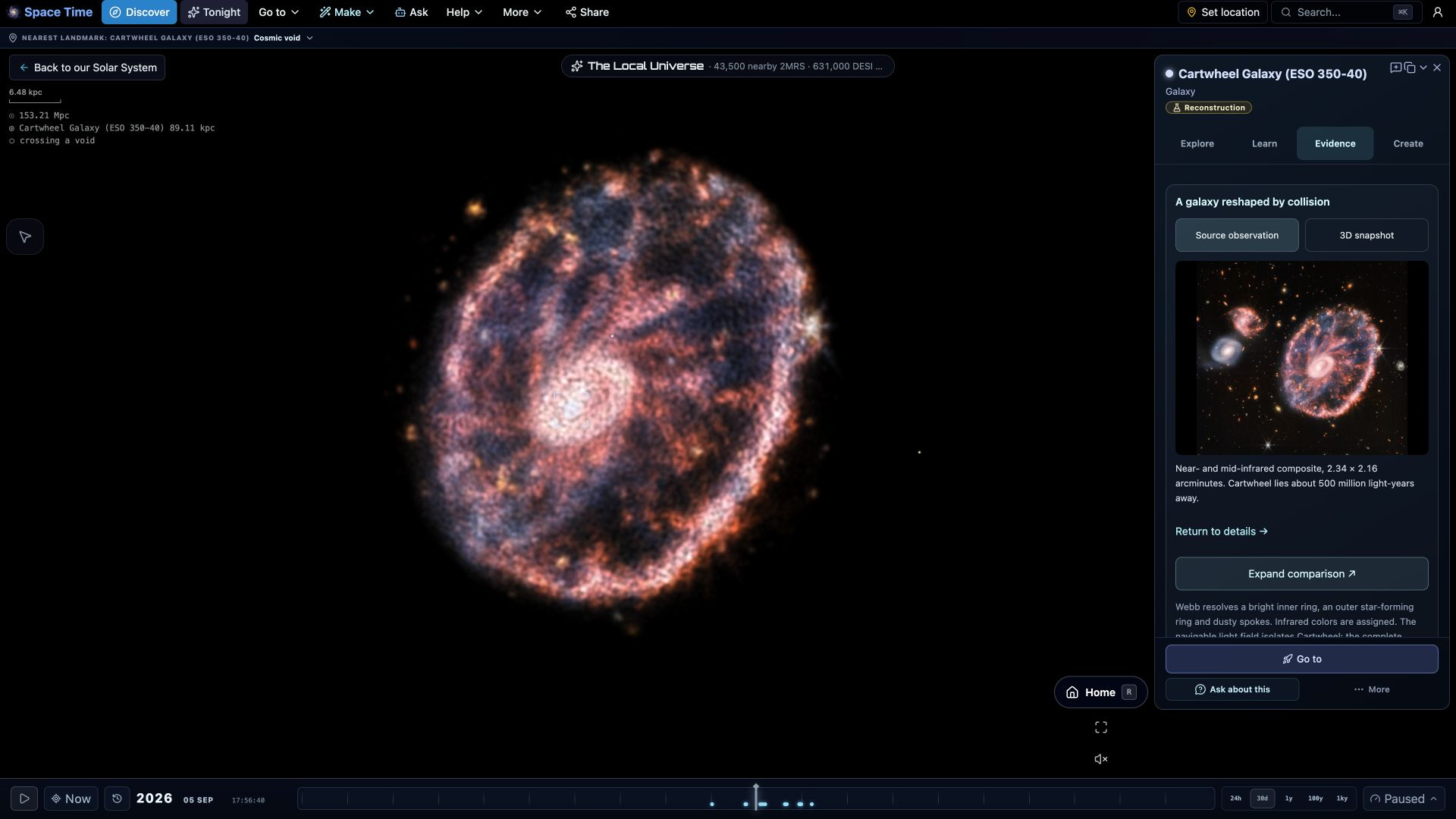
Switch between real telescope observations inside the same 3D scene. Sweep across 19 destinations to compare stars, dust and glowing gas without moving your camera. Each view explains its instrument, colors, source and field coverage. Sky positions are registered; depth remains illustrative.
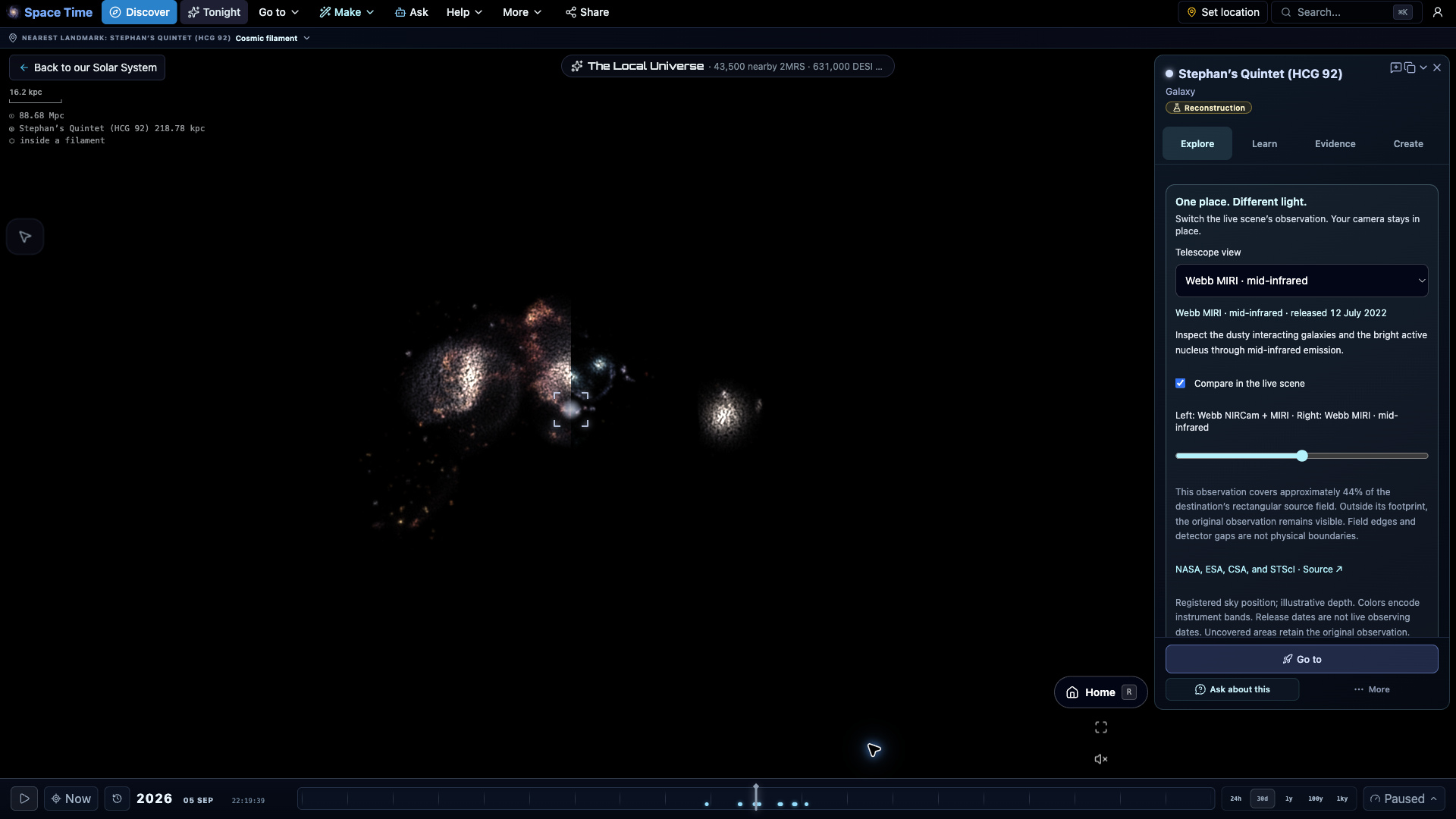
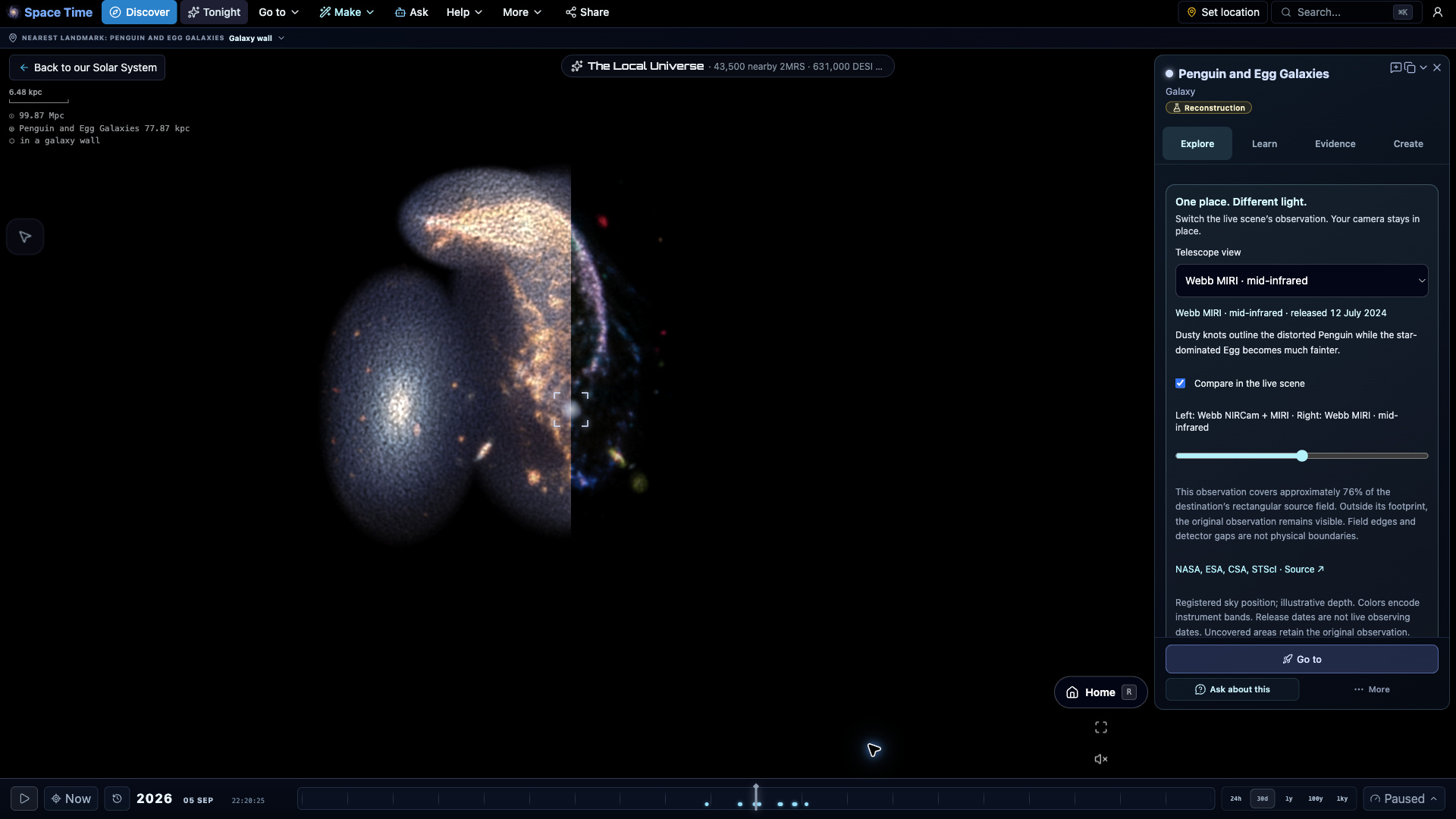
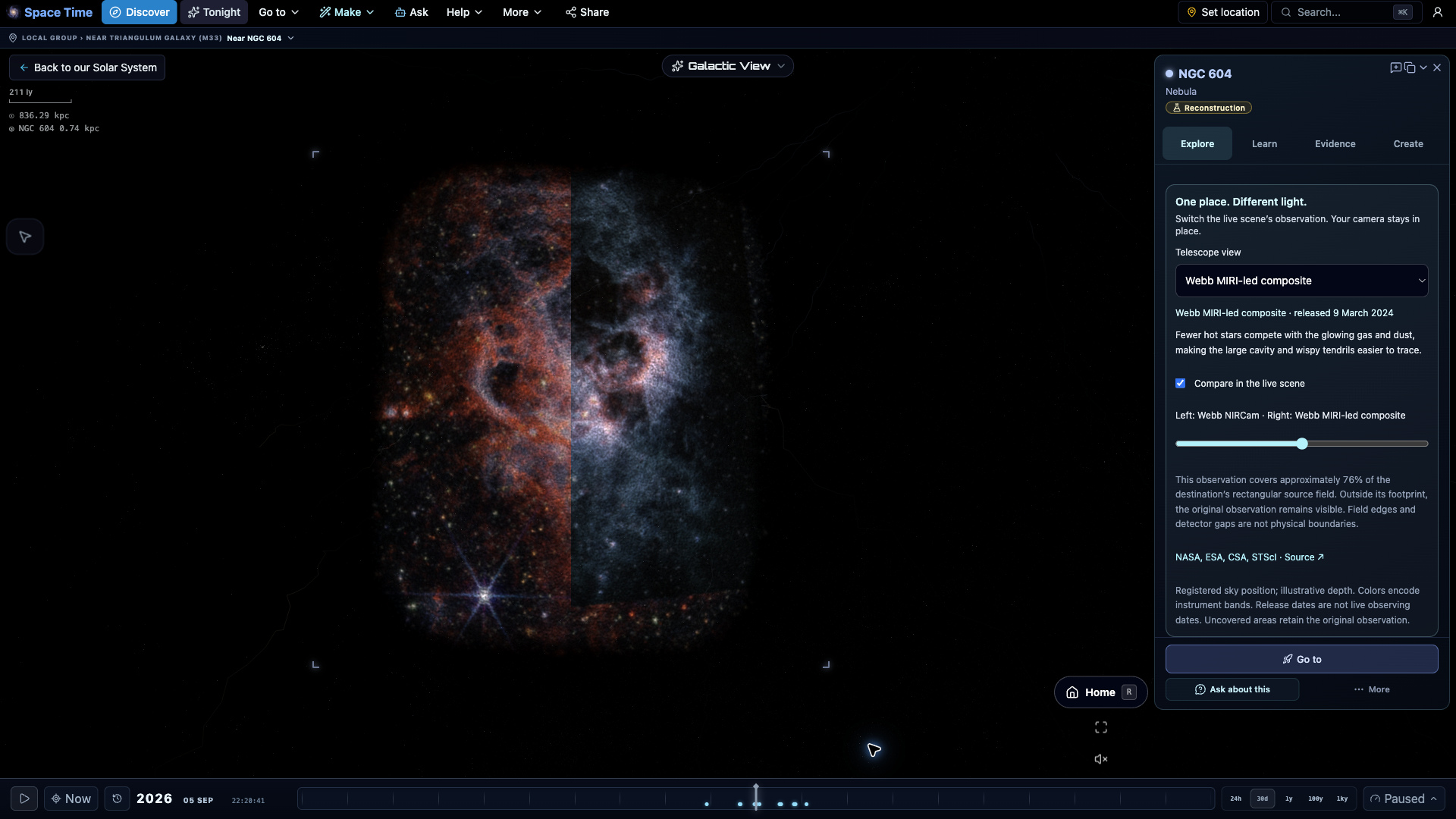
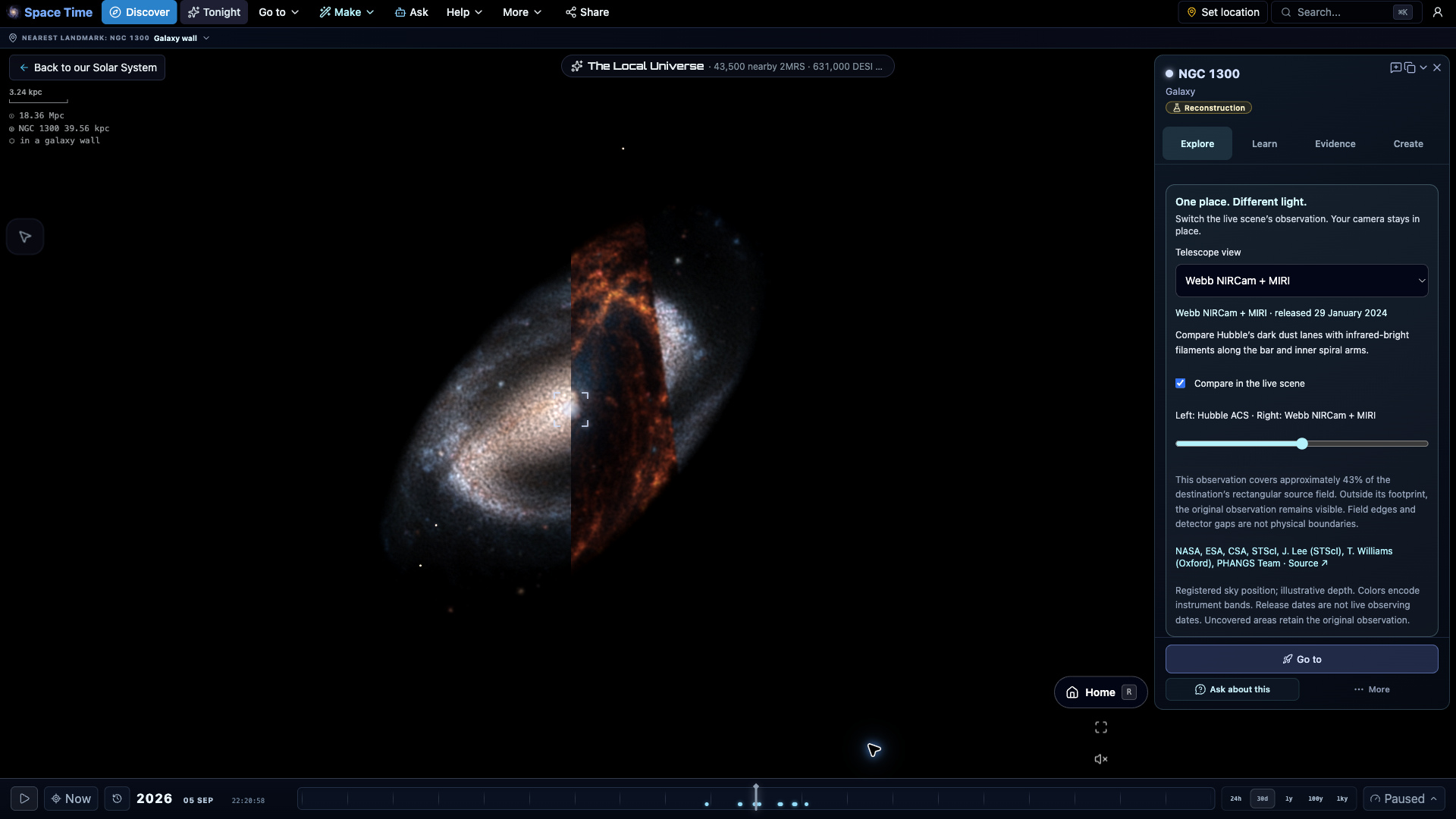
Compare all 19 destinations
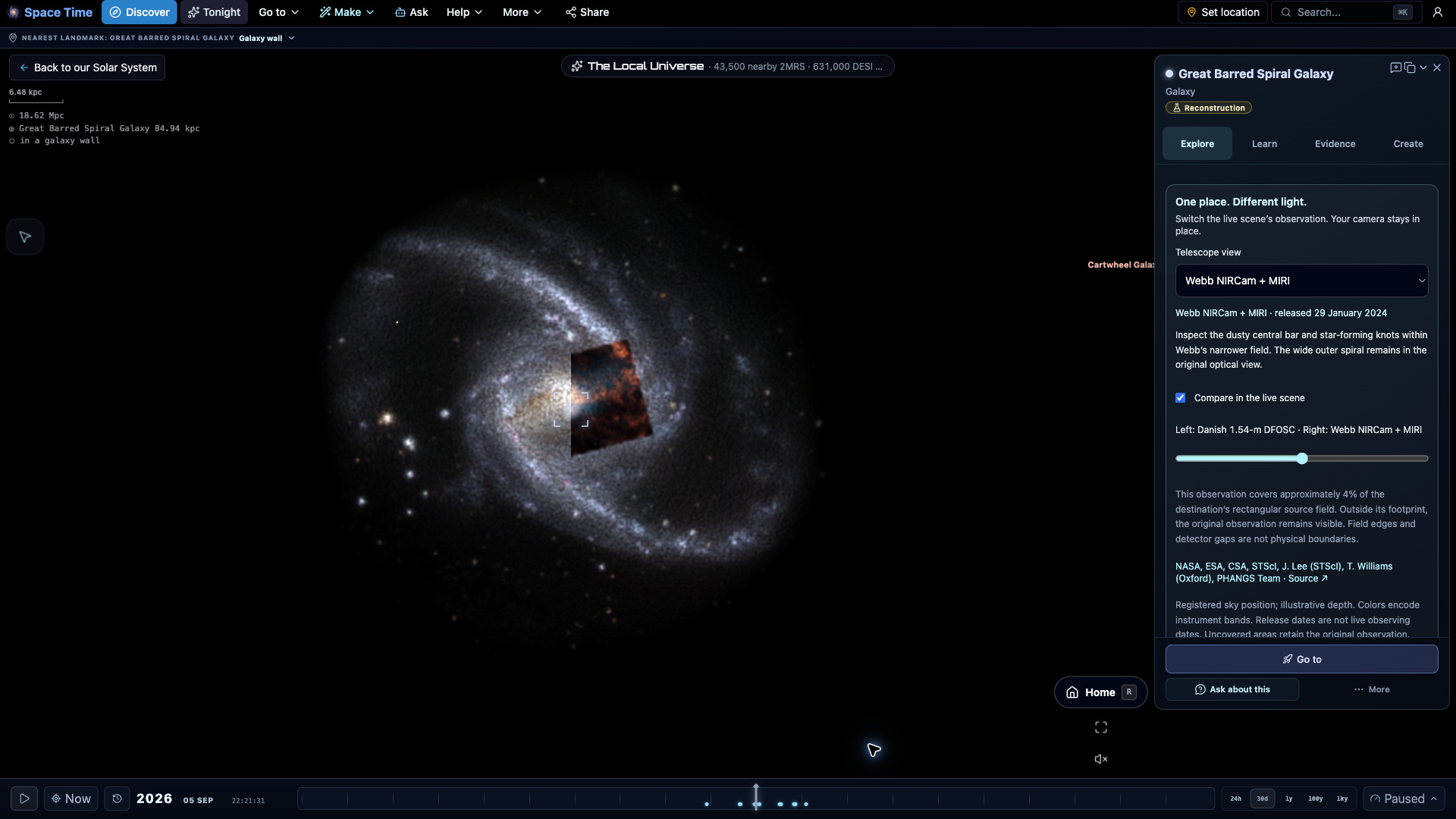
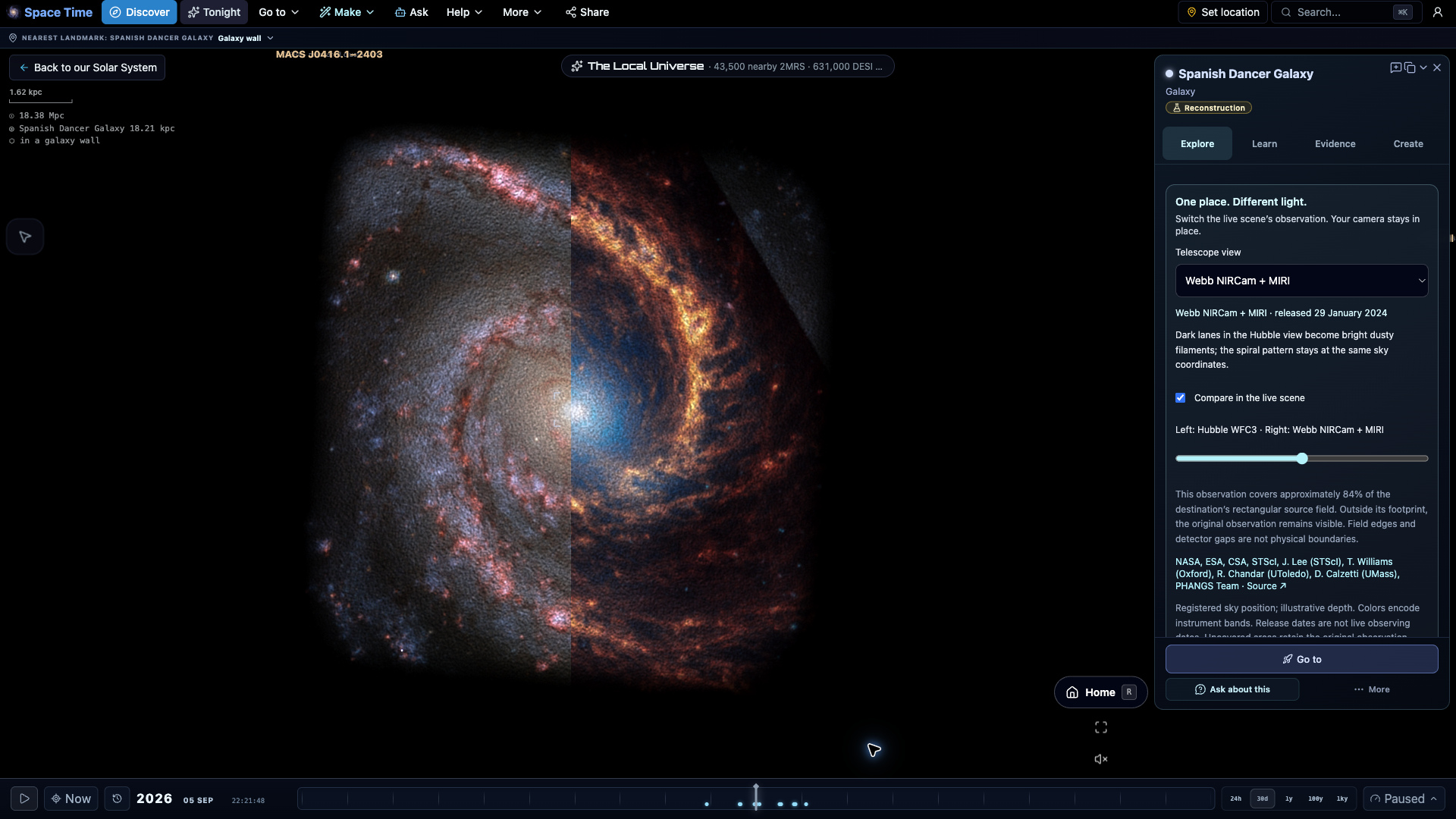
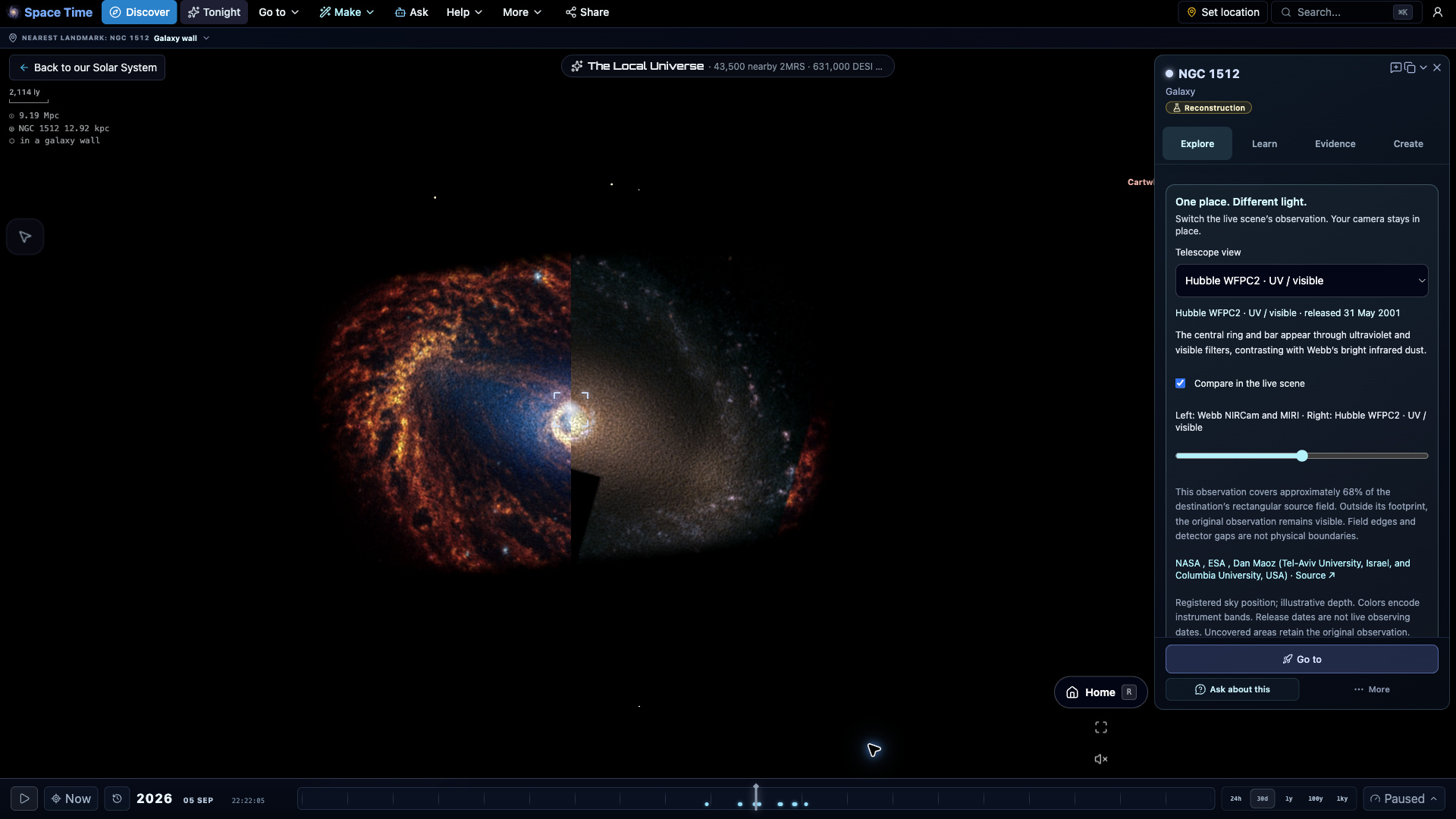
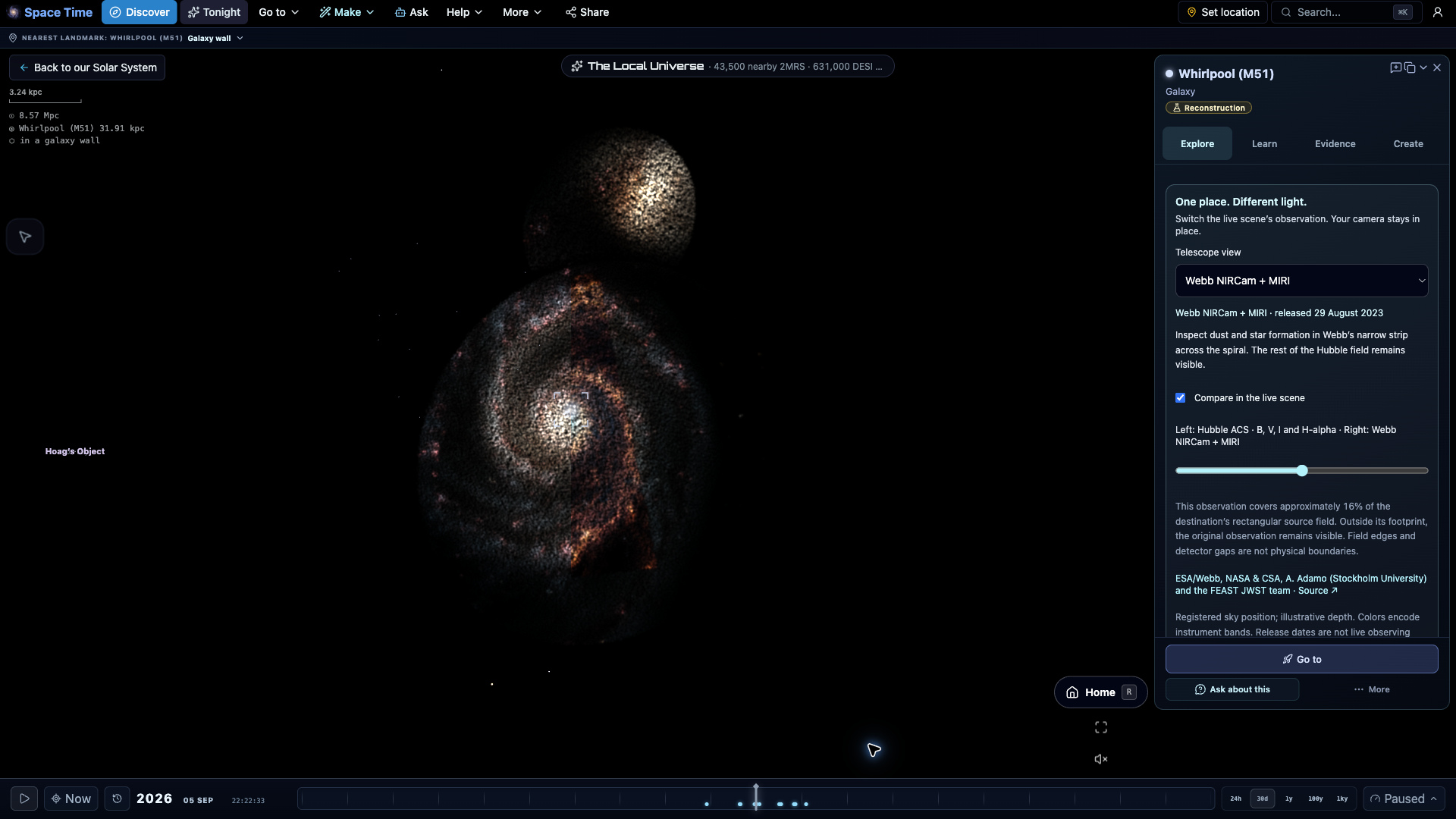
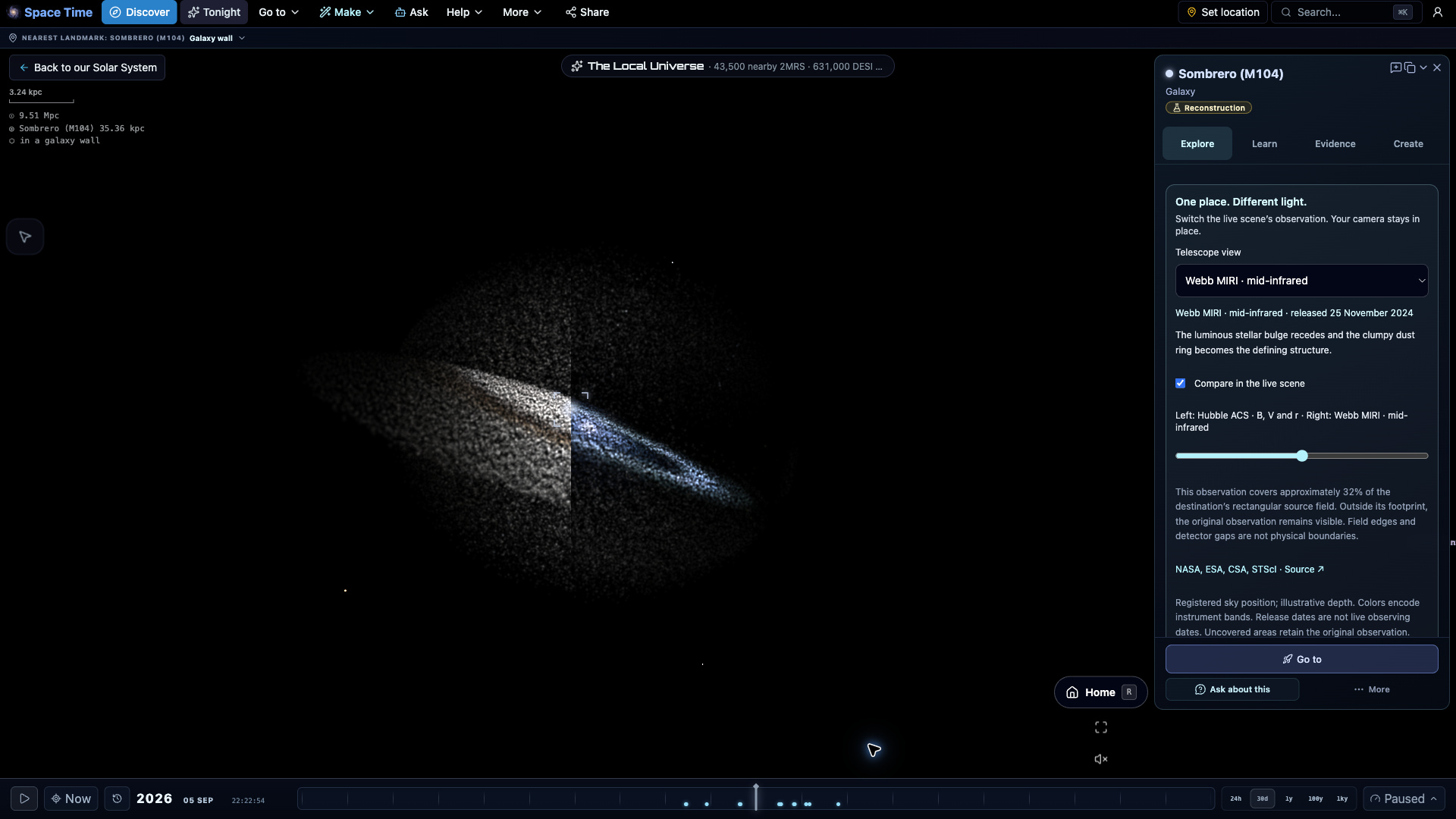
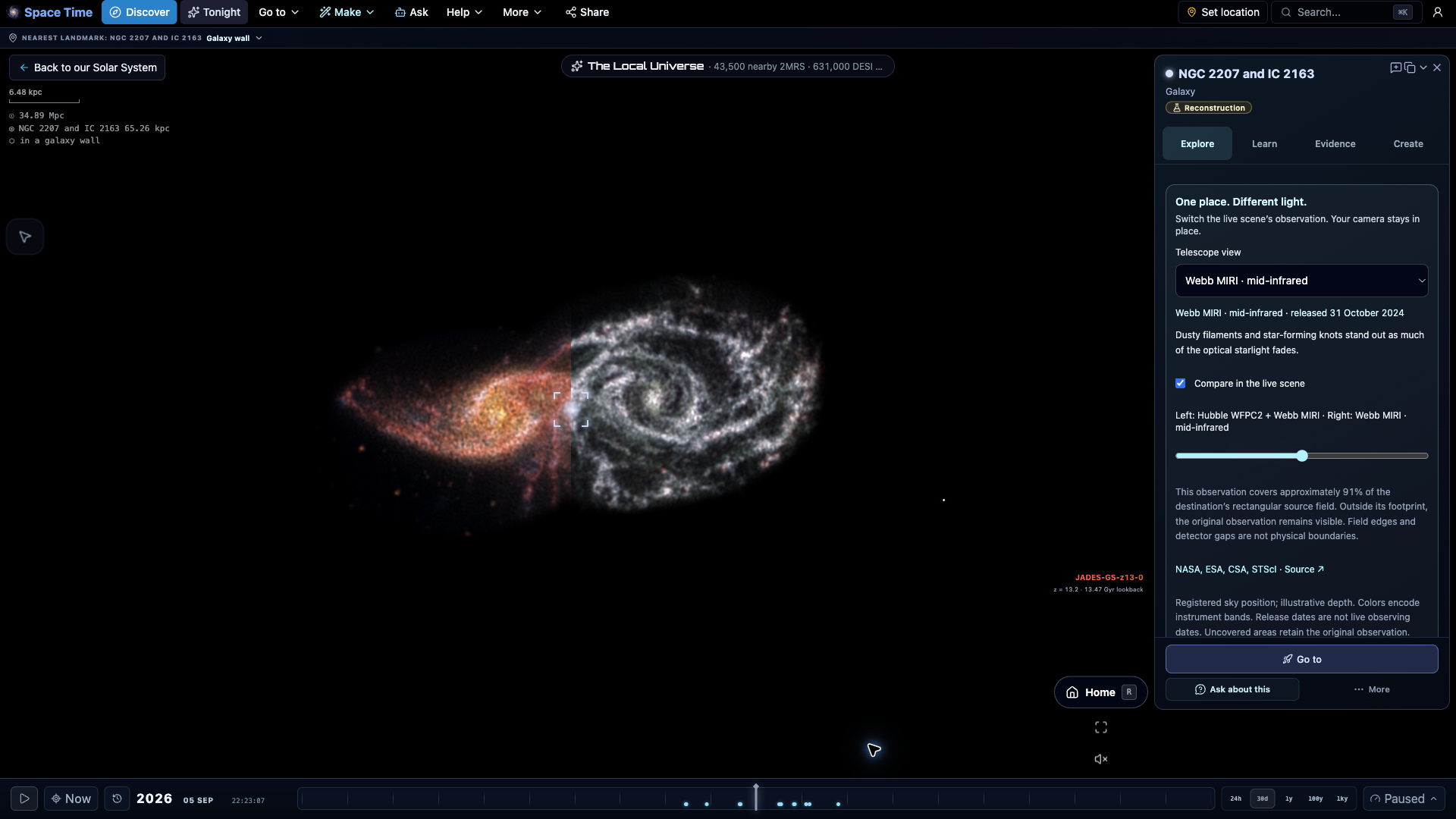
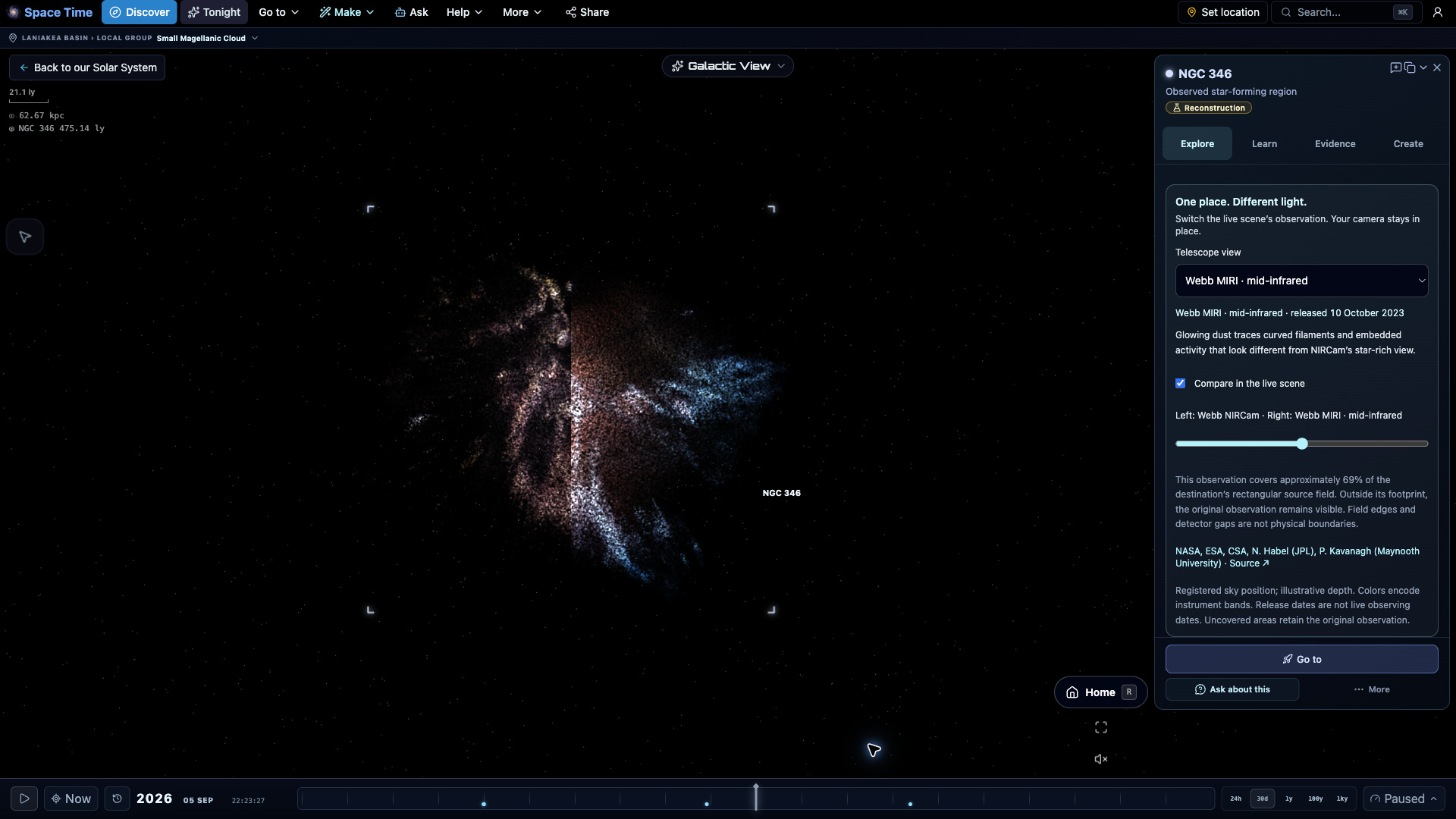
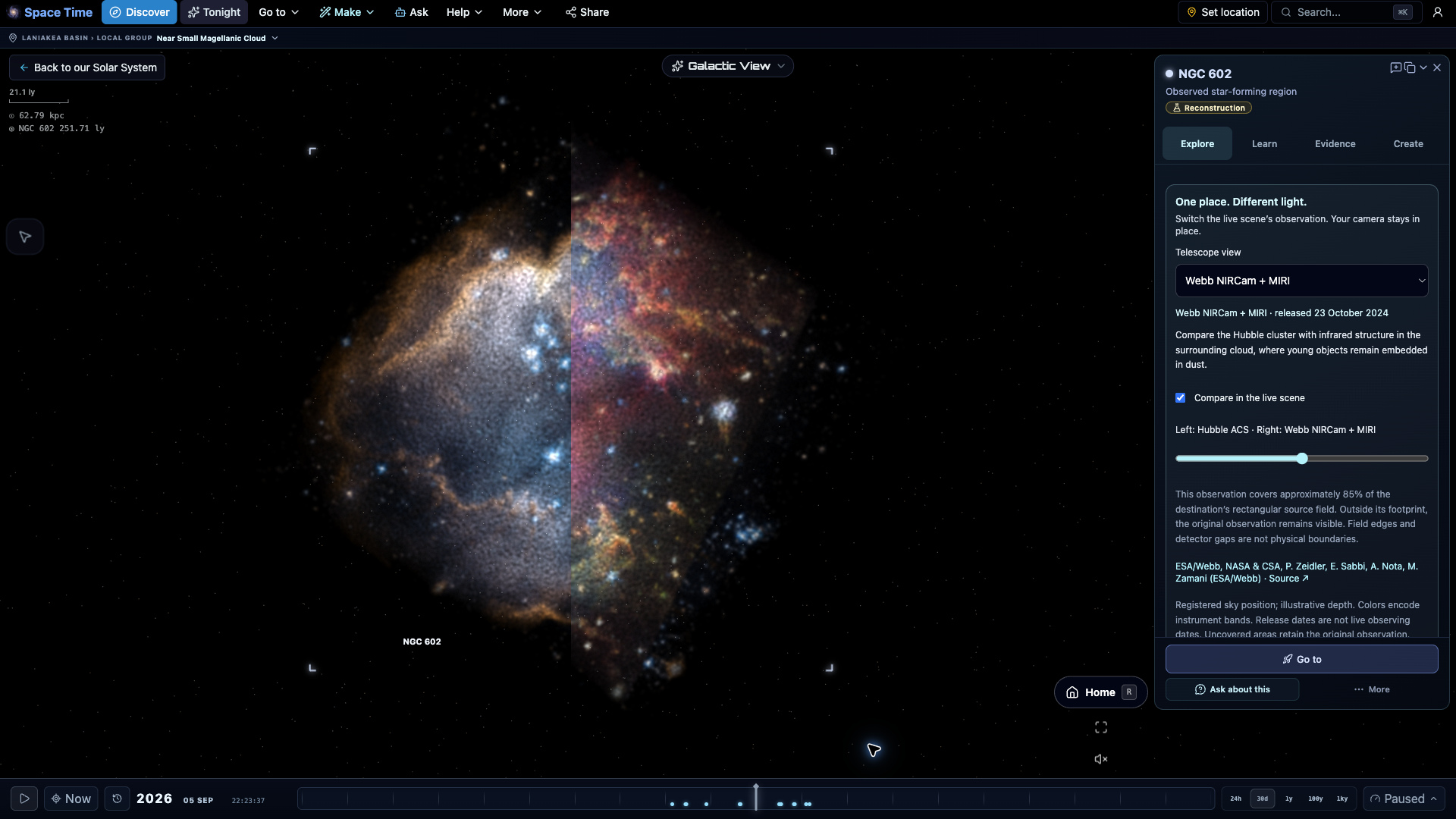
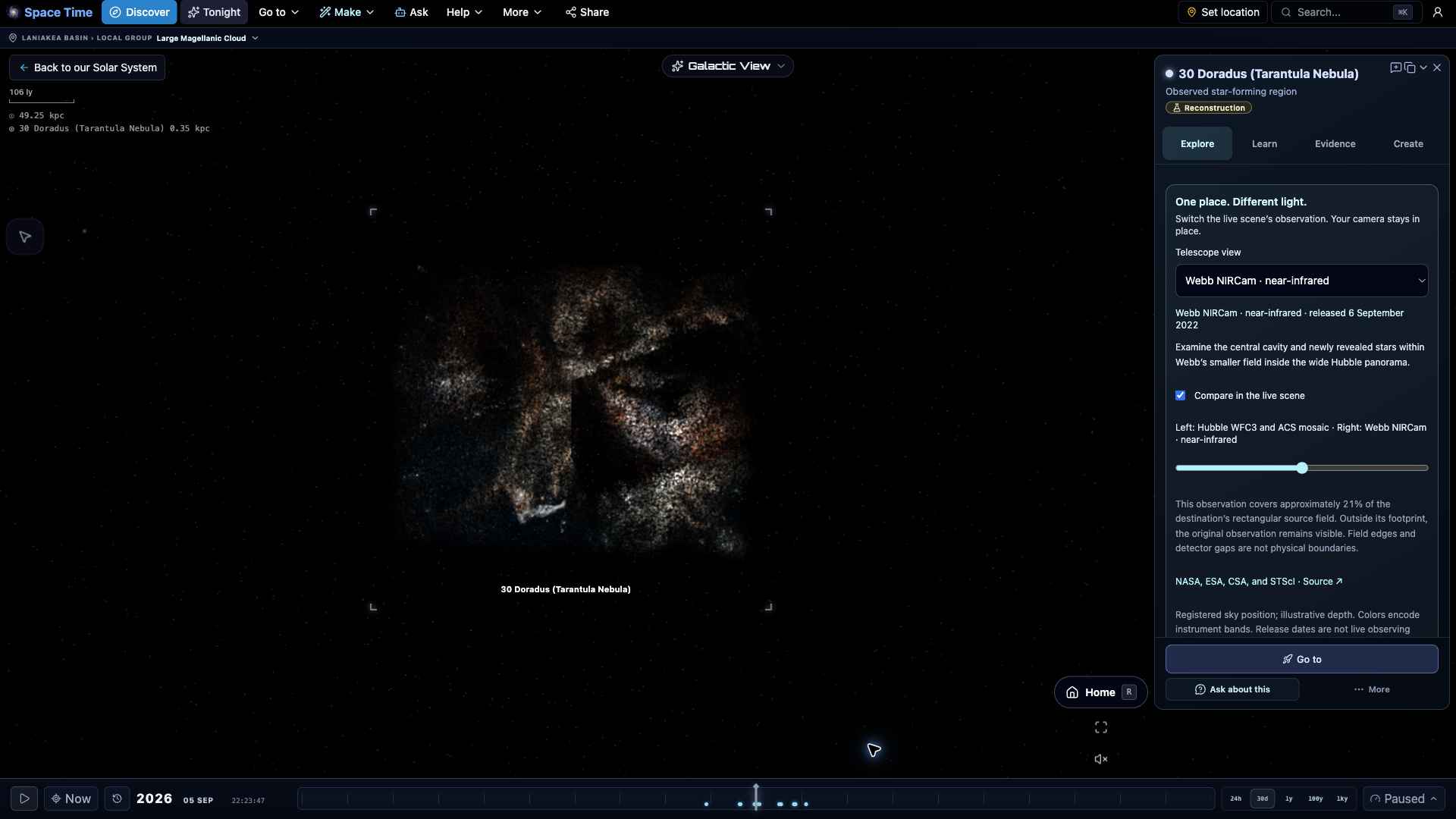
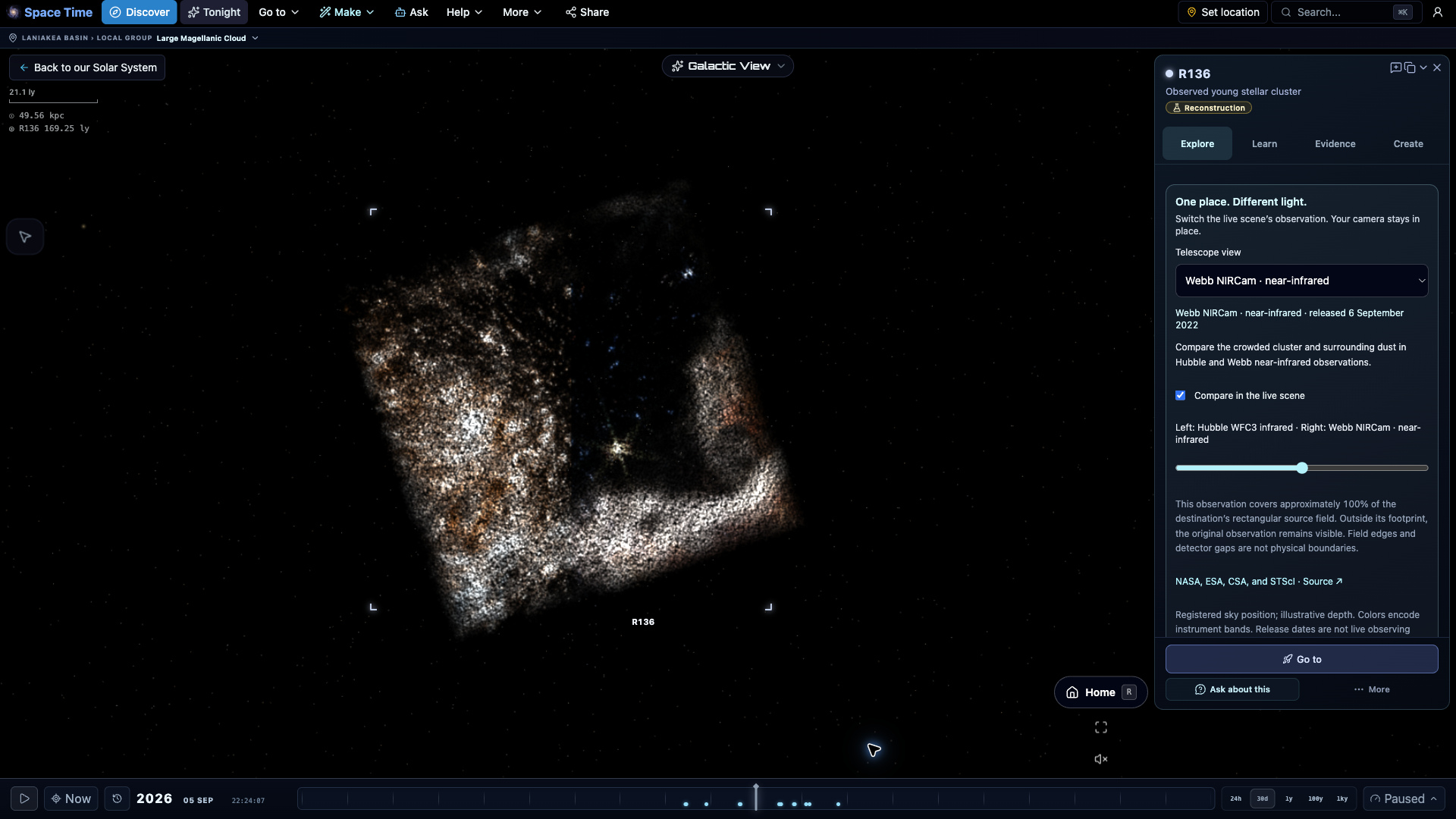
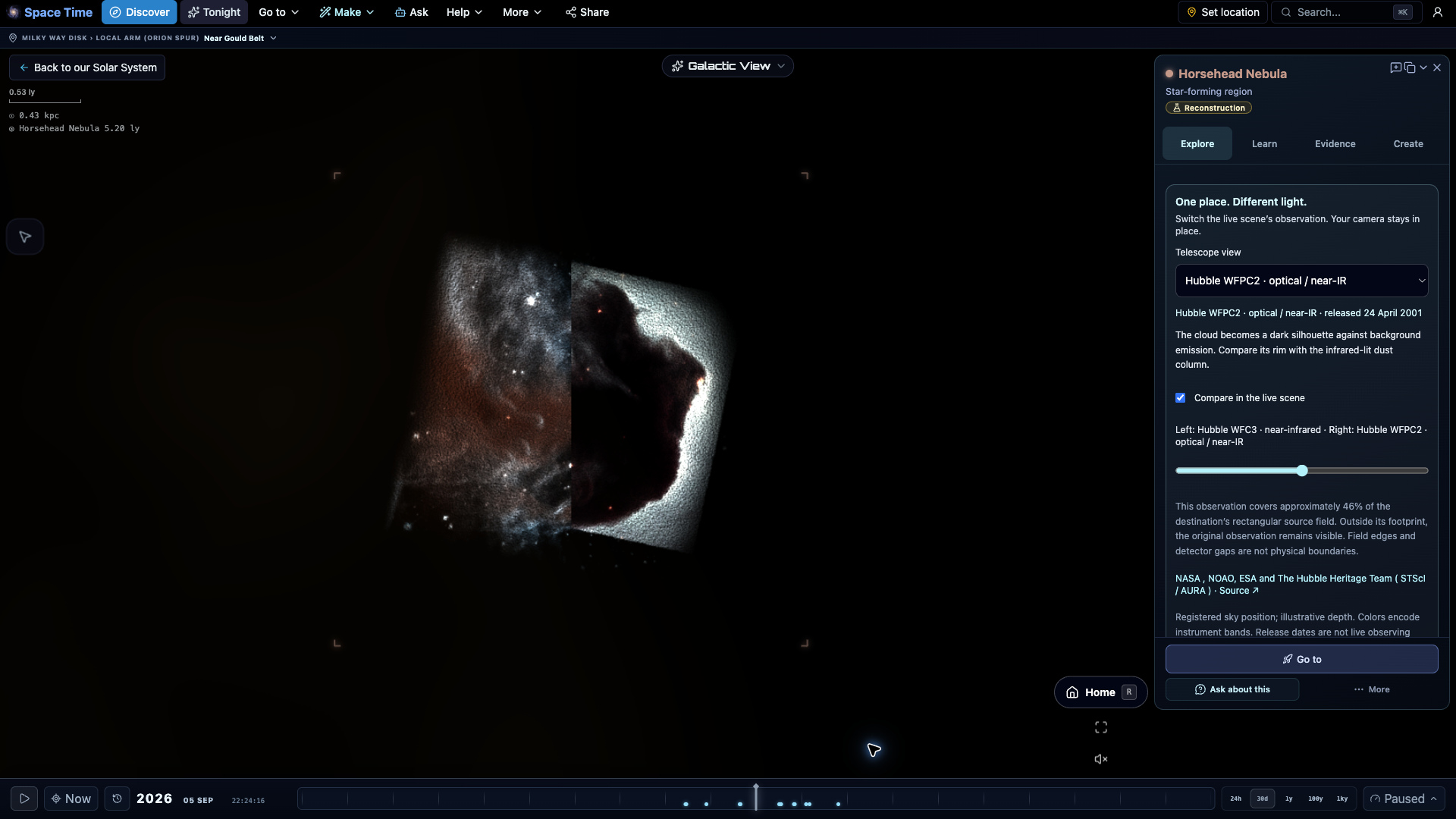
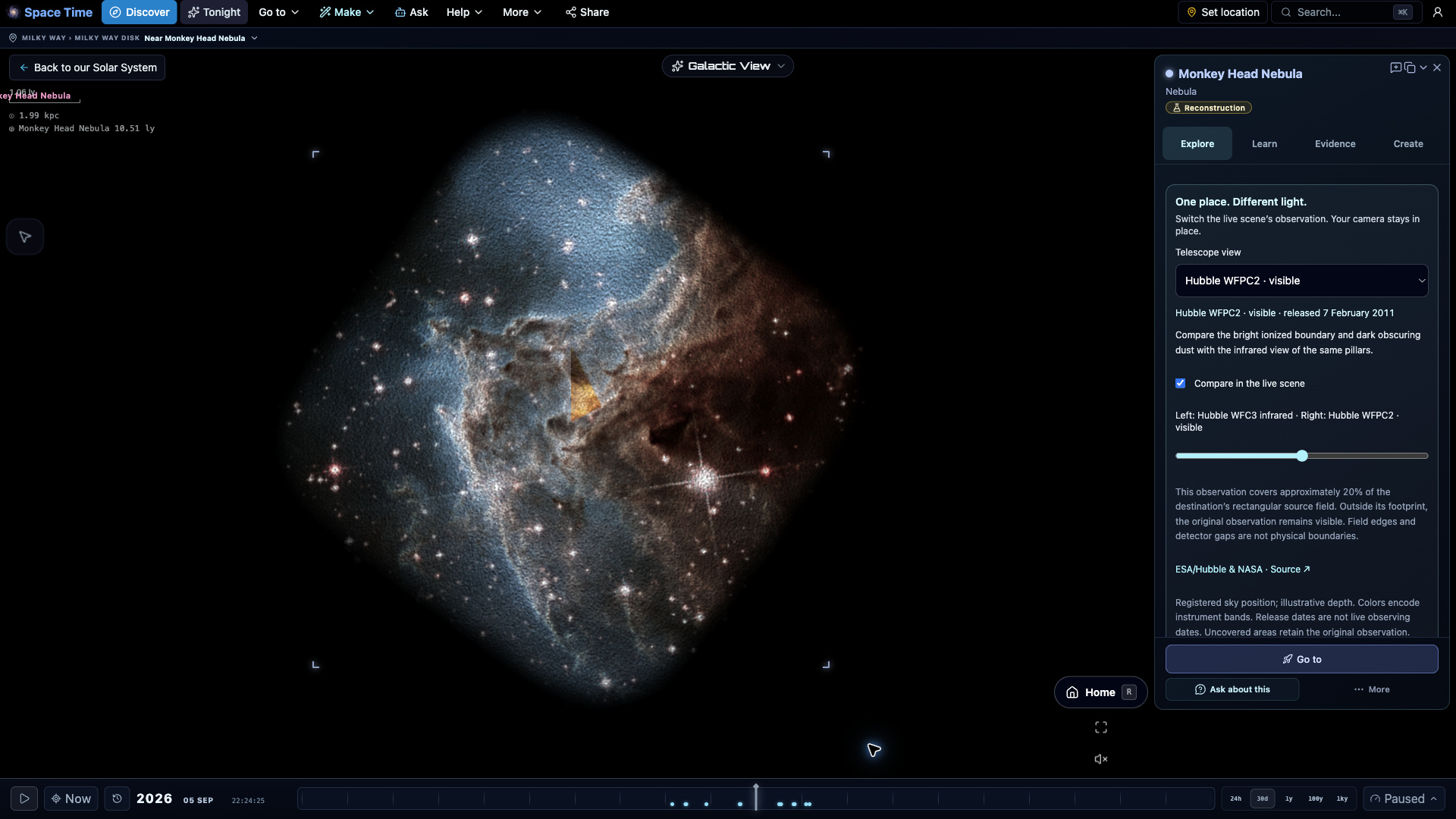
Destination atlas expansion
Galaxies and the nurseries within them
Explore six distinctive galaxies and two stellar nurseries within our neighboring galaxies, with the observations that reveal their structure.
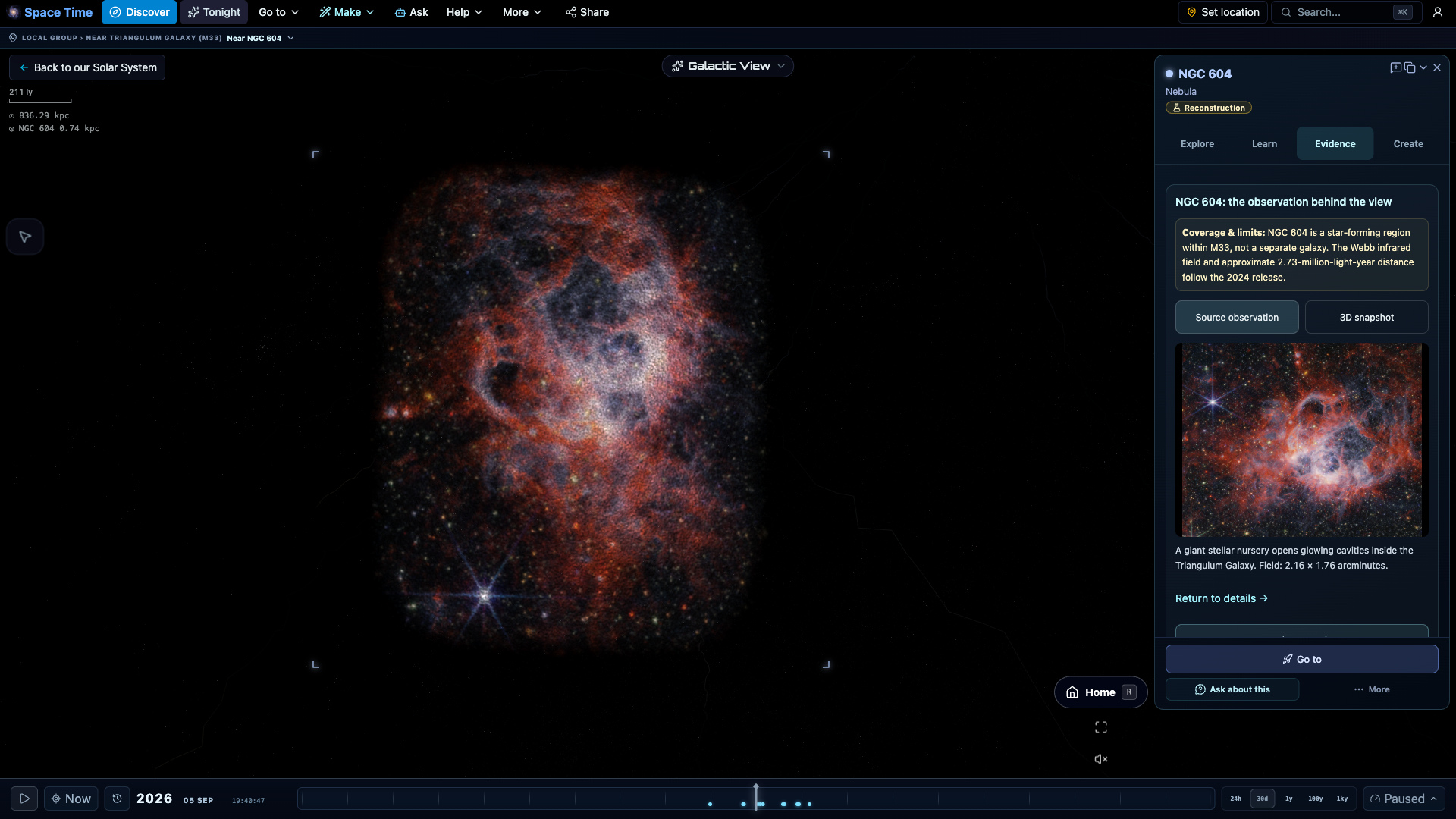
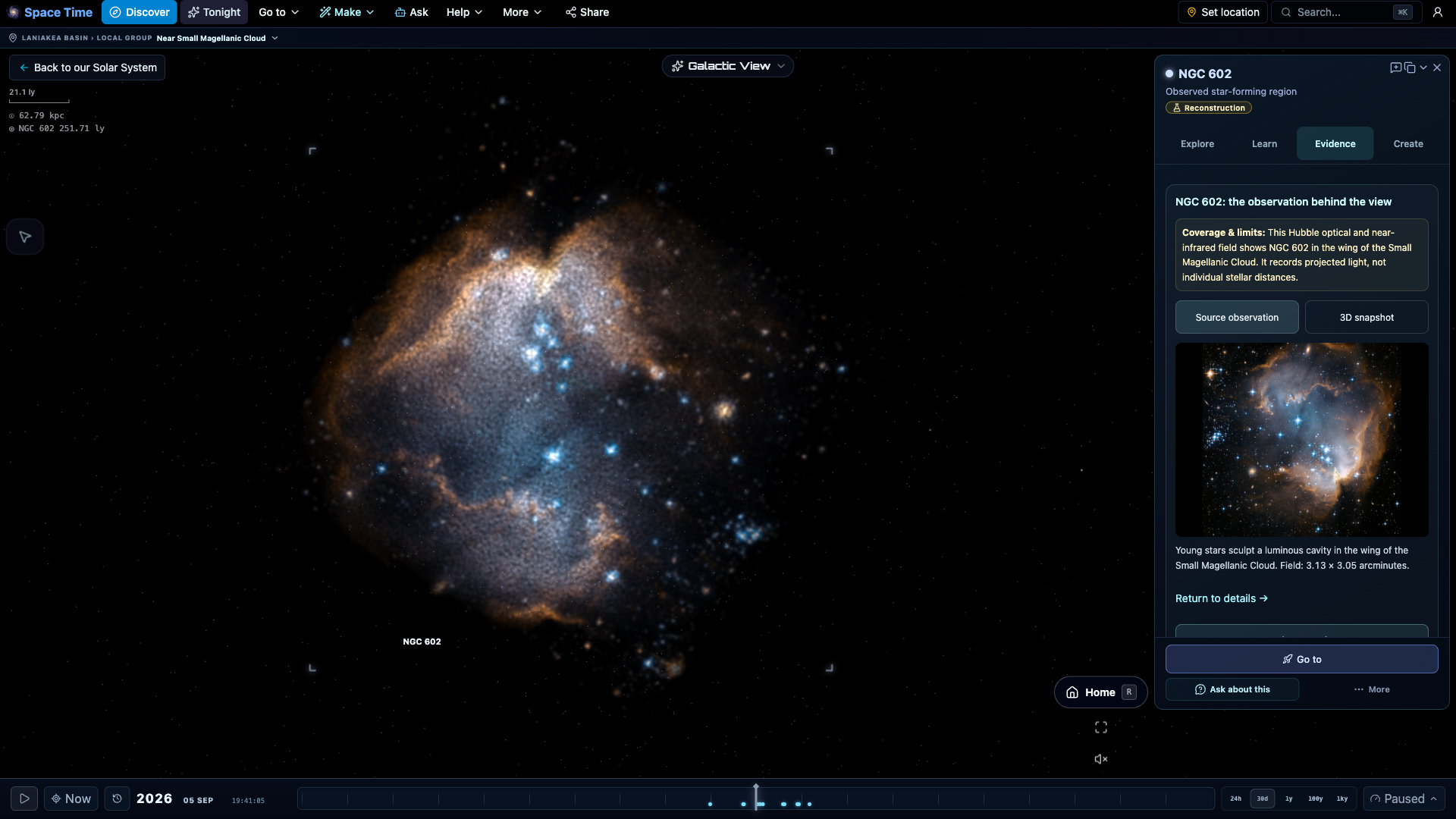
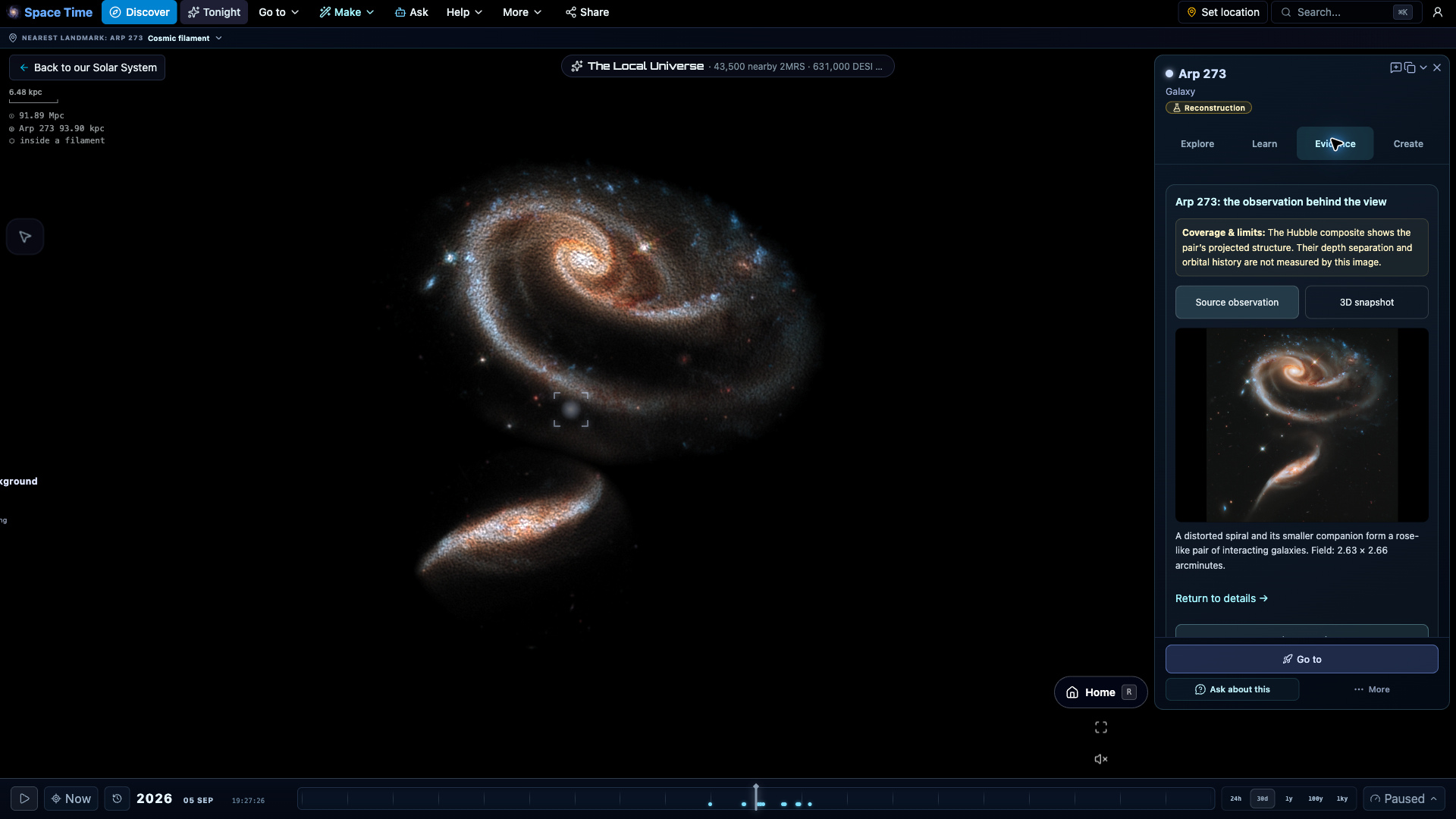
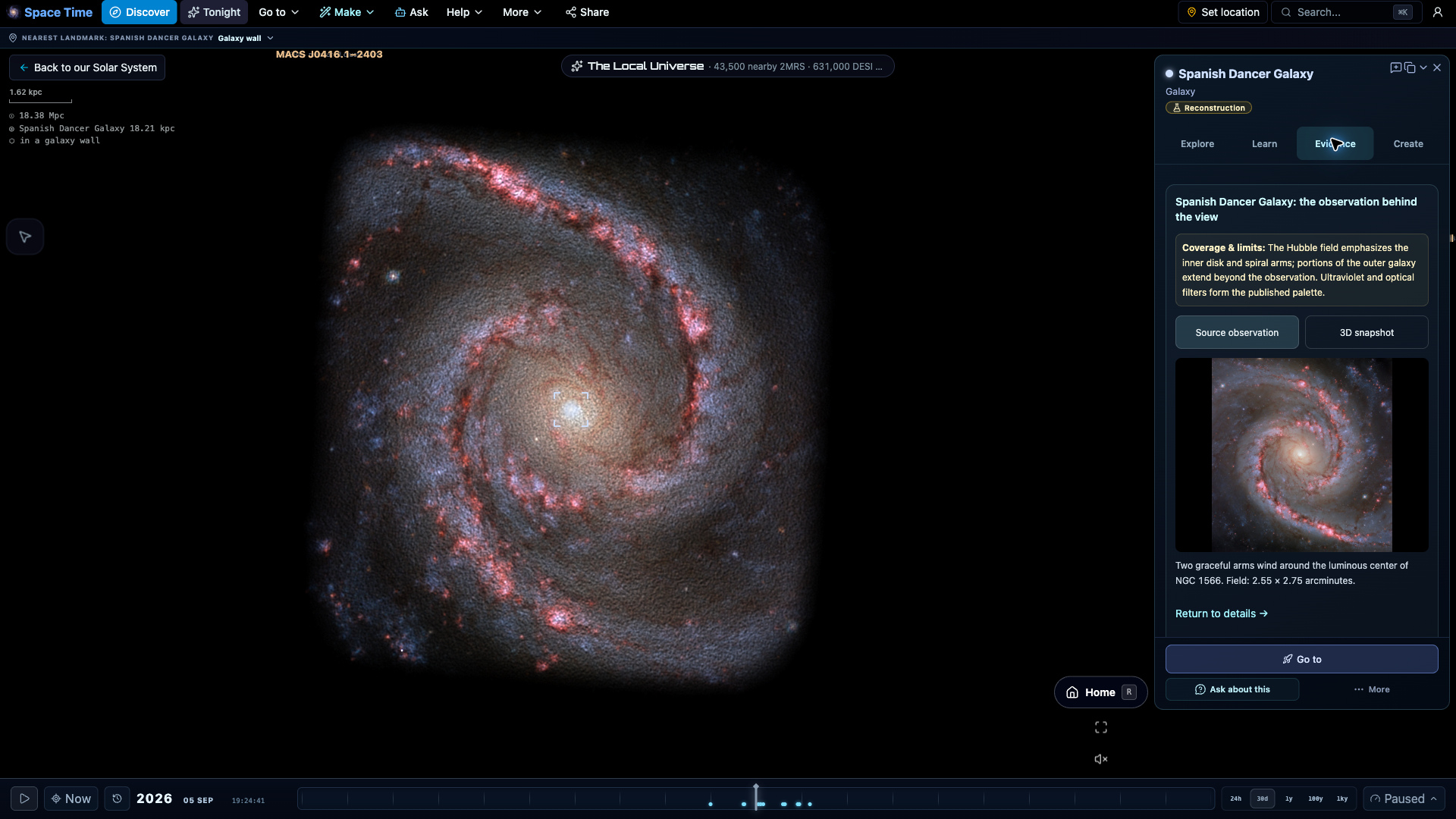
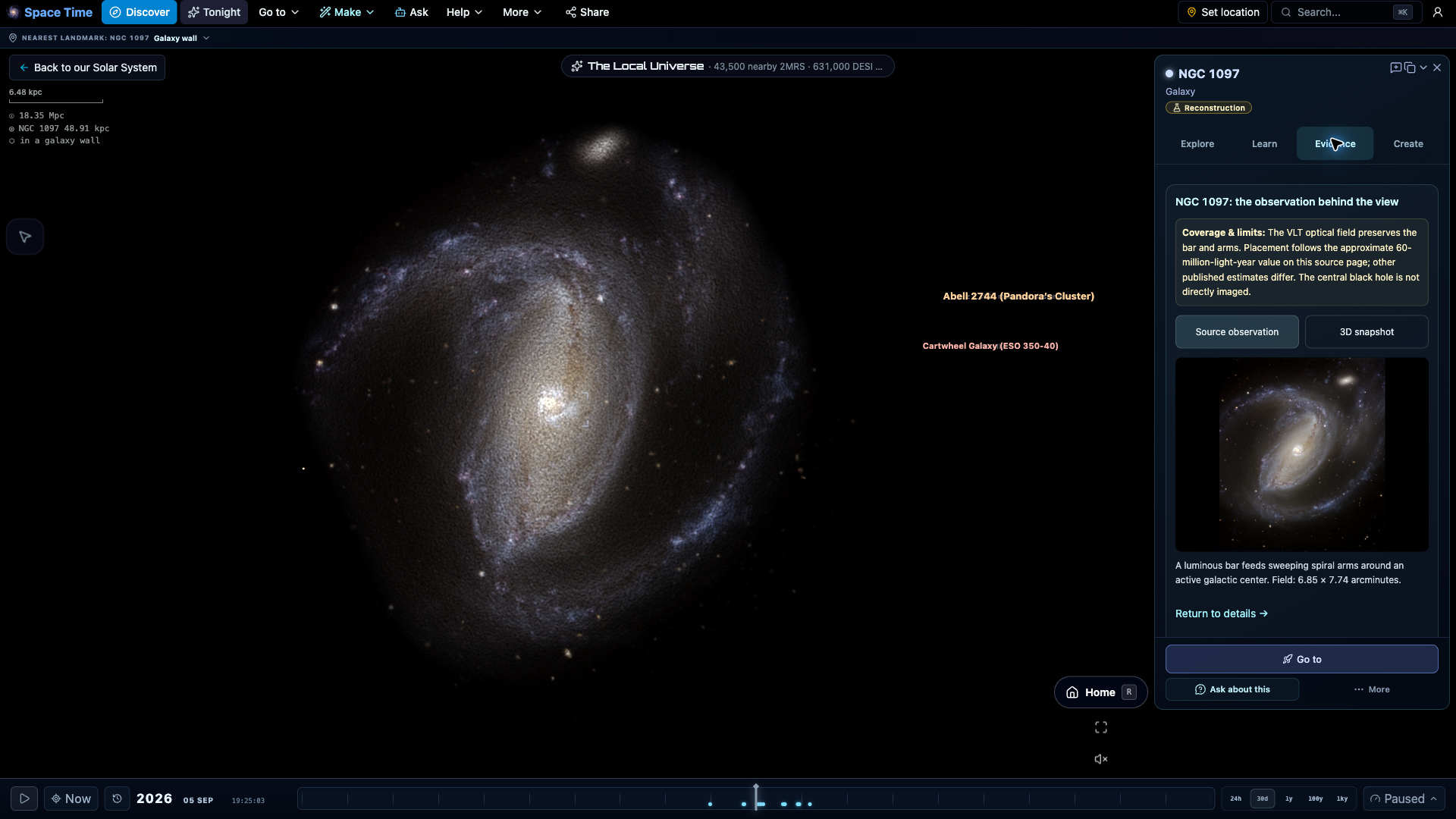
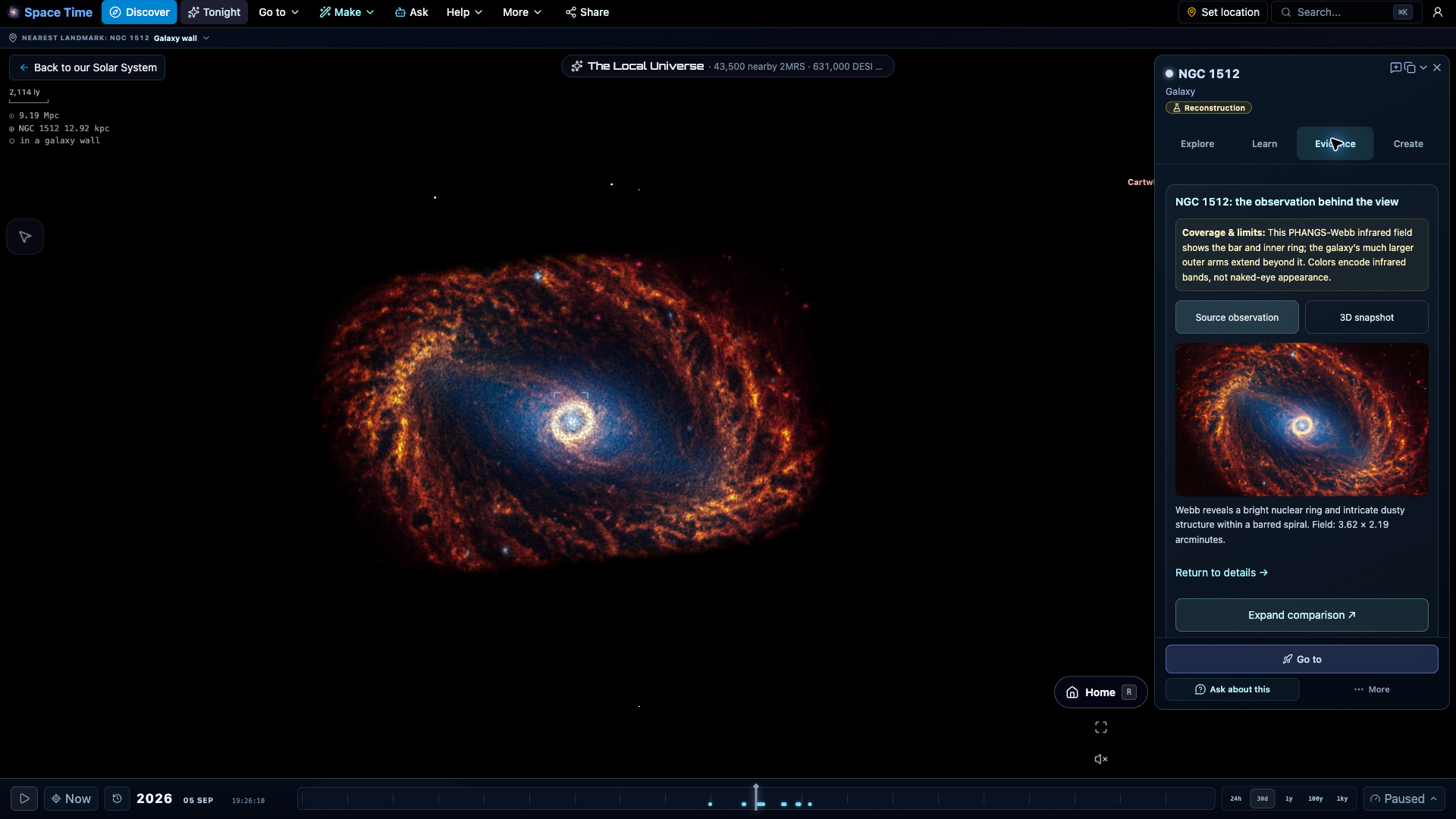
Explore all 8 destinations
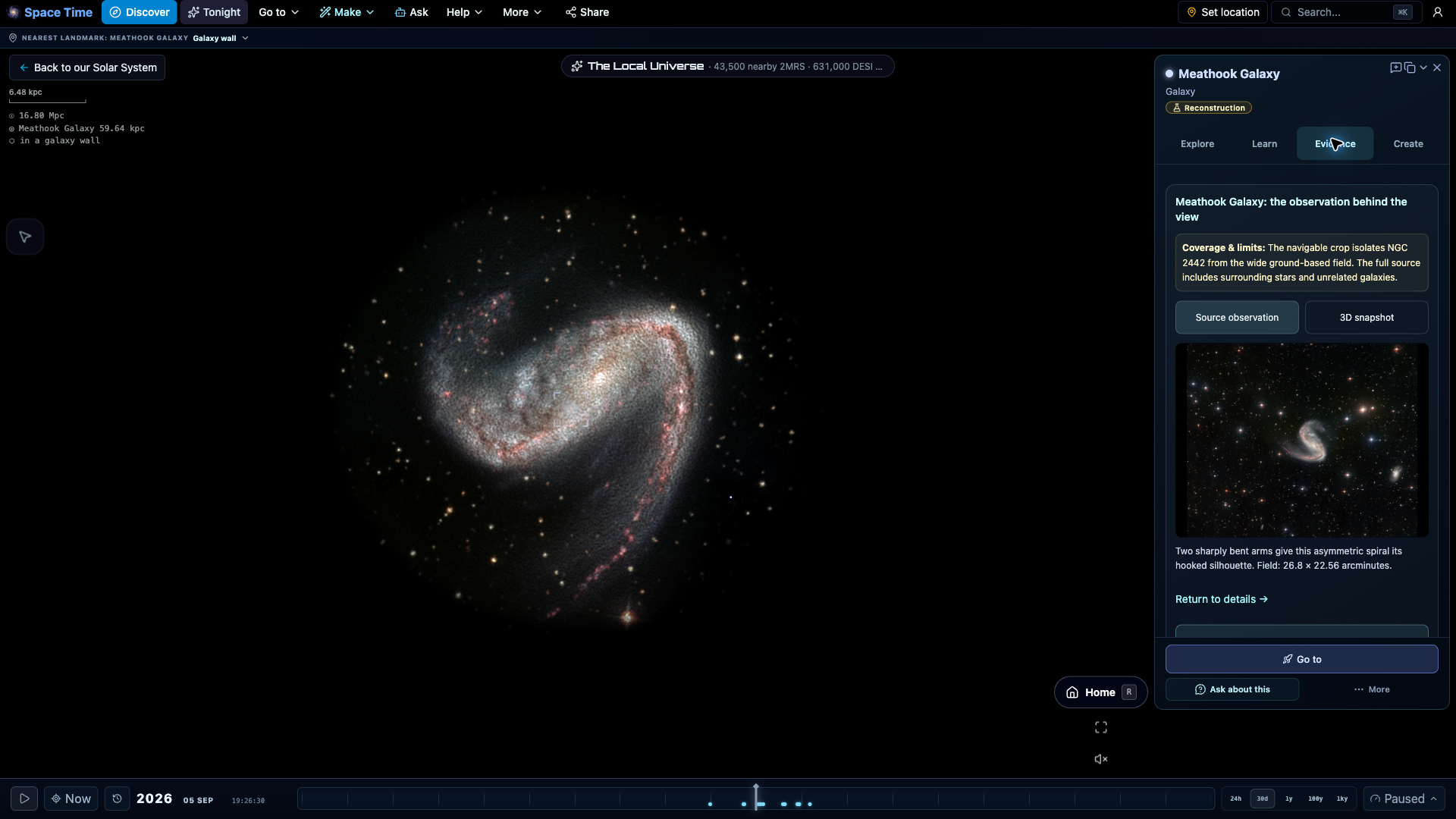
Visit the Cartwheel Galaxy
A ring galaxy, nested dust shells and two remarkable nebulae. Explore telescope-derived light fields, then inspect the source observations. The added depth is illustrative.
FAQ
Are the galaxies real or procedural?
The point fields use 43,530 measured nearby 2MRS galaxies and 630,968 sampled DESI DR1 galaxies and quasars. Directions and redshifts are measured; radial distances and lookback times use the stated Planck cosmology. Missing galaxies are not generated.
How far does the map reach?
Nearby 2MRS connects to sampled DESI DR1 sources at roughly redshift 0.1–3.5, then sparse early-universe destinations and the Planck 2018 microwave sky. Last scattering is shown at a cosmology-derived comoving radius, not a physical wall or the edge of the universe.
Can I click on individual galaxies?
Yes. Distance, lookback time and, where the survey knows it, the galaxy's type. Dot brightness follows real infrared luminosity.
What is the dark band across the field?
The Zone of Avoidance: our own Milky Way's dust hides the galaxies behind it. It is in the real data, so it is in the map.
Is it free?
Yes. In your browser, no account, no download.
Different surveys reveal different parts of the web
The 2MRS layer describes a nearby galaxy sample, while DESI DR1 adds a larger redshift survey with its own footprint and selection. The samples have different coverage, so their counts are not interchangeable. Redshift-derived distances depend on a cosmological model and can be affected by galaxies’ peculiar velocities; empty-looking regions can also reflect survey gaps.
Start with Andromeda’s observation-based destination to connect a recognizable galaxy to the larger structure. For a contrasting scale, visit Sagittarius A* at the center of the Milky Way. Read the layer evidence before interpreting a rendered void as a measured absence of galaxies.