 Space Time
Universe Zoom Out: From Earth to the Cosmic Web in 3D
Start at Earth and keep pulling back. The planets shrink to points, the Sun becomes one star among many, the Milky Way turns into a single galaxy, and then you are looking at real surveys of nearby galaxies. Space Time does this in your browser, using measured distances wherever they exist.
Start the zoom out → Free · No account · No download · 3D view requires WebGL 2.0Watch the journey first
This recording is one unbroken camera move from Earth to the Coma Cluster, a group of about a thousand galaxies. The light from those galaxies left them about 323 million years ago.
Two ways to zoom out
The narrated zoom out is hands-off. It stops at five scales, with a caption at each: Earth, the solar system, our stellar neighborhood, the Milky Way and the local universe. Between the larger scales the view fades briefly to black while the next scene loads, so treat it as a guided tour rather than one continuous shot. You can pause, skip or replay it, and save a postcard at the end.
Free zoom is continuous. Scroll the mouse wheel or pinch on a touch screen and the camera pulls straight back through every scale in one space. Stop anywhere and select whatever you find, whether it is a moon, a star or a galaxy.
- Open the zoom out. It begins with Earth and the caption “You are here.”
- Let it run, or press Skip to move to the next scale. Press Exit at any time to take over the camera.
- From the final view, scroll or pinch back in toward any galaxy cluster, then select it to read its distance and lookback time.
How far out each step goes
Each step multiplies the distance enormously. The right-hand column says where the numbers come from, so you can tell a measurement from a model.
| Scale | Typical distance | Where it comes from |
|---|---|---|
| Earth and the Sun | About 8 light-minutes | Calculated planetary positions from Astronomy Engine |
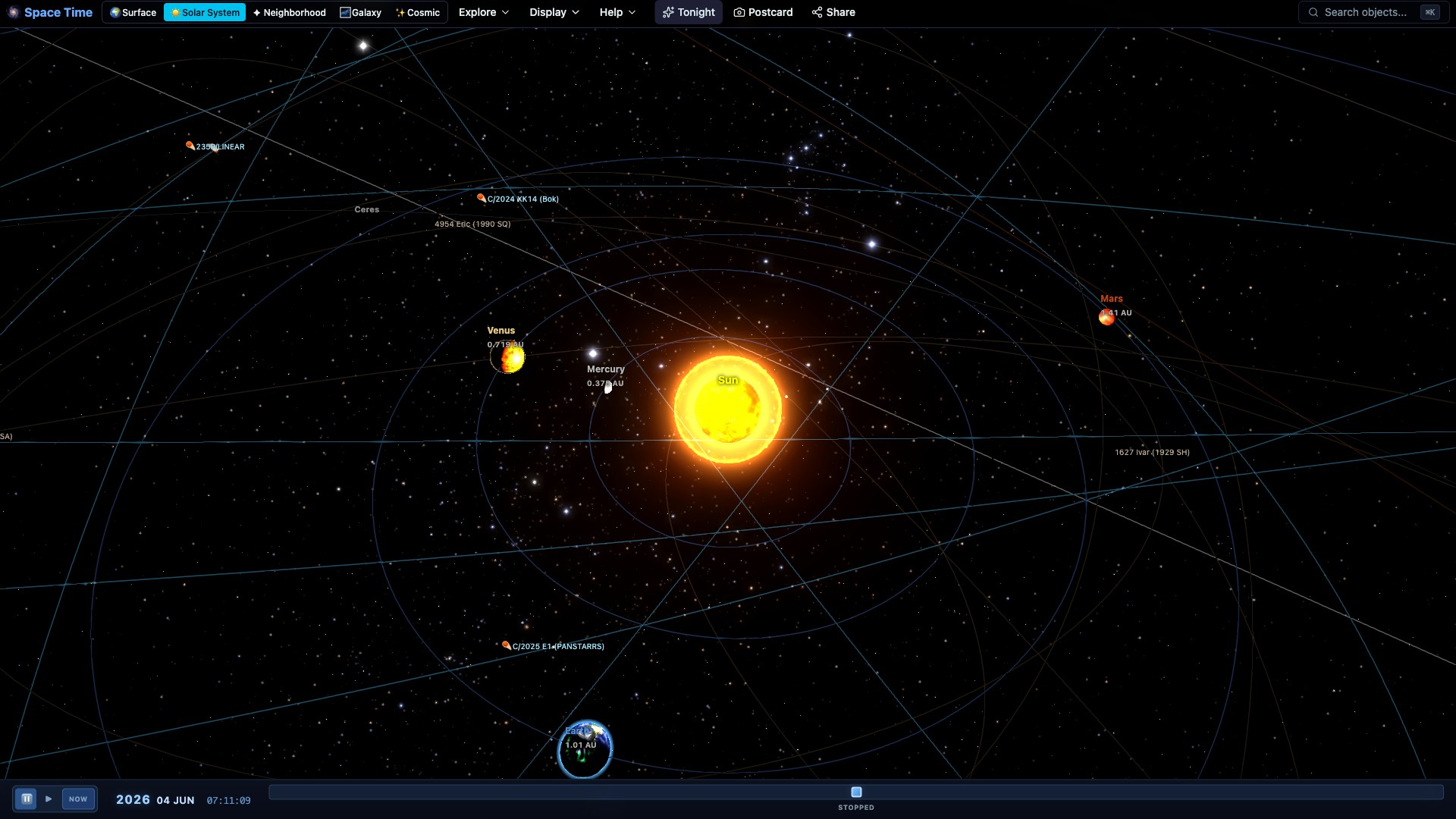
| The solar system | Neptune is about 4 light-hours from the Sun | Calculated orbits for any date |
| Nearest stars | Proxima Centauri is about 4.2 light-years away | Measured parallax from star catalogs, including Gaia |
| The Milky Way | About 100,000 light-years across | A model; no spacecraft has photographed our galaxy from outside |
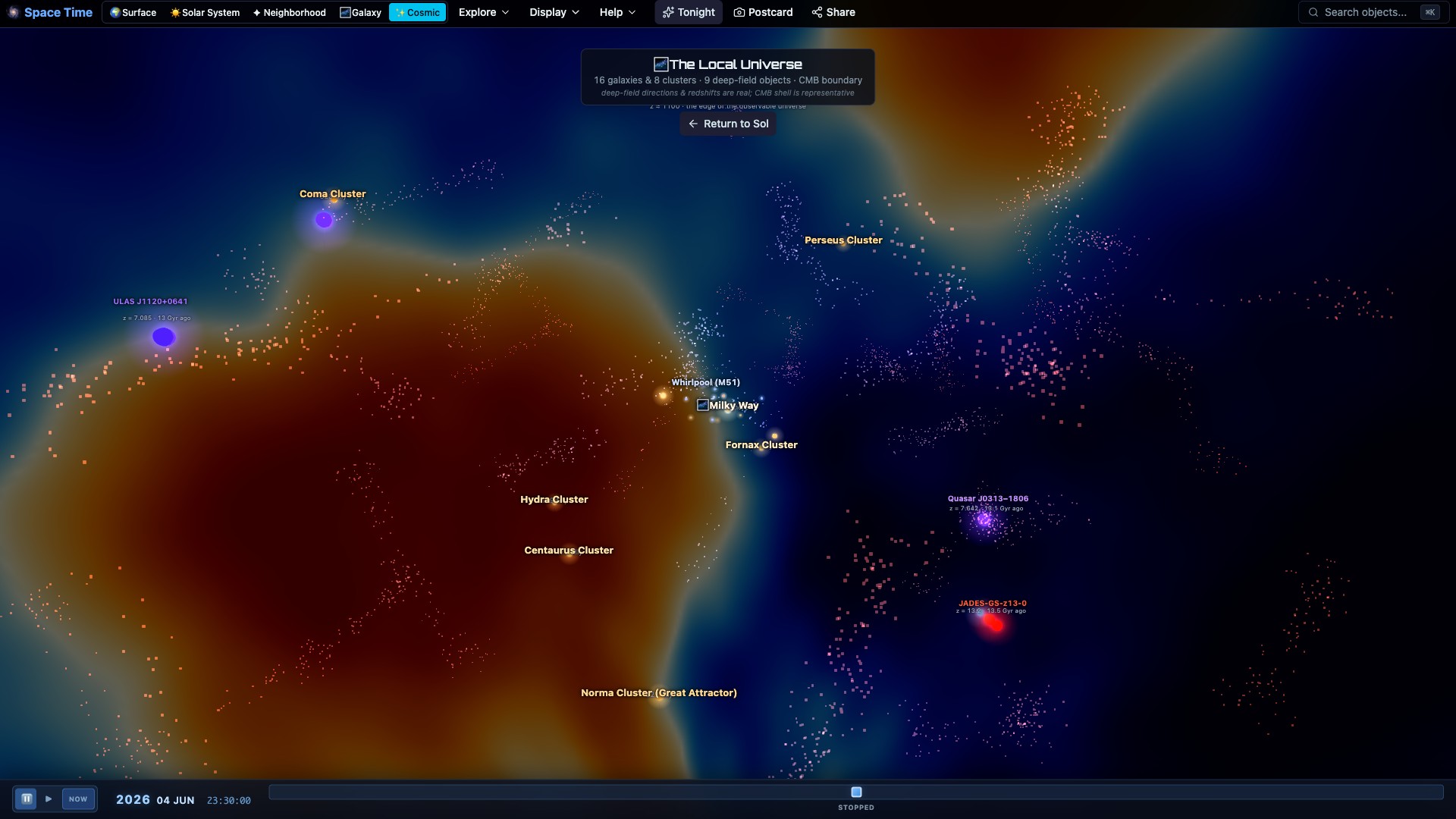
| Nearby galaxies | Hundreds of millions of light-years | 2MASS Redshift Survey positions and redshifts, converted to distance with a cosmology model |
| The oldest light | Emitted about 13.8 billion years ago | Planck 2018 map of the cosmic microwave background, shown as the distant sky |
What is real and what is a model
Planet and star positions are calculated or measured. The Milky Way’s overall shape is reconstructed, because we see it only from inside. Galaxy positions come from measured sky directions and redshifts, and a standard cosmology model turns redshift into distance. The dark band across the galaxy map is the Zone of Avoidance, where dust in our own galaxy hides the galaxies behind it. Gaps like that are part of the evidence, not empty space.
To go deeper into the galaxy data, read the guide to the cosmic web and its surveys. For the planets and moons, see the 3D solar system simulator.
Questions
Is there a free website where I can zoom out of the universe?
Yes. Space Time runs in your browser with no account and no download. Start the narrated zoom out or use your mouse wheel or a pinch to pull back from Earth through the solar system, nearby stars and the Milky Way to surveys of real galaxies.
Is the zoom out to scale?
Distances use real values in one continuous space, from the planets out to galaxies hundreds of millions of light-years away. Labels, glows and markers are added so you can find things; they are not part of the model.
Does it reach the edge of the observable universe?
The farthest light shown is the cosmic microwave background, from the Planck 2018 map. It is drawn as the distant sky behind everything. It is the oldest light we can observe, not a wall or an edge you can travel to.
Does it work on a phone?
Yes, on phones and tablets with a browser that supports WebGL 2.0. Pinch to zoom and drag to look around. If the 3D view cannot load, this page and its sources remain readable.
Sources
- Astronomy Engine: planetary position methods and accuracy
- ESA Gaia: measuring the positions and distances of stars
- Huchra et al. 2012: the 2MASS Redshift Survey
- ESA Planck: the cosmic microwave background
- Space Time’s object evidence, methods and source dates
Guide by Point Dynamics. Reviewed October 20, 2026. Screenshots and recordings show the app’s models; they are not current observations.