Geminids 2026: December 13–14 Viewing Guide
The American Meteor Society lists the night of December 13–14 for the 2026 Geminids. A waxing crescent Moon gives this shower a more favorable moonlight outlook than the October Orionids. Your best observing window still depends on latitude, local darkness, weather and how high Gemini climbs.
Plan the Geminids in the sky chart →Free in your browser · No account required · 3D view uses WebGL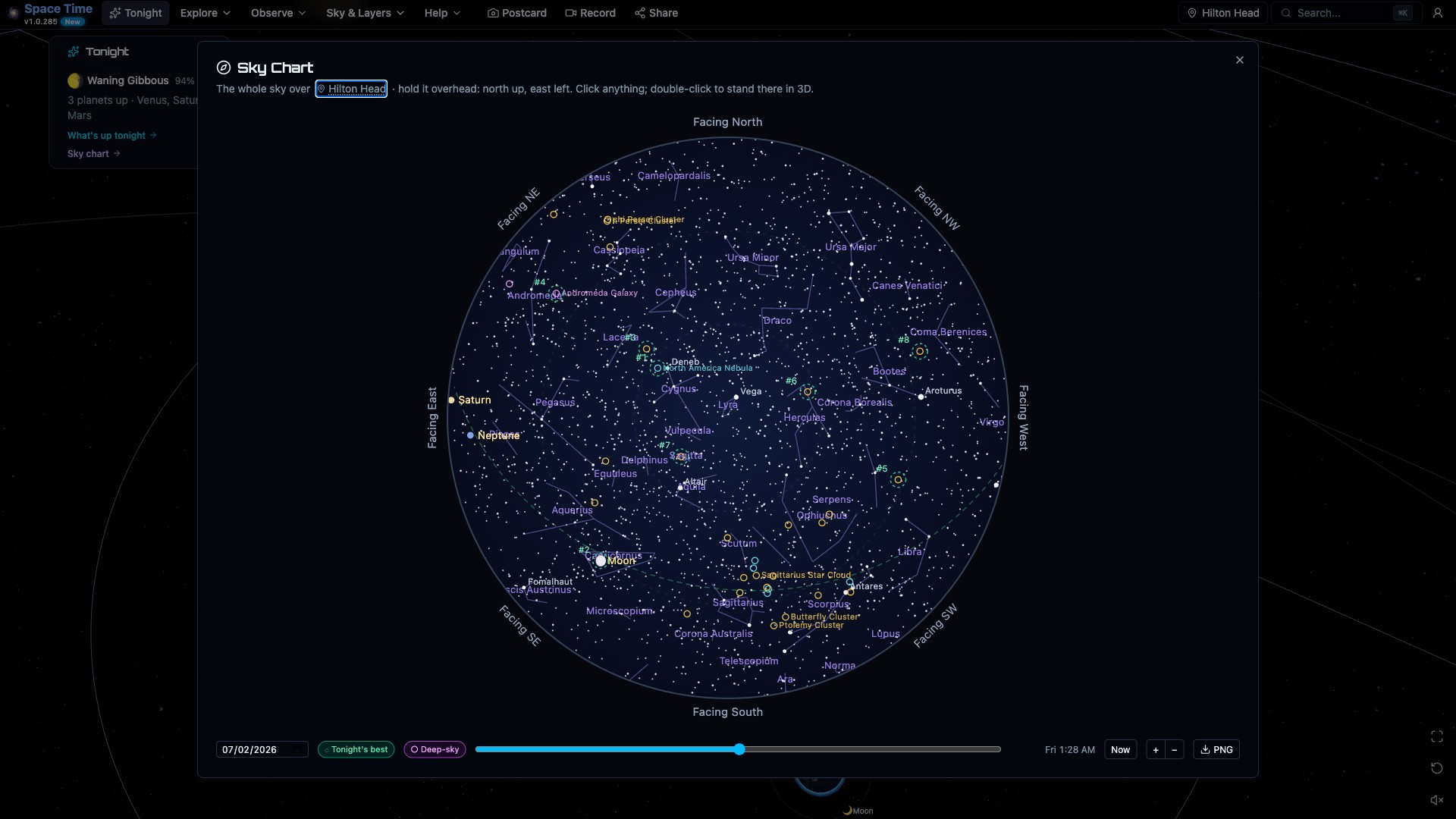
Try it in the app
- Open the chart and set your location. The starting time is December 14, 00:00 UTC; adjust it to the evening of December 13 or morning of December 14 where you are.
- Find Gemini and compare its altitude over the night. Check the Moon and the beginning of morning twilight before choosing a window.
- Plan a comfortable broad-sky view and a backup night. Record the actual observing conditions alongside any count so you can distinguish the shower from the limits of your site.
On a phone, drag to change the view and pinch to zoom. If the 3D view cannot load on your device, the guide and its source links remain available here.
Peak night and neighboring dates
Start with December 13 into December 14, 2026. AMS lists this season’s activity from December 4 to 17. The strongest part of a shower is not equally visible from every longitude, and a clear neighboring night can be more useful than a cloudy nominal peak. Recheck the source calendar as the event approaches.
Northern and southern views differ
Gemini rises higher from many northern locations, giving a longer useful observing window. Southern observers can still see Geminids, but a lower radiant generally reduces the number crossing the visible sky. Use the chart for your latitude; a universal “best time” would conceal that difference.
A favorable Moon is only one ingredient
The 2026 peak falls with a waxing crescent Moon. Check local moonset rather than reading the phase as an all-night guarantee. Dark surroundings, transparency and an unobstructed horizon remain important. Published idealized shower rates are not a forecast of what one person will count from a city.
An unusual parent body
The Geminids are associated with 3200 Phaethon, an object classified as an asteroid, rather than a familiar active comet. Small pieces entering Earth’s atmosphere make the light trails. The apparent radiant lies in Gemini, but the particles do not come from its distant stars.
Sources and evidence
Guide by Point Dynamics. Reviewed 2026-09-23. Saved scene images illustrate the experience; they are not current observations.