Orionids 2026: Peak Night, Moonlight and a Local Sky Plan
The American Meteor Society lists October 21–22 as the Orionids’ 2026 peak night. A waxing gibbous Moon can hide faint meteors while it is above your horizon. Use that date as a planning window, then check moonset, darkness and the height of Orion for your own location.
Plan the Orionids in the sky chart →Free in your browser · No account required · 3D view uses WebGL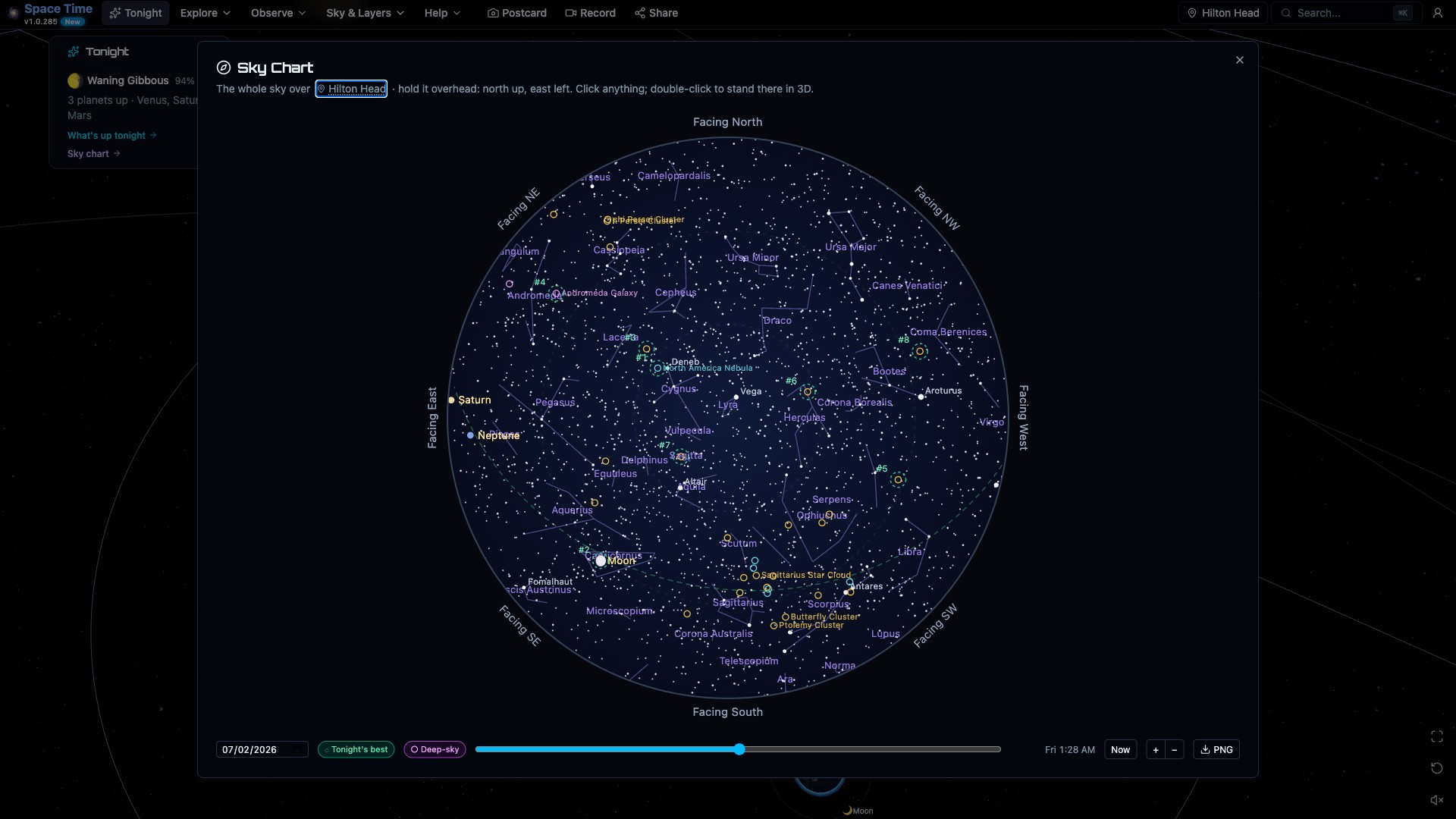
Try it in the app
- Open the chart and set your observing location. The link starts at October 22, 00:00 UTC, a reference time rather than a predicted peak instant.
- Move the clock through your local night. Compare Orion’s height, the Sun below the horizon and the Moon’s position; a calendar date alone cannot choose your best hour.
- Choose a broad, dark view of the sky. Use the chart before observing, then dim or put away the screen while your eyes adapt.
On a phone, drag to change the view and pinch to zoom. If the 3D view cannot load on your device, the guide and its source links remain available here.
Which night should I choose?
Begin with the night of October 21 into October 22, and consider neighboring nights if weather intervenes. AMS lists activity from October 2 to November 7. A shower has an extended activity profile, so the date is not an appointment at which every meteor arrives. Local time zones and the changing radiant altitude matter.
What the Moon changes in 2026
The waxing gibbous Moon is the main seasonal complication. Its light raises the sky background and makes faint trails harder to see. A useful local window needs both a sufficiently high radiant and a dark sky; check the Moon’s actual setting time instead of assuming the whole night is equally favorable.
Why the meteors seem to come from Orion
The Orionids are associated with debris from comet 1P/Halley. Their roughly parallel paths through our atmosphere appear to diverge from a point called the radiant, near Orion. They are not arriving from Orion’s stars, which lie far beyond the solar system. The constellation-depth guide helps separate those two scales.
What you can realistically see
You do not need a telescope: it would restrict your field of view. Give your eyes time in darkness and watch a broad area rather than staring at the radiant. Cloud, haze, artificial light, obstructions and moonlight can greatly reduce the count. The app models sky geometry; it cannot predict each meteor or guarantee a rate at your site.
Sources and evidence
Guide by Point Dynamics. Reviewed 2026-09-23. Saved scene images illustrate the experience; they are not current observations.