 Space Time
Watch any eclipse
Choose a date and location to watch a solar or lunar eclipse from the ground or from space. The simulator shows totality, the solar corona, and Earth's shadow crossing the Moon.
🚀 Open the eclipse simulator Free · Any date, past or future · Any location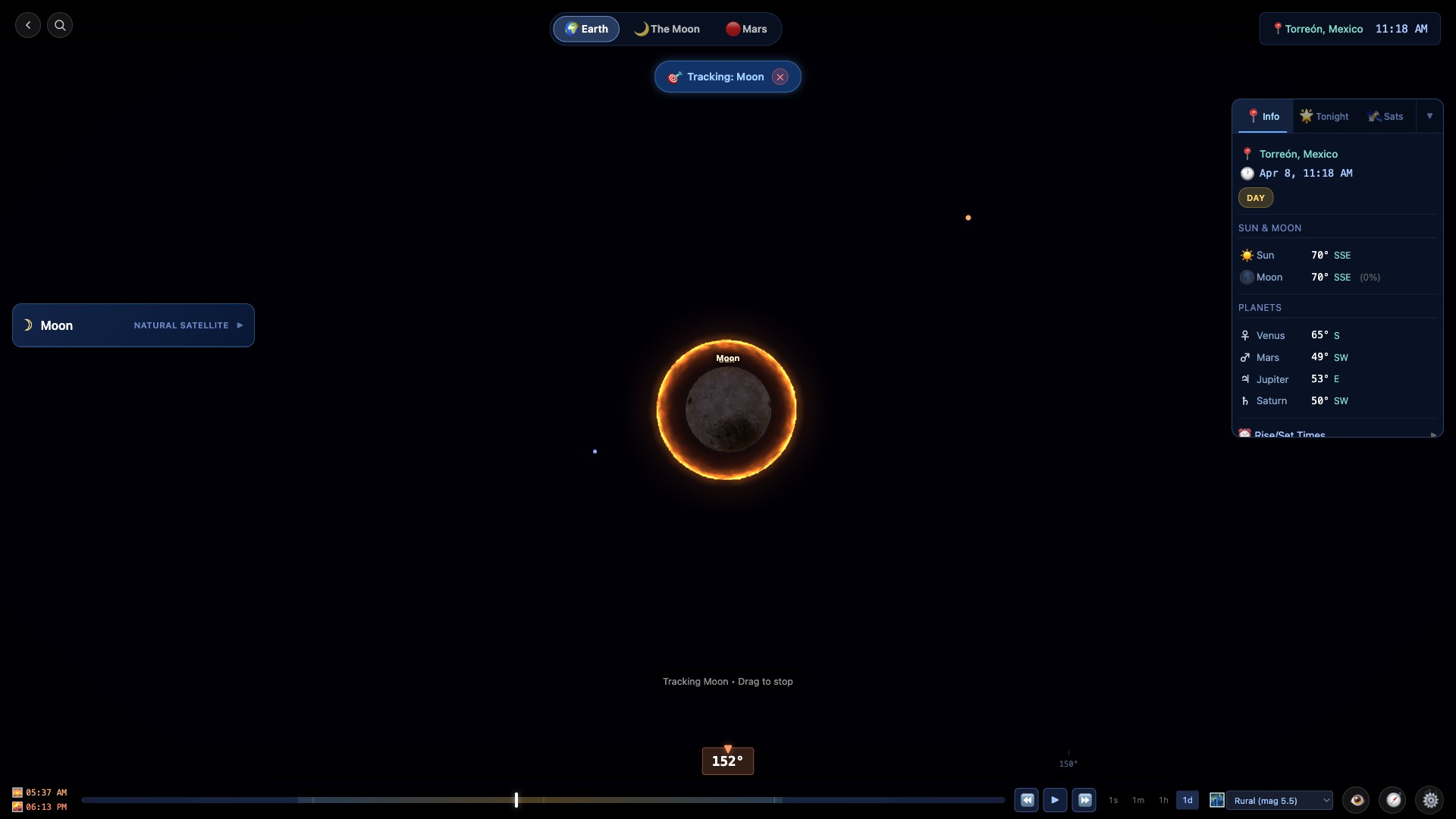
Total solar eclipses, corona and all
Set a location on Earth and move the clock through an eclipse. The relative sizes of the Sun and Moon determine whether the view is partial, annular, or total. Switch to space to follow the Moon's shadow across Earth.
Lunar eclipses & the blood moon
For a lunar eclipse, the model shows Earth's umbra moving across the Moon and the red color seen during totality. Timing is calculated for the location you choose.

Finding the next eclipse
Eclipses are calculated from ephemeris data. Jump to the next solar or lunar eclipse visible from your location, or choose a past event.
Upcoming eclipse guides
- Annular Solar Eclipse of February 6, 2027 — coastal Argentina & the Gulf of Guinea coast of West Africa. View the observing guide and local circumstances.
- Total Solar Eclipse of August 2, 2027 — southern Spain, North Africa & the Middle East. View the observing guide and local circumstances.
Past eclipses to replay
- Deep Partial Lunar Eclipse of August 28, 2026 — the Americas, Europe, Africa & the eastern Pacific. Historical guide and 3D replay.
- Total Solar Eclipse of August 12, 2026 — Iceland & northern Spain. Historical guide and 3D replay.
FAQ
Can I simulate a solar eclipse?
Yes, for any date and location. The sky darkens at totality and the corona appears, viewed from space or the ground.
When is the next solar or lunar eclipse?
Step forward to the next eclipse from your location, or jump to any eclipse past or future and watch it unfold.
Can I see the blood moon?
Yes. Lunar eclipses render Earth's umbra across the Moon, turning it blood-red with accurate timing.
Is it free?
Yes. In your browser, no account, no download.