 Space Time
A free SkySafari alternative in your browser
SkySafari is a mature observing app with strong telescope support. Space Time is a free browser-based planetarium with observing tools and a larger 3D scene. This page compares where each one fits.
🚀 Try it now, nothing to install Free · No account · No subscription · Any modern browser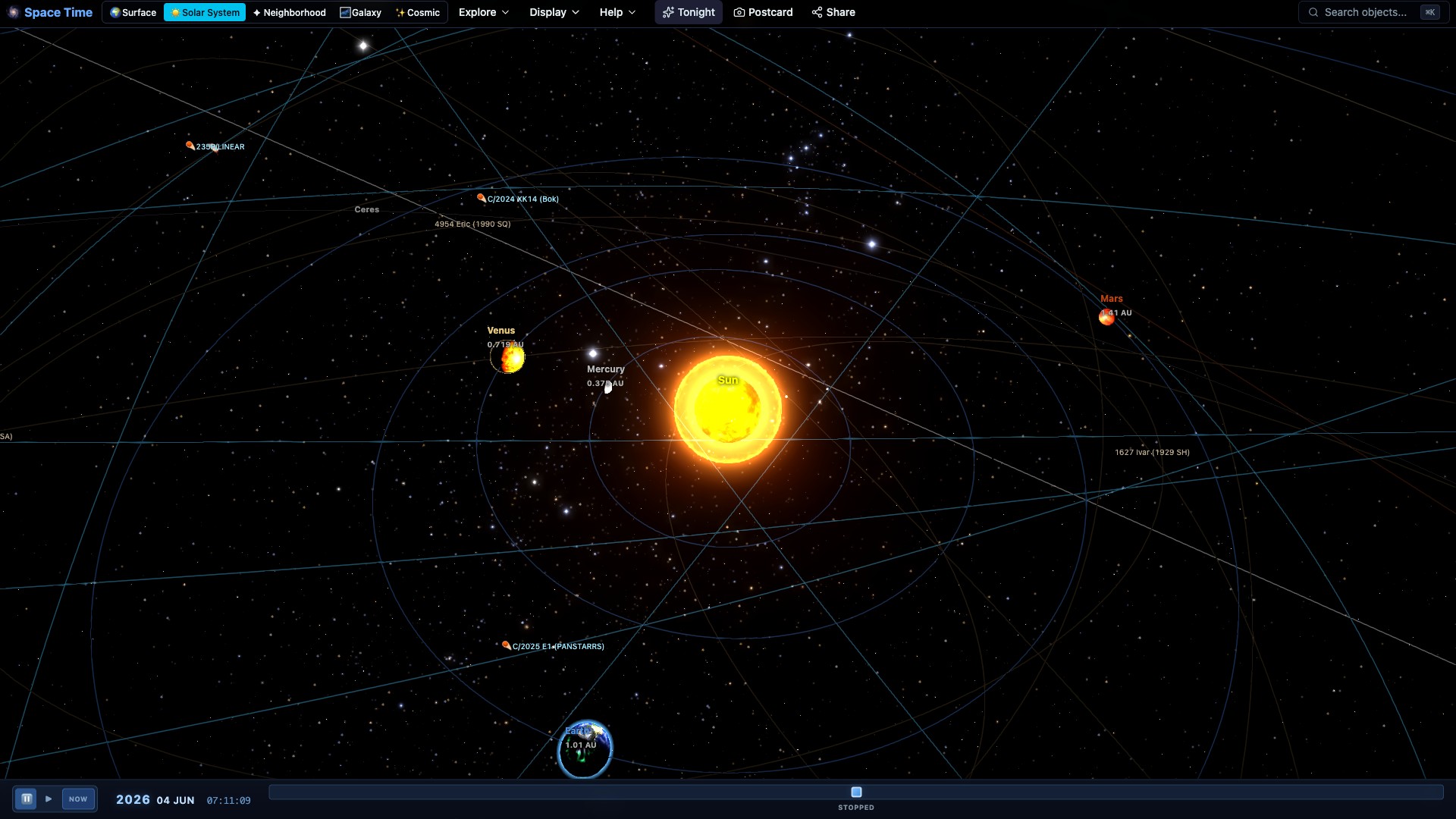
Feature comparison
SkySafari sells Plus and Pro editions, with some online services in a LiveSky Premium subscription. The table compares those editions with the features available in Space Time.
| Capability | Space Time | SkySafari Plus | SkySafari Pro |
|---|---|---|---|
| Price | Free | ~$30 once | ~$50 + $40–50/yr |
| Runs in the browser, nothing to install | Yes | No, app | No, app |
| Same on every device, no per-platform repurchase | Yes | Buy per platform | Buy per platform |
| Planetarium sky for your location & time | Yes | Yes | Yes |
| Star catalog | 2.5 million (HYG + Tycho-2, Gaia DR3 distances) | 2.55 million | 29M + 109M Gaia |
| Deep-sky objects | 32,000+ (NGC/IC + Sharpless, Arp, Abell, more) | 32,537 | 784k + 3.4M galaxies |
| Comets (every known, searchable) | 4,000+ | 621 | 3,497 |
| Asteroids on real orbits | 7,700 | 5,112 | 746,410 |
| Moons | 187 | 38 | 187 |
| Live satellites + ISS passes (TLE + SGP4) | ~9,000 (full Celestrak) | 1,847 | 1,847 |
| Observing planner ranked for your site & night | Yes | No | Yes |
| Custom observing lists you create, name & highlight in the sky | Yes, free | Bundled lists only | Yes |
| Telescope & eyepiece field-of-view simulator | Yes | Yes | Yes |
| Fly the solar system in 3D, out to the cosmic web | Yes, five scales | Orbit Mode flyby | Orbit Mode flyby |
| Stand on the Moon, Mars, Venus or Mercury | Yes | No | No |
| Clickable named-feature atlas on those worlds | 4,600+ IAU features | No | Moon outlines only |
| Cinematic eclipses (totality, blood moon, umbra on globe) | Yes | Event finder | Event finder |
| Mission replays (Apollo, Voyager, New Horizons) | Yes | No | No |
| Shareable by link, embeddable in a page | Yes | No | No |
| Telescope / mount control (GoTo + push-to) | Yes, ASCOM Alpaca (server on the same machine) | No | Yes (Alpaca + INDI) |
| Camera control + plate solving | Plate solving via astrometry.net; no camera control | No | Yes |
| Cloud-synced observing lists & logs | One device only | One device | Yes (Premium) |
| Works fully offline | Core set after one visit; deep catalogs online | Yes | Yes |
What you get that SkySafari doesn't have
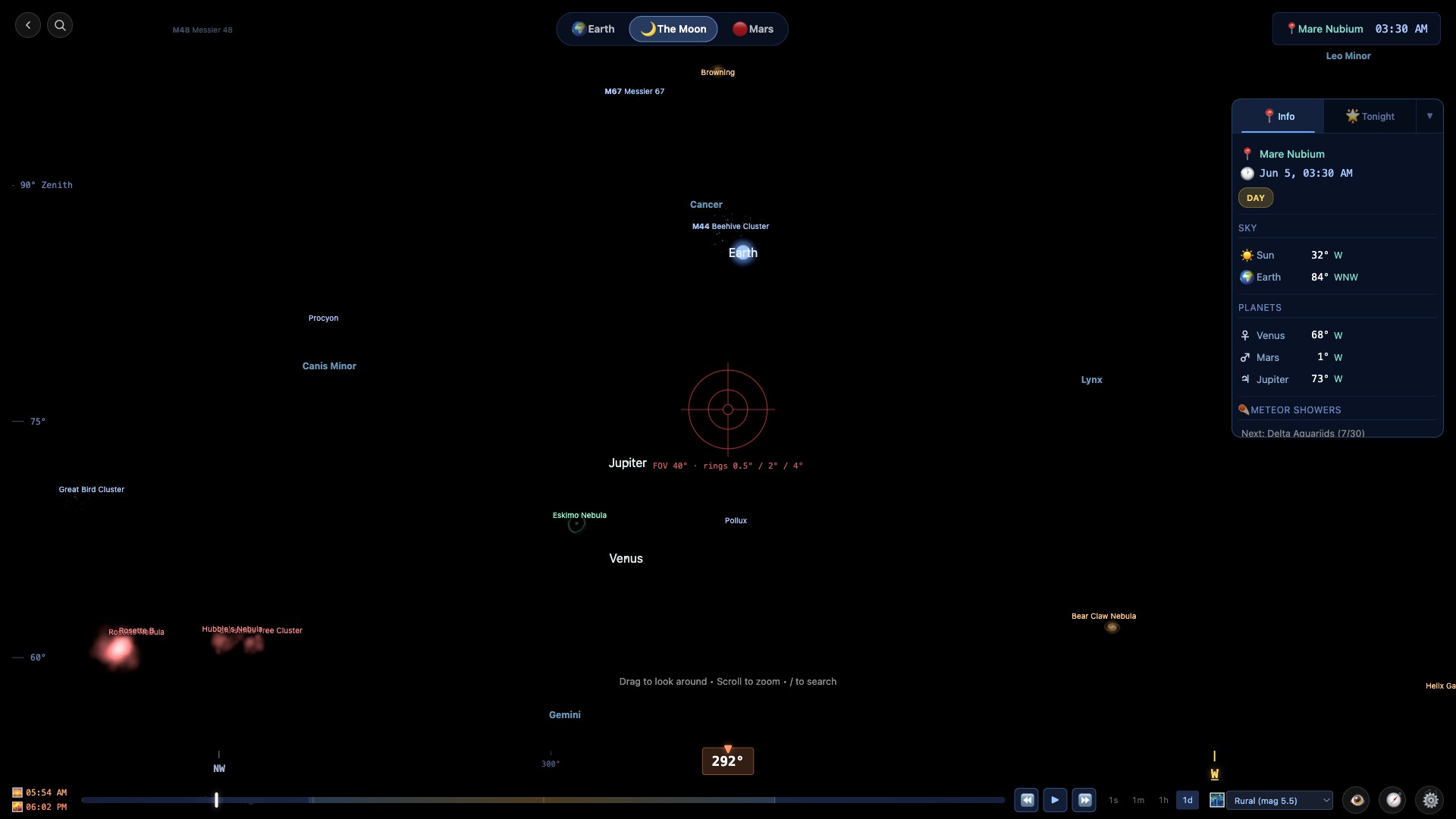
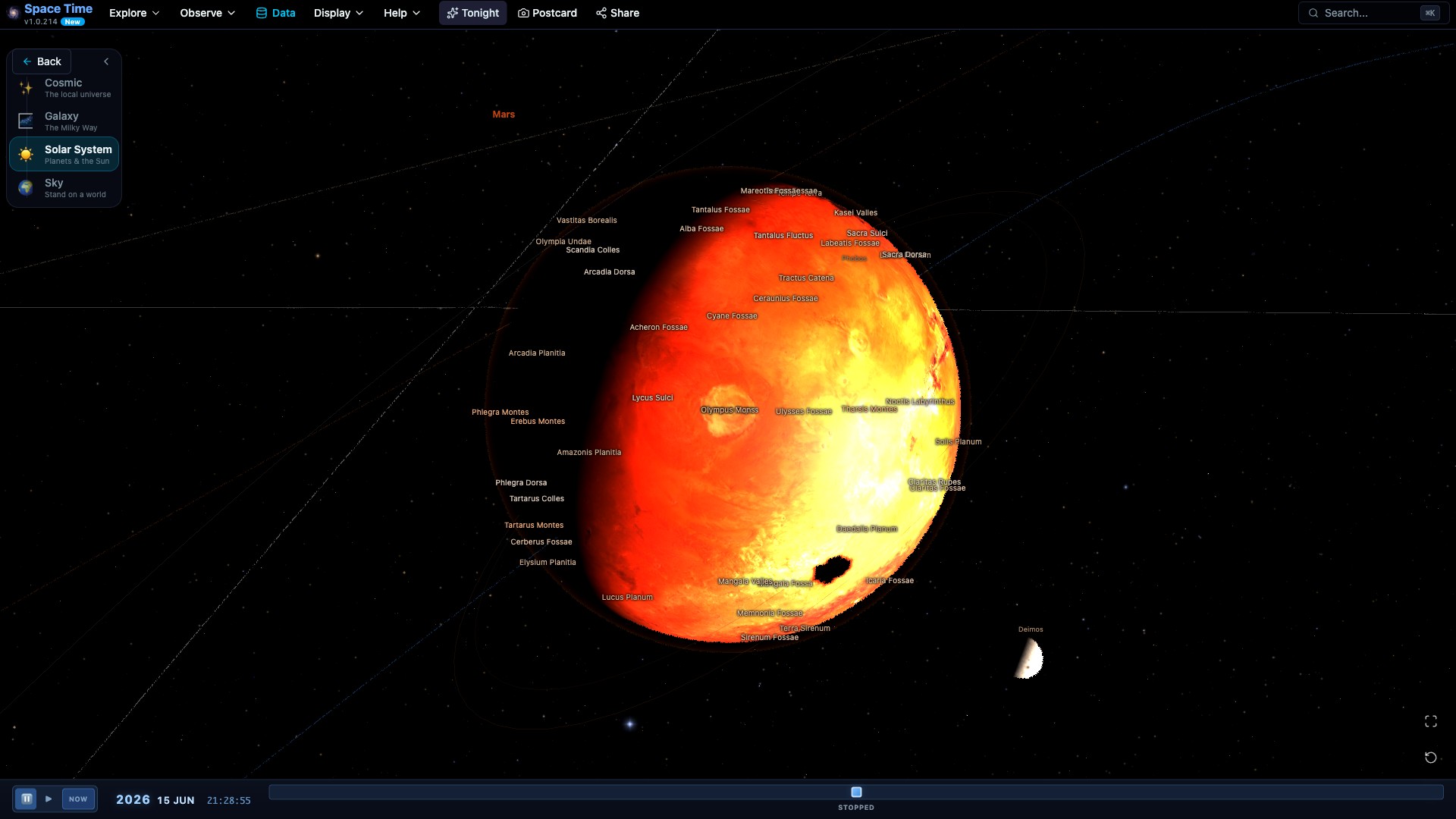
Space Time lets you go to Mars, land near Jezero Crater, and look at the Martian sky. It includes thousands of named features across rocky worlds, mission replays, eclipse views from orbit, and a map extending beyond the Milky Way.
When SkySafari is the better choice
SkySafari Pro is the better choice for INDI mounts, camera control, much deeper on-device catalogs, and fully offline observing. Space Time now covers Alpaca mount control, photo plate solving and a core offline set, and focuses on free browser access, planning, education, and 3D exploration.
FAQ
Is Space Time a good alternative to SkySafari?
For most people, yes, and it's free: a real planetarium that matches the paid Plus tier on most catalogs, plus a true 3D universe SkySafari doesn't attempt.
What does SkySafari Pro still do better?
INDI mounts and camera control, the deepest on-device catalogs (109M stars, 746k asteroids), mature cloud-synced records, and fully offline use. Space Time drives Alpaca mounts from the browser; for INDI or camera control at the eyepiece SkySafari Pro is still the tool.
Is it really free?
Yes. No account, no download, no paid tier, and no subscription. SkySafari charges per version and puts sync and weather behind LiveSky Premium.
Can it control my telescope?
Yes, over ASCOM Alpaca, the plain-HTTP telescope standard: GoTo, sync, park and a push-to mode that follows your selection, with horizon and solar-cone safety checks. On the https site the Alpaca server (for example ASCOM Remote) runs on the machine you browse from. INDI and camera control are not supported.
Does it work offline?
For the essentials, yes. After one online visit the sky, planets, Tonight and ISS passes load without signal, and a chip in the app says what is cached. Deep catalogs, survey imagery and live feeds still need a connection.