Neptune in 3D: The Outermost Planet and Triton
Neptune was found by calculation before anyone recognized it in a telescope. Its largest moon, Triton, circles it in the opposite direction to the planet’s spin. Space Time’s guided story starts at Triton, shows where Voyager 2’s map ends, then returns to Neptune.
Explore Neptune and Triton in 3D →Free in your browser · No account required · 3D view uses WebGL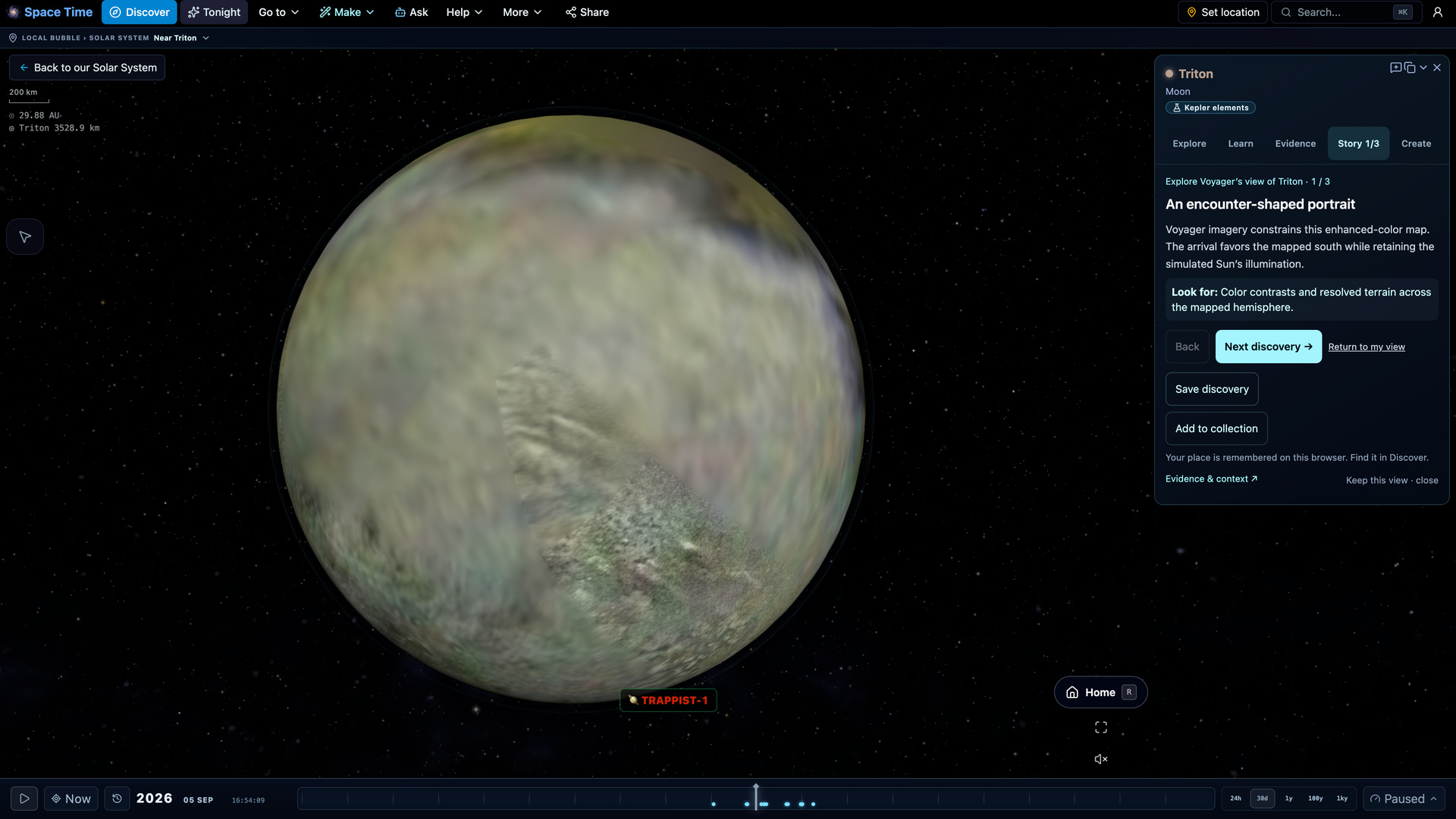
Try it in the app
- Open the Triton story and orbit the moon. Find the textured southern terrain Voyager 2 imaged.
- Inspect the map layer. Compare the resolved terrain with the smooth area where no measurement exists.
- Continue to Neptune and pull the camera back to see Triton’s orbit around the planet.
On a phone, drag to change the view and pinch to zoom. If the 3D view cannot load on your device, the guide and its source links remain available here.
Found with mathematics
Small differences between Uranus’s predicted and observed positions suggested another planet was pulling on it. Using Urbain Le Verrier’s prediction, Johann Galle found Neptune in 1846 close to the expected place. Neptune takes about 165 years to orbit the Sun, so it completed its first full orbit since discovery in 2011.
Triton orbits backward
Triton travels around Neptune opposite to the direction the planet rotates. That is unusual for a large moon, and many scientists think Triton was captured from the Kuiper Belt rather than forming beside Neptune. Watch its orbit in the app with the clock running.
What Voyager 2 saw
Voyager 2 flew past Neptune and Triton in August 1989, the only spacecraft to do so. It imaged part of Triton’s surface and saw dark streaks linked to plumes. The map in the app shows that coverage; the smooth cap is where no images exist. Neptune’s clouds in the app are reconstructed from archived observations, not live weather.
Neptune’s real color
Voyager’s best-known Neptune images were contrast-enhanced, which made the planet look deeper blue than it is. A 2024 reanalysis found Neptune and Uranus are closer in color, both a pale greenish blue. Neptune is too faint to see without a telescope.
Sources and evidence
Guide by Point Dynamics. Reviewed 2026-10-20. Saved scene images illustrate the experience; they are not current observations.