Uranus in 3D: The Tilted Planet and Miranda
Uranus spins on its side, with its axis tipped over by almost a right angle. Only one spacecraft has visited: Voyager 2, in January 1986. Space Time’s guided story starts at Miranda on the date of that flyby, shows which part of the moon Voyager actually mapped, then returns to Uranus.
Explore Uranus and Miranda in 3D →Free in your browser · No account required · 3D view uses WebGL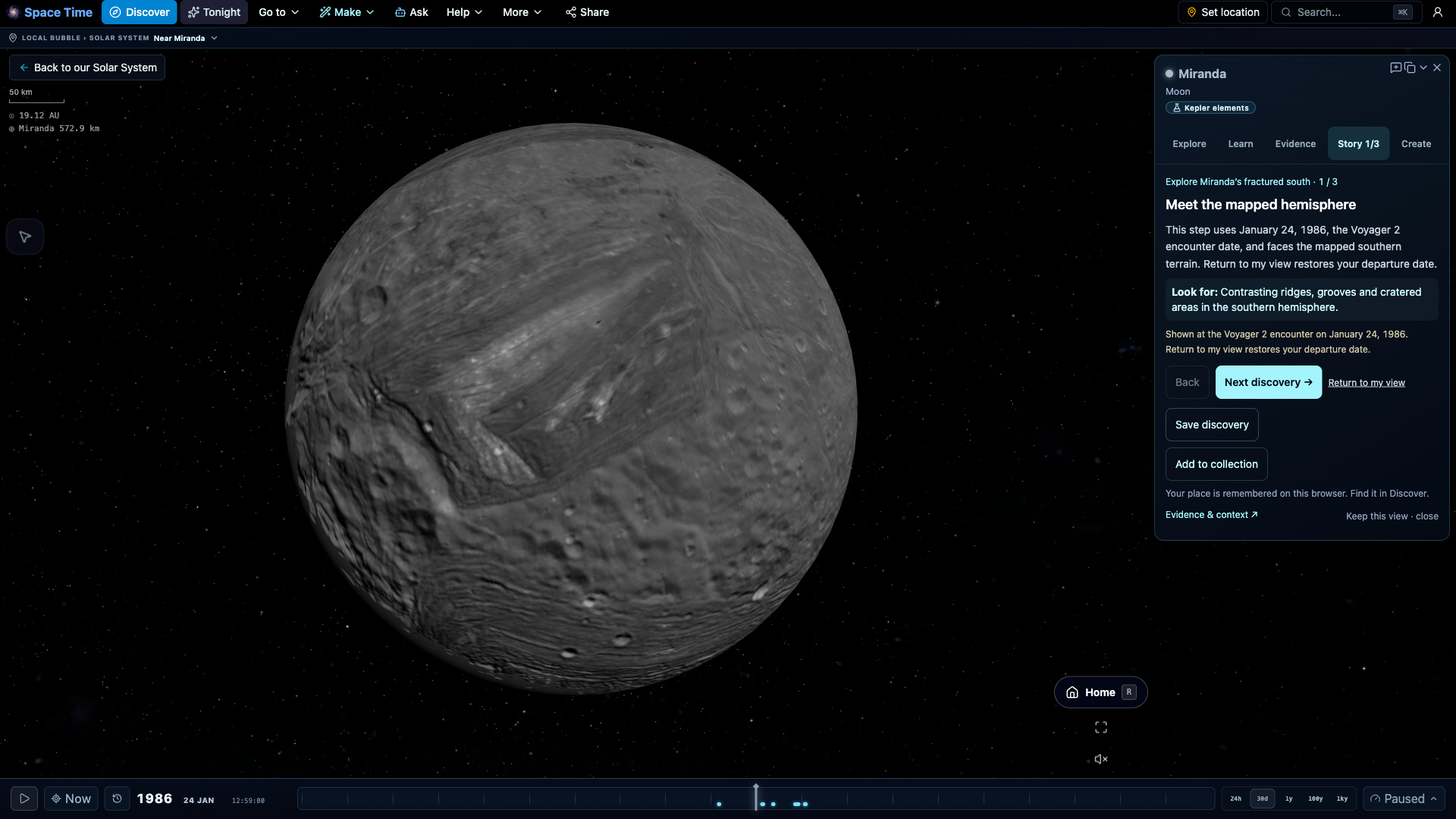
Try it in the app
- Open the Miranda story. It moves the clock to January 24, 1986 and faces the southern hemisphere Voyager 2 mapped.
- Inspect the map layer. Find the sharp change from detailed ridges and grooves in the south to the plain, unmapped north.
- Continue to Uranus. Pull the camera back to see the planet’s tilted system, then use Return to my view to restore your own date.
On a phone, drag to change the view and pinch to zoom. If the 3D view cannot load on your device, the guide and its source links remain available here.
A planet on its side
Uranus’s axis is tilted about 98 degrees, so it rolls around the Sun rather than spinning upright. Over its 84-year orbit, each pole spends decades in sunlight and then decades in darkness. Speed up the simulation clock to watch the lit hemisphere change across many years.
One flyby, half a map
Voyager 2 passed Uranus and its moons in a single day. At that time the Sun was shining on the southern hemispheres, so the northern halves of Miranda and the other large moons were in darkness and were not mapped. The smooth gray areas in the app mark that missing coverage; they are not real terrain.
Miranda’s patchwork surface
Miranda is small, about 470 kilometers across, but its surface mixes old cratered ground with large grooved regions and tall cliffs. Scientists still debate how those features formed. The app shows Voyager-based imagery; it cannot tell you more than the flyby recorded.
Seeing Uranus from Earth
Uranus is at the limit of naked-eye visibility under a dark sky and is easier with binoculars. William Herschel identified it as a planet in 1781. Check your city’s Tonight page or the ephemeris tools in the app for its current position.
Sources and evidence
Guide by Point Dynamics. Reviewed 2026-10-20. Saved scene images illustrate the experience; they are not current observations.