Venus in 3D: Clouds, Phases and the Radar-Mapped Surface
Venus is close to Earth in size, but its surface is hidden under a thick layer of cloud. Space Time shows the clouds you would see in sunlight, then lets you switch to a map made by radar, which sees through them. The guided Venus story ends with Earth for comparison.
Explore Venus in 3D →Free in your browser · No account required · 3D view uses WebGL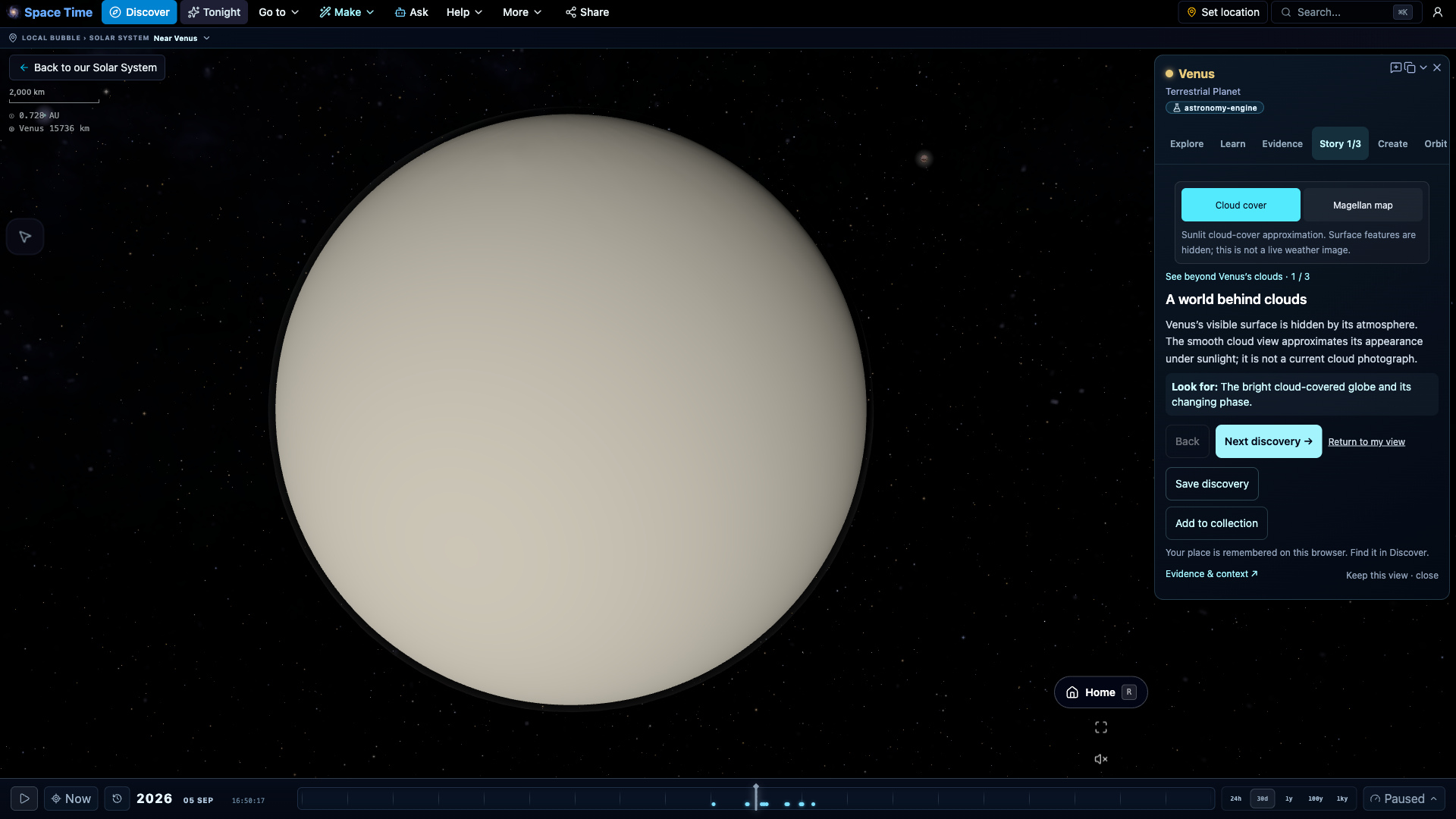
Try it in the app
- Open the Venus story and look at the cloud-covered globe. Move around it and notice how much of the disc is lit.
- Switch to the Magellan map. Find large bright and dark regions, and the areas where the source has no measurement.
- Continue to Earth. Compare a rocky planet you can see the surface of with one you cannot.
On a phone, drag to change the view and pinch to zoom. If the 3D view cannot load on your device, the guide and its source links remain available here.
Why Venus shows phases
Venus orbits inside Earth’s orbit, so from Earth we see different amounts of its sunlit side over time, much like the Moon. Galileo’s telescope observations of these phases in 1610 supported a Sun-centered solar system. Move the simulation clock and watch the lit fraction change as Venus moves around the Sun.
Clouds you can see, a surface you cannot
Venus is wrapped in clouds of sulfuric acid above a dense carbon dioxide atmosphere. Visible light does not reach the surface and back out, so the smooth cloud view in the app is an approximation of what an eye would see. It does not show real cloud features on any particular date.
What the Magellan map measures
NASA’s Magellan spacecraft mapped almost all of Venus with radar between 1990 and 1994. The layer in the app encodes a microwave measurement. Bright and dark pixels are not surface colors or heights, and gaps mark places with no data. Read the evidence page before treating any pattern as terrain.
Finding Venus in your own sky
Venus is the brightest planet and appears in the evening after sunset or in the morning before sunrise, never far from the Sun. Your city’s Tonight page shows whether it is up. Never point binoculars or a telescope near the Sun.
Sources and evidence
Guide by Point Dynamics. Reviewed 2026-10-20. Saved scene images illustrate the experience; they are not current observations.