Planet Size Comparison: Diameters and a 3D Scale View
Jupiter is about eleven Earth diameters across; Mars is a little over half an Earth diameter. The table compares the same rounded catalog diameters used by Space Time’s comparison tool. Open the tool to choose two or three worlds and place them side by side at a common size scale.
Compare planets in 3D →Free in your browser · No account required · 3D view uses WebGL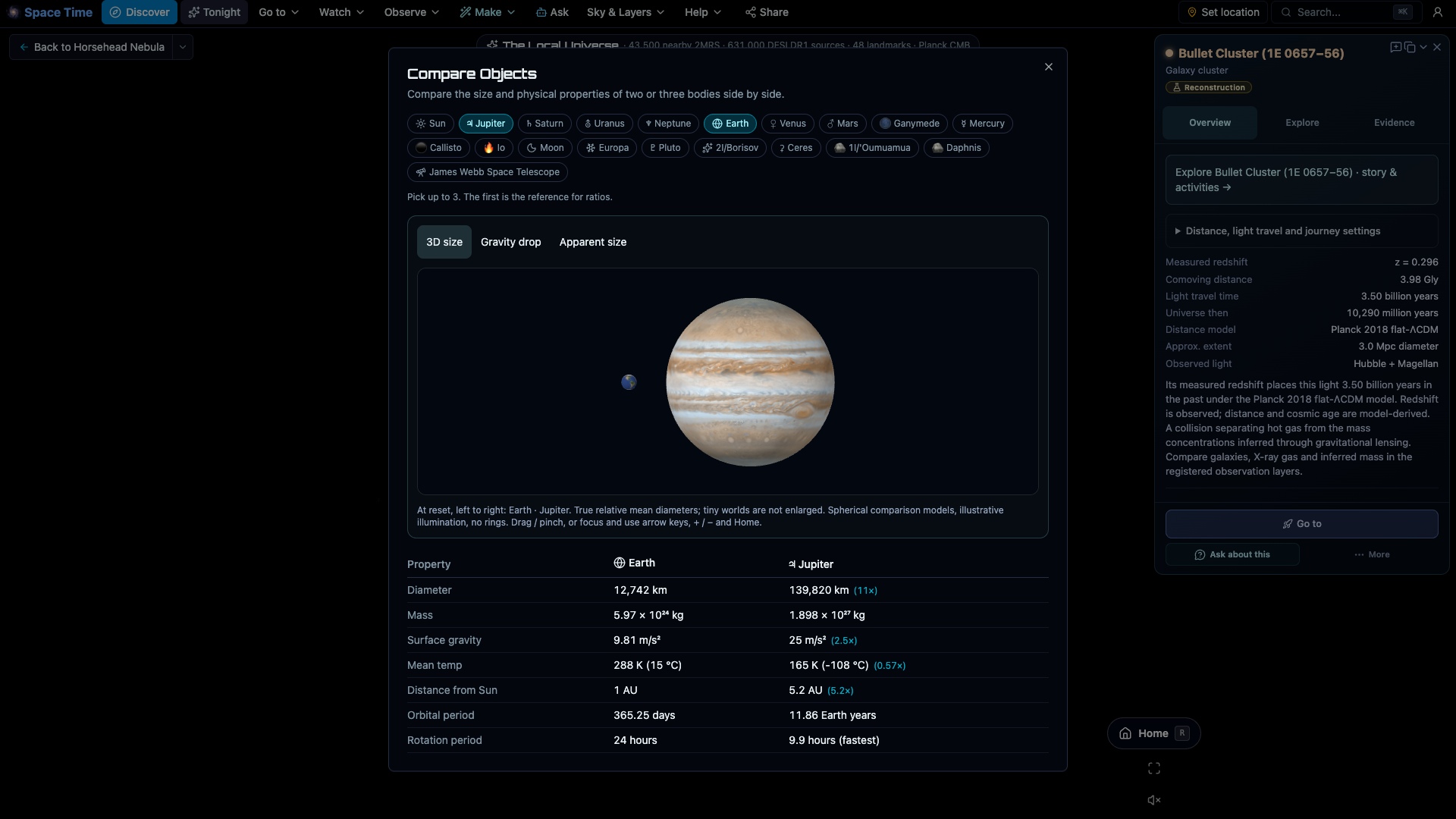
| Planet | Catalog diameter (km) | Earth diameters |
|---|---|---|
| Mercury | 4,879 | 0.38 |
| Venus | 12,104 | 0.95 |
| Earth | 12,742 | 1.00 |
| Mars | 6,779 | 0.53 |
| Jupiter | 139,820 | 10.97 |
| Saturn | 116,460 | 9.14 |
| Uranus | 50,724 | 3.98 |
| Neptune | 49,244 | 3.86 |
Rounded mean-diameter values from the app’s comparison catalog, checked against twice JPL’s mean radii. Small rounding differences remain. Gas-giant radii use a reference atmospheric level. Rings and orbital distances are excluded.
Try it in the app
- Open Compare Objects. Begin with Earth and Jupiter, or select two or three planets in the picker.
- Use the size comparison and read the diameter row. The first selected object is the reference for displayed ratios.
- Try the apparent-size comparison at one chosen observer distance. This is a hypothetical common distance, not the planets’ current locations in our sky.
On a phone, drag to change the view and pinch to zoom. If the 3D view cannot load on your device, the guide and its source links remain available here.
Diameter is not volume
Doubling a sphere’s diameter multiplies its volume by eight. A diameter ratio therefore cannot be read as “how many Earths fit inside.” For ideal spheres, cube the diameter ratio to compare volumes. Real planets are not perfect spheres; rapid rotation makes the giant planets visibly oblate.
Why Saturn’s rings are excluded
Saturn’s diameter describes the planet, not the full ring system. Including rings for one planet while measuring the bodies of the others would answer a different question. Explore the rings separately, or compare the adopted body diameters consistently across the table.
A large planet can look small in the sky
Apparent size depends on both physical diameter and distance from the observer. The interactive tool lets you hold the distance fixed to isolate diameter. For real observing, use the date-dependent apparent sizes in the opposition guides; the side-by-side display is not an arrangement that exists in the solar system.
Sources and evidence
Guide by Point Dynamics. Reviewed 2026-09-23. Saved scene images illustrate the experience; they are not current observations.