Jupiter in 3D: Cloud Bands and Galilean Moons
Jupiter is an atmosphere above a giant planet, surrounded by a moving family of moons. Explore the cloud bands, inspect an archived Hubble map, and continue to Europa. Changing the simulation time moves the system; it does not turn the cloud map into a photograph of today’s weather.
Explore Jupiter and its moons →Free in your browser · No account required · 3D view uses WebGL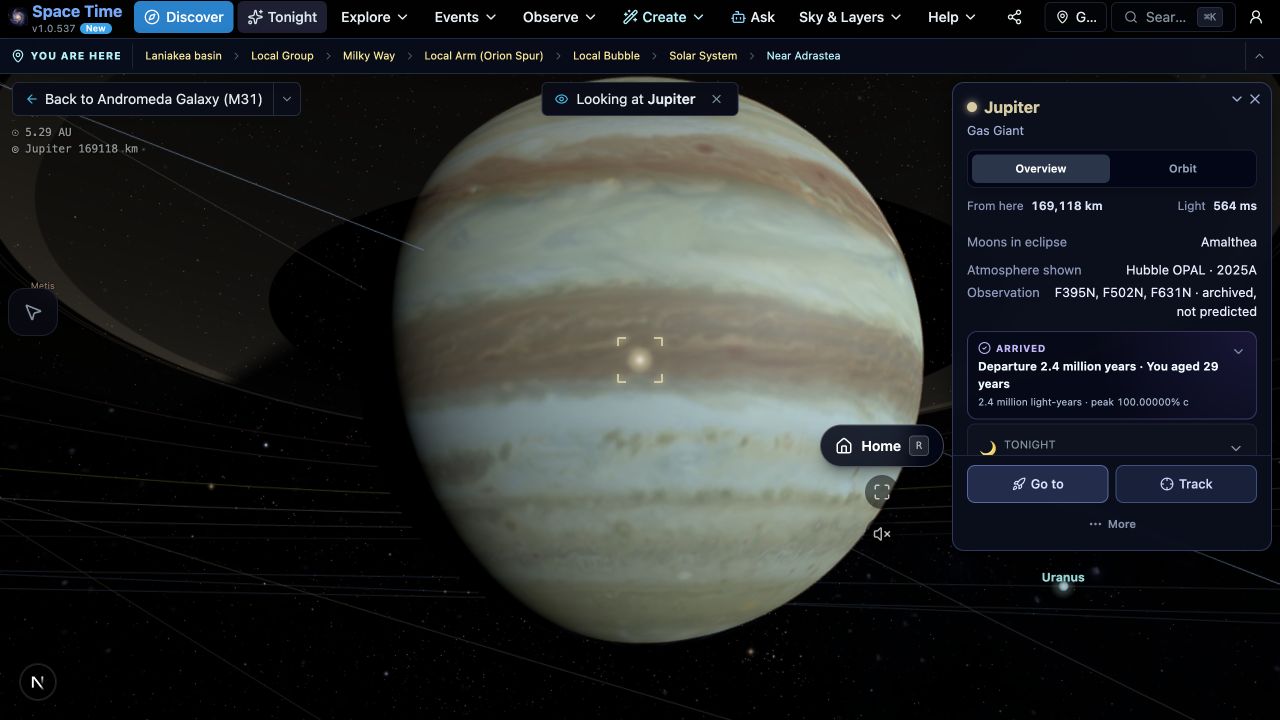
Try it in the app
- Open the Jupiter story. Orbit the view and identify the alternating light and dark cloud bands.
- Inspect the Hubble reference observation, including its date and color/filter information.
- Continue to Europa, or select Io, Ganymede and Callisto. Advance time to compare their positions around Jupiter.
On a phone, drag to change the view and pinch to zoom. If the 3D view cannot load on your device, the guide and its source links remain available here.
Cloud bands belong to an atmosphere
The visible bands trace atmospheric structure rather than solid ground. A mapped image records an earlier state of the clouds. The Great Red Spot also drifts, so a calculated marker and an archived cloud map need not remain aligned indefinitely. Read each layer’s date and purpose before treating features as simultaneous observations.
Four moons, four moving viewpoints
Io, Europa, Ganymede and Callisto form the familiar Galilean system. Their positions change visibly over an observing session. In the app, changing time helps explain why a moon may appear beside Jupiter, cross the disc, pass behind it or enter shadow. Your viewpoint determines which alignment you see.
Use the event calendar for transits
A pleasing arrangement in the 3D view is not a local observing forecast. Use the event calendar for calculated moon phenomena and Tonight for Jupiter’s altitude at your location. Telescope resolution, atmospheric seeing, daylight and weather all affect whether a predicted event is observable.
Keep observation dates with the picture
Hubble’s Outer Planet Atmospheres Legacy program provides repeated observations useful for comparing giant-planet atmospheres over time. Space Time exposes the observation behind a selected map. The rendered camera view combines that evidence with a three-dimensional model; the whole result is not a current telescope image.
Sources and evidence
Guide by Point Dynamics. Reviewed 2026-09-23. Saved scene images illustrate the experience; they are not current observations.