Saturn in 3D: Rings, Moons and the View from Earth
Saturn’s rings look broad from above and narrow from the side. Move around the planet to see that geometry, then compare the view with the observations behind it. Space Time’s guided Saturn story connects the rings, their reference map and the icy moon Enceladus.
Explore Saturn’s rings in 3D →Free in your browser · No account required · 3D view uses WebGL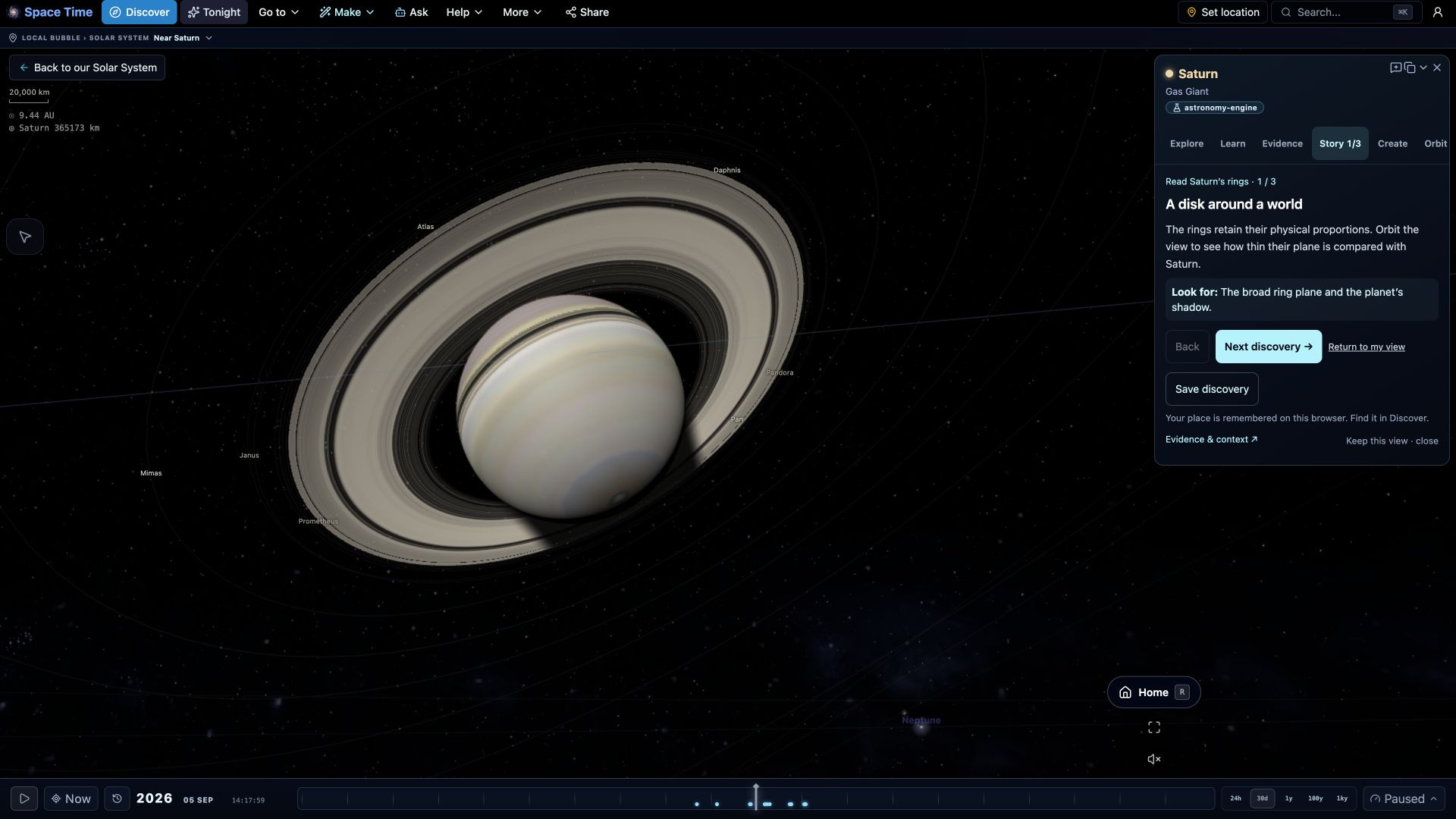
Try it in the app
- Open the Saturn story and orbit the planet. Compare an oblique view with a view close to the ring plane.
- Inspect the reference observation. Find the broad bright bands and the darker Cassini Division.
- Continue to Enceladus. Read the source notes before interpreting surface detail or the appearance of a plume.
On a phone, drag to change the view and pinch to zoom. If the 3D view cannot load on your device, the guide and its source links remain available here.
Why the rings seem to open and close
The rings sit around Saturn’s equator. As Saturn and Earth move around the Sun, our viewing angle to that plane changes. An edge-on view hides much of the bright area without making the rings disappear physically. Move the camera to study shape; change the simulation date to study the geometry for another time.
A ring system made of many particles
Saturn’s rings are made largely of icy particles rather than a solid sheet. The broad bands in the app help you recognize the ring system, but the renderer does not track each particle or measure its brightness. Cassini observations provide the scientific context for ring structure and the nearby moons.
Titan and Enceladus tell different stories
Titan has a thick atmosphere that veils its surface in visible light. Enceladus is an icy moon associated with the diffuse E ring. The bright main rings shown beside Saturn are not a depiction of that entire faint ring. Search for either moon in the app and use its evidence panel to distinguish imagery, geometry and reconstruction.
Finding Saturn in your own sky
The 3D camera can show a view that no observer on Earth currently has. For practical observing, use your city’s Tonight page, then check Saturn’s altitude and your weather. The 2026 opposition guide gives the season’s date and apparent size; being near opposition does not guarantee a clear or steady telescope view.
Sources and evidence
Guide by Point Dynamics. Reviewed 2026-09-23. Saved scene images illustrate the experience; they are not current observations.