Pluto in 3D: New Horizons, the Heart and Charon
Pluto was a blurry dot until July 14, 2015, when NASA’s New Horizons flew past and revealed mountains of water ice and a bright, heart-shaped plain. Space Time can replay that nine-year journey along the spacecraft’s real trajectory, then let you look at the map New Horizons made.
Replay New Horizons to Pluto →Free in your browser · No account required · 3D view uses WebGL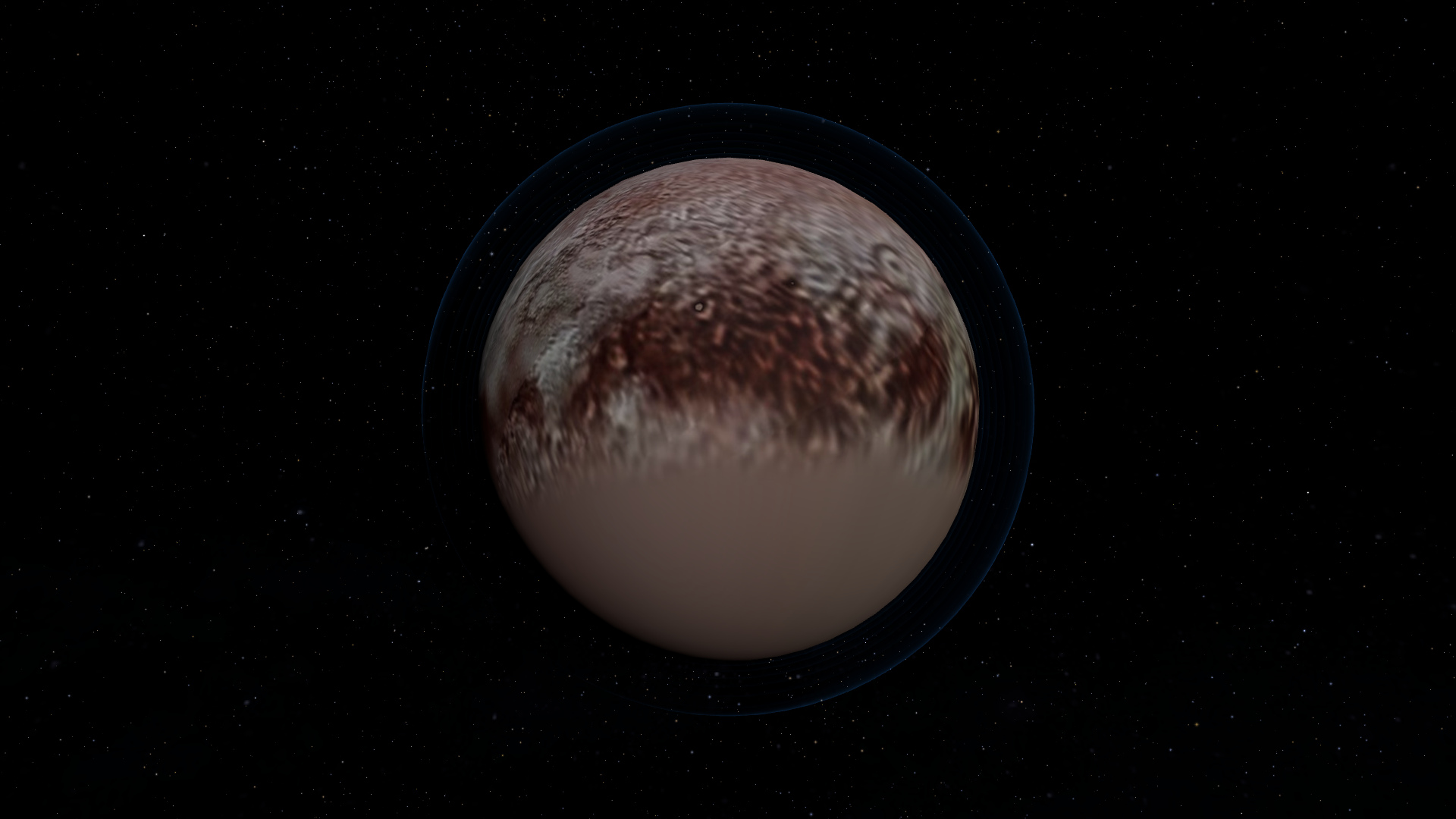
Try it in the app
- Open the New Horizons replay. The clock speeds through the cruise and slows near the encounter.
- Use the timeline dots to jump to the Pluto flyby, then look for the bright heart-shaped region.
- Find Charon and compare its size with Pluto. Close the replay to return to your own view and date.
On a phone, drag to change the view and pinch to zoom. If the 3D view cannot load on your device, the guide and its source links remain available here.
One flyby, one detailed side
New Horizons flew past Pluto once, so it saw one hemisphere in detail and the rest at lower resolution, with parts of the south in darkness. In the app, the smooth areas are where no detailed images exist. They are not real terrain.
The heart
The bright region nicknamed the heart is Tombaugh Regio. Its western half, Sputnik Planitia, is a vast plain of frozen nitrogen with no visible impact craters, which means its surface is young. Mountains of water ice rise along its edges.
Pluto and Charon
Charon is about half Pluto’s width, large enough that the two circle a point in the space between them. Pluto takes about 248 years to orbit the Sun. Clyde Tombaugh discovered it in 1930, and in 2006 the IAU reclassified it as a dwarf planet.
After Pluto
New Horizons continued into the Kuiper Belt and flew past Arrokoth on January 1, 2019, the most distant object any spacecraft has visited up close. The replay continues to that encounter.
Sources and evidence
Guide by Point Dynamics. Reviewed 2026-10-20. Saved scene images illustrate the experience; they are not current observations.