Mercury in 3D: Craters, Scarps and the Innermost Planet
Mercury is the smallest planet and the closest to the Sun. Its gray, cratered surface looks like the Moon’s, but it is crossed by long cliffs that formed as the planet cooled and shrank. Space Time’s Mercury Atlas lists the planet’s officially named features and turns the globe to any one you choose.
Explore Mercury’s named features →Free in your browser · No account required · 3D view uses WebGL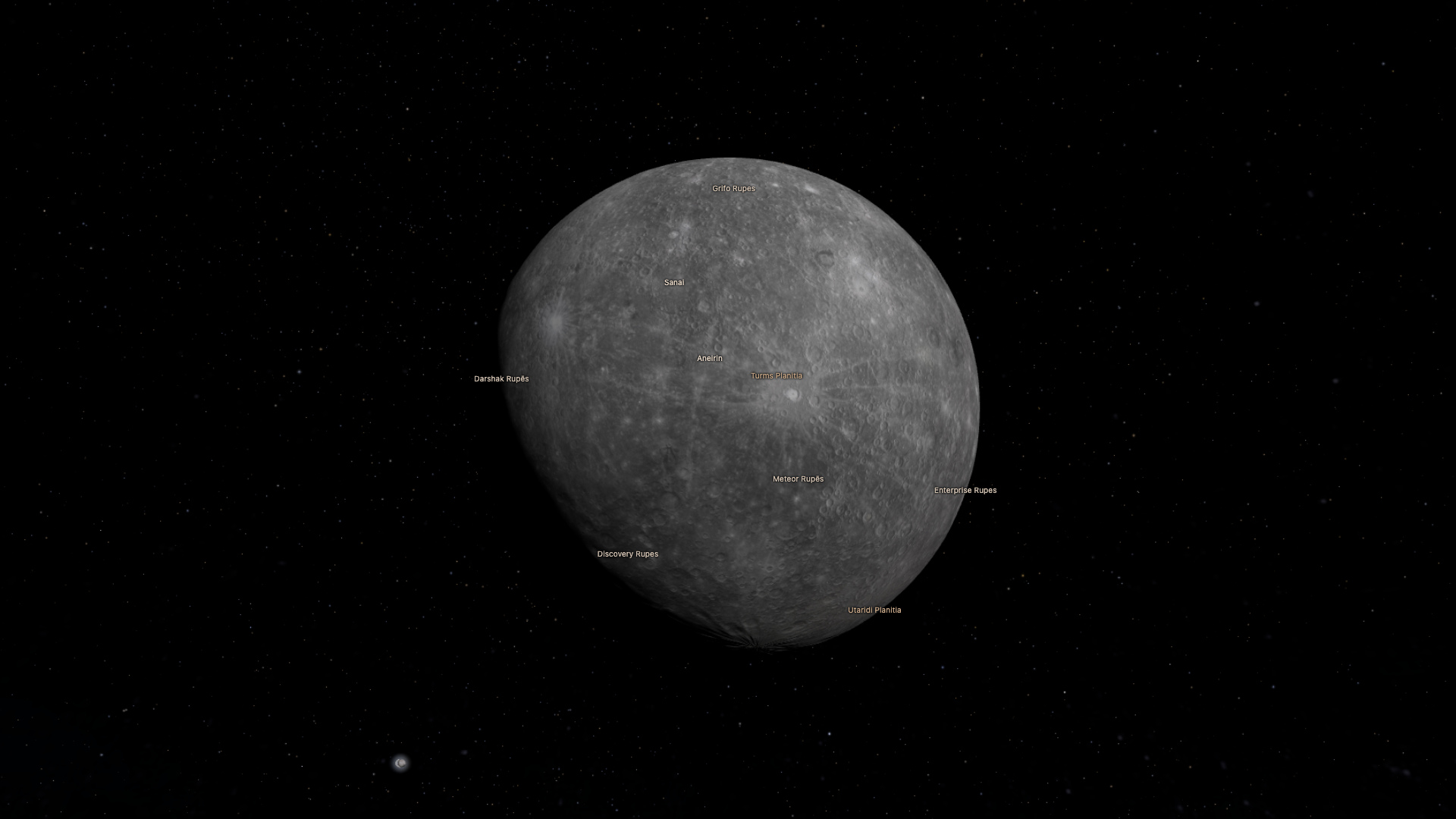
Try it in the app
- Open the Mercury Atlas. Filter by craters, plains or terrain, or search for a name such as Caloris.
- Choose a feature. The globe turns to its catalog latitude and longitude, and labels appear as you approach.
- Pull back and run the clock forward to watch Mercury complete an orbit in 88 days.
On a phone, drag to change the view and pinch to zoom. If the 3D view cannot load on your device, the guide and its source links remain available here.
A planet that shrank
Long, curving cliffs called rupes run for hundreds of kilometers across Mercury. Scientists think they formed as the planet’s large iron core cooled and Mercury contracted, wrinkling its crust. Look for Discovery Rupes and Enterprise Rupes in the atlas.
Named for artists
Mercury’s craters are named for writers, composers and painters, so you can find Beethoven, Rembrandt and Shakespeare on its surface. The names come from the International Astronomical Union’s Gazetteer of Planetary Nomenclature. The largest basin, Caloris Planitia, is about 1,500 kilometers across.
A slow, strange day
Mercury spins three times for every two trips around the Sun. Combined with its fast orbit, that makes one full day, from sunrise to sunrise, last about 176 Earth days. Speed up the clock to see how slowly the sunlit side moves.
Finding Mercury in your sky
Mercury never strays far from the Sun, so it appears low in twilight, just after sunset or just before sunrise, for a few weeks at a time. Your city’s Tonight page shows when it is up. Never point binoculars or a telescope near the Sun.
Sources and evidence
- NASA: Mercury
- NASA: MESSENGER mission
- IAU Gazetteer of Planetary Nomenclature: Mercury
- Mercury data and appearance evidence
Guide by Point Dynamics. Reviewed 2026-10-20. Saved scene images illustrate the experience; they are not current observations.